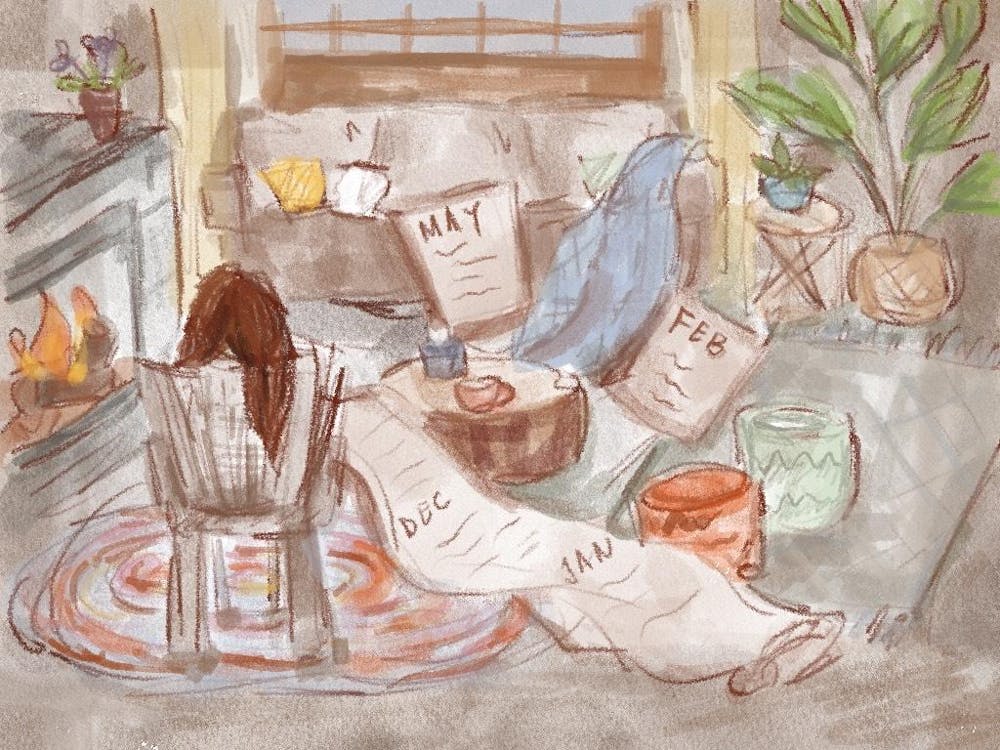
My first year at Brown passed by like a speeding train. I remember it only in images—snapshots, swathes of color, moments. I went to a lot of places. I said a lot of things, some of which were true and some of which were not untrue. And I read a lot of poems. Here, I’ve compiled some of my favorites, along with brief explanations of the meaning I find in them and how they helped me get through each month of the year. I hope you like them.
September: “Scintilla, Star” by Jameson Fitzpatrick
“How embarrassing / to have been fourteen”
My first month of college made me into an actor. I memorized lines—hi I’m Chelsea I’m from California I live in Champlin I want to study English and math—and picked up my props from the bookstore. I studied and went to parties and talked to strangers in the lounge until midnight, and I did it all with the sense that I was performing for an invisible audience, trying not to tremble or flinch under their piercing gaze. It was a middle-schoolish anxiety, a nervous voice in the back of my head always whispering Do they like me and Is this right? “Scintilla, Star” speaks to this panopticon-like fear in short, enjambed lines: “there was no place / that did not see me.” It’s a lonely poem—its queer, teenage speaker faces gossip and social isolation—and in September, I was lonely too, lonely even when I was surrounded by people. It was still a good month. I made a lot of friends and discovered new ways of speaking and being. And when I felt a bit too perceived and a bit too nervous, “Scintilla, Star” reminded me that I wasn’t the only one.
October: “Black Stone on a White Stone” by Cesar Vallejo
“I will die in Paris with a rainstorm / on a day I already remember”
“Black Stone on a White Stone” is a fascinating poem that constantly shifts, moving back and forth between present and past tense and first and third person. The poem’s translation in English is unrhymed and unmetered, but its original Spanish text holds rich sound devices. “Me moriré en París—y no me corro,” the speaker announces. “Tal vez un jueves, como es hoy, de otoño.” After taking a semester of Spanish at Brown, reading the translation of “Black Stone” beside its original version was illuminating—I felt like I was seeing the poem through a new pair of glasses. After months of stumbling through grammar exercises and conversation sections, I could tangibly point to what I had learned.
November: “Why Write Love Poetry in a Burning World” by Katie Farris
“To train myself, in the midst of a burning world / to offer poems of love to a burning world.”
Hypothetically, if there were some hypothetical student in her first year at college who was hypothetically having some thoughts about the hypothetical presidential election while also hypothetically debating between hypothetically studying the humanities or the sciences and hypothetically losing it and hypothetically doubting her choices and hypothetically questioning the value of language and the purpose of poetry—this would be a good poem for her to read.
December: “All My Friends Are Finding New Beliefs” by Christian Wiman
“...and my friends, / my beautiful, credible friends.”
In the pictures from December, I’m walking through the streets of Providence with my friends. I’m describing the state fish of California in the Ratty. I’m gesturing to the screen at slideshow night. I’m grinning at the camera. In the pictures from December, I’m overwhelmingly happy—happy to be done with classwork, happy to be turning 19, happy to have found friends who laugh with me and tell me stories about their lives. “All My Friends Are Finding New Beliefs” is a poem about loving your friends unwaveringly, across time and space, even as they grow and change and die. The speaker’s friends remain “credible” even as their beliefs change—the speaker is telling them I will believe what you believe simply because you believe it. In the pictures from December, you can see me beaming in a crowd of people. I’m thinking about spending the next four years laughing with them. I’m thinking that I’ll love them through anything.
January: “The Love Song of J. Alfred Prufrock” by T.S. Eliot
“In a minute there is time / For decisions and revisions which a minute will reverse.”
This is my favorite 110-year-old poem. There’s not much I can say about it that hasn’t already been said—the Poetry Foundation calls it “one of the most famous poems” in the English language. The poem sings its reader a melancholy song of doubt and hesitation in scattered, interlocking rhymes. The best lines ring in the reader’s head like a bell for days. In January, I saw my family and my high school friends; I slept and read and walked for miles up and down the beach. Time seemed to slow down, stretching out in front of me like a deserted highway. “And indeed there will be time,” says Eliot’s speaker, and for a month, I believed it. But then, in a flash, I was packing my bags. I was on the plane, and the plane was on the runway, and as we accelerated I felt a clock wind itself up in my chest. Countdown to the next round. Three-two-one. Go.
February: “UDFJ-39546284” by Rick Barot
“...something that…has nothing / to do with what you know about distance and time.”
We read “UDFJ-39546284” at the start of my English class one day. It’s a tricky poem to read aloud, mostly because you have to say a lot of numbers—take a moment to whisper the title, or the line “the farthest galaxy / we know of … / is 100,000,000,000,000,000,000,000 miles away,” and you’ll see what I mean. The poem talks about art and class and history, questioning which narratives we bring into focus and which ones are left to blur into the background. There were parts that I understood and parts that I didn’t understand but loved anyway. I came away from the poem with new ideas and lots of questions and a voice in my head saying you don’t have to know what it means to know that it matters.
March: “Female CEO” by Jackie Sabbagh
“My colleagues asked me to unionize but I love the female CEO.”
It is 9 p.m. and my friends are watching Severance. It is 10 p.m. on a different day and my friends are watching Severance. The sky is black, the temperature is in the single digits, I have a problem set due in 55 minutes, and I am sitting on the floor of a lecture hall with my friends, who are watching Severance. I don’t know any of the characters’ names. They’re all wearing business casual and walking with purpose down never-ending hallways. Severance, to the best of my knowledge, is a weird show. “Female CEO” is a weird poem. The speaker holds a cup of tea in their hands and it “boil[s] in seconds from the love in my heart.” The female CEO gives the speaker a “small limestone horse statue.” It’s funny, it’s absurd, it’s a reimagining of what a poem can be and how a poem can sound.
April: “Fern Hill” by Dylan Thomas
“Time held me green and dying / Though I sang in my chains like the sea.”
I’m writing this on April 15, and I can tell you with absolute certainty that April 1 was yesterday. Two weeks slipped through my hands like water, and I know the rest of the month will pass just as quickly. I’m wondering where the year went. I’m unsettled, just a bit, when I see groups of high schoolers passing through the campus center for ADOCH. I’m thinking about graduation—I know in my bones that it’ll come before I’m ready. The cherry blossoms bloom. The sun comes out. The world is green and dying, and I’m running out of time.
May: “Movement Song” by Audre Lorde
“we were always saying goodbye / in the blood in the bone over coffee”
“Movement Song” is a poem about saying goodbye. “The sands have run out against us,” the speaker declares. For the next four years, May will be a month of goodbyes for me—saying so long, I’ll miss you, see you next fall until eventually there is no more next fall and no more see you. When I think about this year, I think about all the words I have learned. I can say things in new and interesting ways, I can define a vector space and compute the line integral along a curve, and I can tell you the middle names of a handful of people who I didn’t know at all before September. The clock in my chest ticks faster and faster. “Movement Song” ends with the statement that “we cannot waste time / only ourselves.” I say it to myself, feel the shape of the words in my mouth. Let’s run out of time together.


