I’ll be twenty-two before you know it, and my final year of college starts in three days. I am watching the sun slip through the openings in the fence and gilding the honeysuckle. I am pressing my palms against the pavement, still warmed by the final day of August. I am listening to the cicadas. They will die soon, but they don’t know it yet.
A few minutes after the sheen has slipped from the flowers and trees, my mom comes into the backyard, and we walk a loop around the neighborhood. It’s too dark to see anything, but we know all of our favorite spots implicitly, trusting that they are always the same, whether or not they are visible. There is the quiet rumble of traffic in the distance, the crunch of leaves under our sneakers.
As we walk, I think about how my life will never be quite like this ever again. Maybe that’s dramatic, but it doesn’t make it any less true.
***
“All my life I’ve been obsessed with adolescence, drunk on it,” Ella Yelich-O’Connor, best known to us as Lorde, wrote on Facebook to commemorate her twentieth birthday in 2016. “Even when I was little, I knew that teenagers sparkled. I knew they knew something children didn’t know, and adults ended up forgetting.”
I’ve loved Lorde for practically all of my life, but I always find myself relating to each record on a few years’ delay, finally growing up enough to understand it just as she’s moved on. When she released her debut album, Pure Heroine, in September 2013, I was nine and she was sixteen, and I still had a long time to go.
Pure Heroine is a love letter to being young in the suburbs—a love letter to that feeling of invincibility that comes with growing up somewhere ordinary, the precocious pretense of maturity. Above all, it is a love letter to putting down roots, to growing up, growing alongside, and growing out of the streets more unchanging and better known to you than your own face.
My favorite piece of the album, and potentially of Lorde’s entire discography, is the second track, “400 Lux.” I fell for this song much later than I was meant to. I was nineteen, and I had only started to realize how much I loved my hometown now that I’d left it. The song is a celebration of, for lack of better words, how dumb shit never feels dumb when you are stupidly in love. The first lines of the song ask, “We’re never done with killing time / Can I kill it with you?”
The chorus, too, has stuck with me: “(And I like you) / I love these roads where the houses don’t change / (And I like you) / Where we can talk like there’s something to say / (And I like you) / I’m glad that we stopped kissing the tar on the highway / (And I like you) / We move in the tree streets / I’d like it if you stayed.” Through these lyrics, Lorde captures the frivolous gravity of adolescence and how love between people becomes irrevocably intertwined with a place.
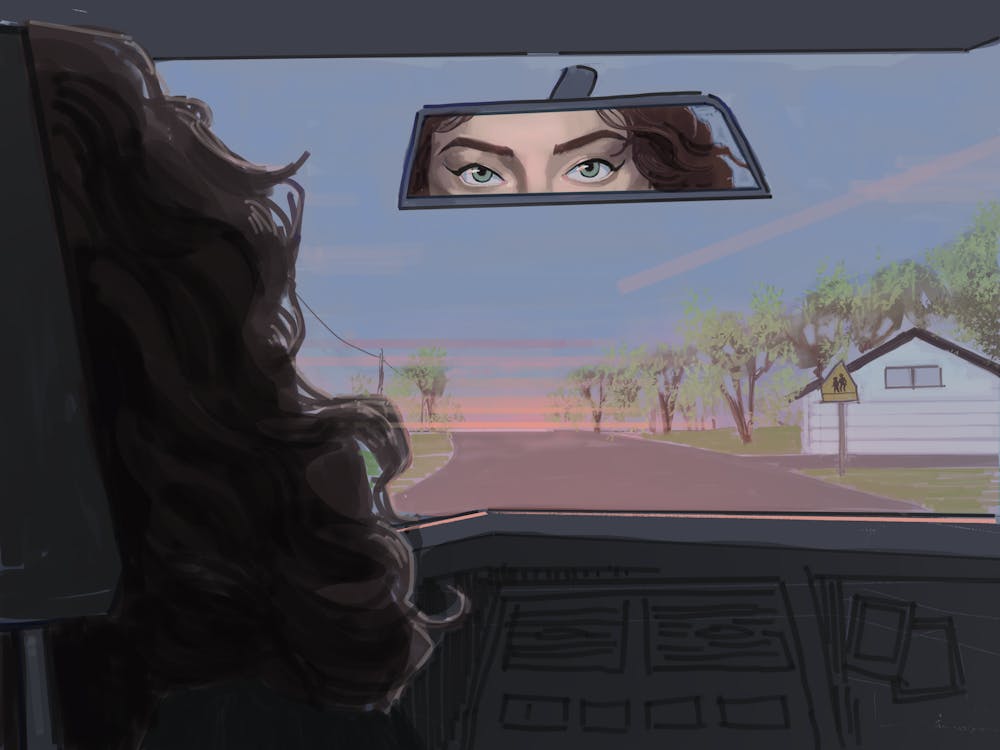
My favorite part of the song kicks in before the lyrics even begin: the sound of a car blinker ticking against the beat. I like to imagine Lorde singing “400 Lux” to herself as she drives around her neighborhood, blinker clicking, windows rolled down, pavement reflecting hot summer air in the twilight, dreaming of staying.
***
Tomorrow, I am graduating high school. It’s the end of June and the sun sets late and lightning bugs glitter like a memory. I am sitting on the curb a few streets away from my house, still sun-baked and warm at dusk, running my hands through the grass and pushing dirt under my nails as if my fingers might suddenly become roots. Spindly and winding and permanent.
Last winter, it snowed over two feet for the first time in years. When I climbed the snowbank leading to the creek down the road, I sank all the way down to my waist, ice packed in the crevices of my sneakers. My neighborhood is right off Route 23, but back by the creek you’d have no idea; the snow fell so thick and clumpy and muting. The trees were wires. The sky was empty. My feet were cold.
I have a nosy neighbor across the street, like we all do. There’s a light above her garage door that flicks on when there’s motion in our driveway, and I’m sure she’s got all our comings and goings on videotape. I’m sure she’s caught me coming home past curfew from Daniella’s on countless nights. Daniella and I started dating back in October, and she’s going to college down the road. I’m the one who’s leaving after high school graduation, and in a few months, we’ll break up because I didn’t want to stay. But we don’t need to know that yet.
***
“That slow burn wait while it gets dark / Bruising the sun / I feel grown up with you in your car / I know it’s dumb” begins “A World Alone,” the closing track of Pure Heroine. It’s self-assured and self-conscious all at once. To me, this track celebrates a quintessential adolescent feeling: that no one in the entire world could possibly understand you, that you are fundamentally unknowable, that you are unique in a way that no one else has been. When I first heard Lorde declare, “Let ’em talk, ’cause we’re dancing in this world alone!” I felt known in this naive unknowability.
Once I grew up a little more, I’d realize what a beautiful delusion this had been—I was never tragically misunderstood, nor was I living a life so fantastically different from anyone else. But “A World Alone” was a companion to me in my adolescence, as I stood by the creek behind my neighborhood in the snow, as I popped the screen off my bedroom window and watched the stars from my roof, as I snuck onto the lake beach, as I tried desperately to exist within my town as deeply as it exists within me.
***
There’s not much to do in my hometown except drive circles around Packanack Lake. This activity, famous to every high schooler with access to a car, is known as “doing lake laps,” and each rotation takes seven minutes. We spent hours every Friday night doing lake laps, which meant that most of our Friday nights were spent spinning around and around in a tight loop past the same landmarks—each of which holds a memory forever enshrined in our collective history. Like the East Beach Parking Lot, where Delaney broke up with her high school boyfriend, and the spot right next to it with the kayaks, where we all went swimming in the middle of November to win a scavenger hunt. There’s the peninsula, where we spent all our time in middle school, and the dam, where we spent all our time in high school, talking at the dark and the water. There’s Delaney’s house, where we made Musical.lys as twelve-year-olds, and Mady’s old house, where we threw a massive party for our senior year Halloween. There’s the pizza place that closed, the hair salon I used to love, the church I grew up in.
A whole universe contained in a seven-minute loop; a history of my friends and me. All the silly, small moments of our adolescence that felt like everything at the time. Driving around and around and around.
We’re barely all home at the same time anymore, maybe only once a year. But whenever at least a few of us are back, we do lake laps. The lake smells strongest on humid summer nights. We drive by the houses of people we used to know. We play the same music we liked when we were seventeen. We tell stories about our new lives and we reminisce about our old one.
“In the underpass where we all sit / And do nothing, and love it,” Lorde sings to close out “White Teeth Teens,” another track off Pure Heroine. This lyric feels spiritual, evoking all those nights that my friends and I spent around the lake as teenagers: We did nothing. We loved it.
***
Out of all of Pure Heroine’s magic, “Ribs” in particular has emerged as a cult classic and a coming-of-age anthem. In “Ribs,” Lorde reflects on growing up, telling us, “My mom and dad let me stay home / It drives you crazy, getting old,” and “I’ve never felt more alone / It feels so scary, getting old.” To me, the most resonant part of the song is when Lorde sings, “I want ’em back, I want ’em back / The minds we had, the minds we had / … / It’s not enough to feel the lack / I want ’em back, I want ’em back, I want ’em!”
To me, the scariest thing about “getting old” is not about facing what lies ahead—it’s about letting go of what lies behind. It’s the aching fear that I might lose touch with the girl I was, the girl who felt everything massively and loved recklessly and made all the small things big.
I think about her, often, that version of me, who was seven and ten and fourteen and seventeen in the same house on the same street in the same town. Really, to say I think of her sometimes is an understatement; I keep my grasp on her tight. And I grieve her, although I know she would be proud of me for moving on.
I think of her when I hear the crickets outside my bedroom window. I think of her when I braid my hair. I think of her when the sky turns deep blue and the streetlights flicker on. I think of her as my blinker clicks on the long drive home.
***
I am five years old and I am catching lightning bugs in my front yard. My hair hasn’t gotten curly yet, but it will. The heat bugs haven’t come out yet, but they will. The air is sweet. The sky is melting into navy. The neighbors are setting off fireworks. My mom and I are laughing together. There is golden light glowing warm in the front window. I will never really leave.


