You came to outrun last semester. The slacking, the smoke, the classes you let tip into a soft, resinous fog. You blamed Donnie Hazel. Hazel of midnight joints, floor-creak monologues, and the art of drifting out of the abstract world of collegiate commitment. So you hit I-95 and called it reform. New York would be your detox, you decided, the kind you walk block by block until it agrees you belong.
It’s 1977, and you live in a studio on 57th and First, a shoebox with a brick wall for a view and FDR Bridge’s hum like distant surf. This is Sutton Place, the crème de la crème of New York in ’77, and you pay two hundred smackeroonies a month because you split it with Robert Shorb. S-H-O-R-B. Not “shore,” which is what people hear when you say it too fast, like he’s a beach and you’re washing up on him.
Shorb knows people—better, he knows the people who know the people who matter, which in this city is the same thing as mattering. You’re both Class of ’79, junior fall, freshly escaped from your bridge-and-tunnel origins to live not just somewhere, but in New York, which, at twenty-one, passes for a plan. You keep telling yourself you’ll become the kind of person Shorb already knows; in the meantime, you practice.
Most mornings, you and Shorb hoof it from 57th and First down to 40th; school’s right off Fifth, across from the public library. Your school is a penthouse situation: the top two floors of a mid-block building with a perpetually busted elevator and a lobby that smells faintly of turpentine and ambition. Everything is dirty and bohemian, and you, having traded slacks for high-waisted orange-tag Levi’s bell-bottoms, are likewise bohemian and dirty.
Today, though, Shorb is bored with the usual route—Shorb is chronically uninspired unless the night promises a club, a line, and a woman, and even then he tires. You angle west on 55th and end up outside Michael’s Pub. You’re not a regular, yet not a stranger. Monday nights, Woody Allen and his New Orleans jazz band play. Woody on clarinet. It’s not exactly your thing, but Shorb swears this is culture, and anyway, why did you come here if not to collect reasons to say you did?
That’s when she finds you.
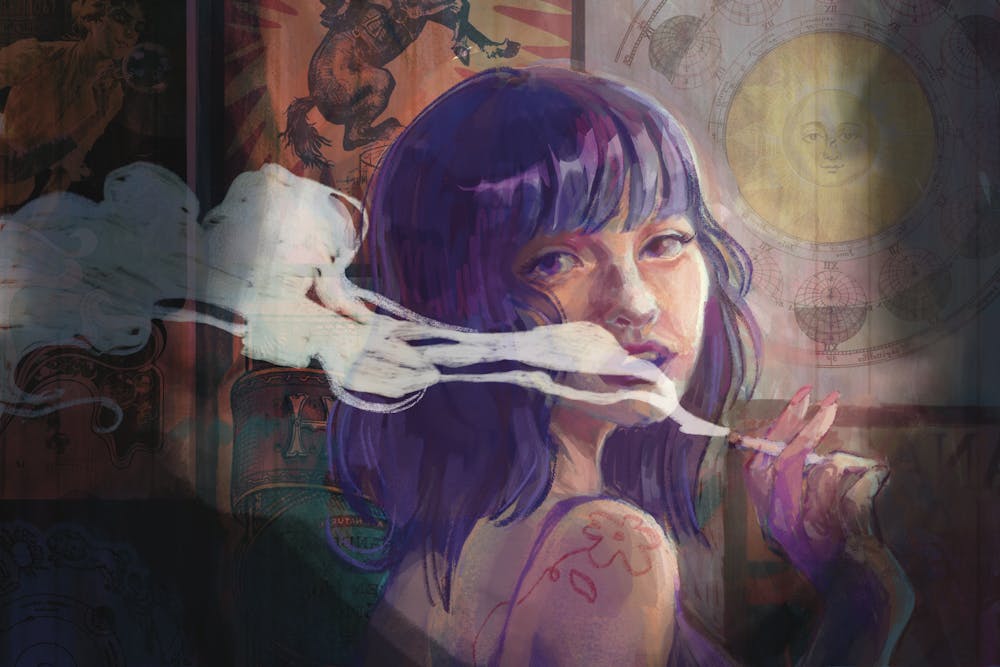
She isn’t beautiful so much as arresting: mousy brown hair to the shoulders in a not-quite-curl, or maybe just uncombed; a dress that hangs on her like a small tapestry; thin gold medallions knocking softly at her wrist and throat. A cigarette rests in her left hand; her right cups her rib cage, holding on as if the city might jostle something loose. She looks at you, really at you, and you sense she’s decided.
“Would you like to go to Woody Allen tonight at Michael’s Pub with me? I’m getting tickets,” she says, and takes a drag, the smoke punctuating her invitation.
You and Shorb chorus a “Sure,” because of course Shorb loops himself in; that’s his sport. Still, the moment cleaves toward you, and you know with him it's got to be tit for tat. She picked you, and she goes to Harvard. And she picked you.
You and Shorb meet Tapestry at 8:30 sharp. She’s brought a friend for him—tall, long bones, hair like sun-faded rope. Both of them look freshly rolled out from a Volkswagen and dusted with patchouli.
Inside, it’s a sauna of cigarette smoke and body heat. You catch yourself trying to breathe correctly, too self-aware, so you stop and let the room do the work. The light, the pub, the smoke, and Tapestry take your hand and walk you into the red-hot ether. Shorb leads, of course, holding Blondie and manning the room like he owns a controlling interest. Blondie links arms with Tapestry; you take Tapestry’s trailing palm and white-knuckle your way through the crush, shimmy and shove, and surrender your body to the small, exhilarating debauch of a Monday night that thinks it’s a Friday.
Four front-row seats open like they were saved with your names, a miracle you all pretend to deserve. You and Shorb bookend the women. He pops up on cue— “What’ll you ladies like to drink?”—already halfway to the bar. You go with him, because that’s the choreography: Shorb leads, you flank. The night complies.
At the far end: Him. Woody Allen, alone at the bar, hunched, tapping his foot, sipping something clear. The lenses of his glasses make his eyes look like they’re looking at everything all at once—including you. Your turn to order. You point at his glass, arrested.
“That.”
Then Louder, as if you’re placing an order with your future self:
“I’ll have that.” The bartender nods, professional, unfazed. “Gibson. Straight up. Onions.”
Shorb eagerly breaks your trance to guide you back to the table. The drinks land sweating. You sip and get the clean punch of chilled vodka and onion brine, whispering from the bottom. It opens a small door behind your breastbone and lets the night walk in. You take another swig just to prove consistency.
House lights cinch tighter. A spotlight finds the microphone like it’s been hunting all night. Tapestry is on her fourth cigarette and you don’t mind the smoke—it suddenly feels like the only sense of structure. The band strolls on, trumpet, trombone, piano, bass, and then the clarinet, that reed-thin question mark. No preamble. A count you feel more than hear, and the room tips forward.
They start New Orleans slow, a sleepy river number, clarinet shouldering the melody like a man carrying a lamp through fog. The trumpet answers with something sour-sweet, bent notes that wobble and then stand up straight. The trombone laughs in brass; the bass walks a long hallway, never turning back. Behind it all, the piano keeps time the way a good friend keeps a secret, steady and unshowy.
Your sense of self loosens. The smoke becomes visible music. Gray ribbons thickening, thinning, a staff in the air. Heat slips under your collar. Your foot finds the floorboards’ hidden drum; your fingers conduct something only you can hear. The clarinet climbs. Not flashy, never flashy, but insistent, patient, like a man making his case to the night. A smear of blue becomes a line of red becomes a violet halo around the bell of the horn. You are in the color now; the color is in you. The Gibson acquires a second life as it circulates: It’s a solvent, a permission slip, a grammar for wanting.
Somewhere mid-set they swing harder. The room jolts awake. The waitress slaloms, ice cracks in a shaker like winter breaking, the trumpet drops a high note that sets the wall mirror trembling. A man two tables back keeps time with a matchbook; the bouncer nods on the off-beat, tender as a lullaby. You feel newly absurdly fluent in a language you didn’t know you were studying. The melody says: Here you are. The rhythm says: Stay as long as you need.
Tapestry leans into your shoulder for one bar, maybe two. Everything after that is a fact of borrowed land. You watch her. She watches the stage like it’s telling her a secret you’re barely qualified to overhear. She smiles without moving her mouth. The smoke makes a chapel out of the light. The bracelets at her wrist become a metronome; glass wind chimes in a minor key.
They peel back for a chorus, clarinet alone, then piano braiding in, bass placing each step like a careful host. The melody comes home without saying goodbye to anyone. Applause detonates. Stomps, hoots, stinging palms. Shorb is first to his feet, of course, clapping high, auctioning for an encore. Blondie whistles through two fingers; Tapestry smiles with her eyes and claps her hands until they blush. You stay seated because standing would be imprecise. You have never liked imprecise.
When you find the courage to stand, the room tilts, one of those ocean-in-a-bottle moments. You realize you’ve drunk the Gibson down to its villainous little onions, which have sunk to the bottom like two corpses. You navigate the aisle, shouldering past a polite wall of bodies, and find the door by instinct, the way animals find water.
When you stumble outside, New York hisses. A bus coughs itself empty at the corner. The air feels refrigerated. Across the way a couple argues like dancers—turn, step, turn. You inhale the unflavored oxygen, and it tastes like being twenty and lying competently.
This, you think, is why you came “abroad” to New York. To sit in a red room and let a clarinet reassemble you. To point at Woody Allen’s drink and meet your future at the bottom of the glass. To be chosen by a woman in a tapestry dress and feel, briefly, like the kind of person who gets chosen.
And yet, you can't help but think about your small campus with its varnished hush and its library lamps like moons at elbow height. The domestic tragedy of Donnie Hazel’s midnight joints. Of the soft discipline of small lives well-attempted. There’s a charm in knowing the snack bar closes at one and your friends at two. The city will always have another Monday, another room to be remade inside. But the other place—the one with the creaking floors and the undeserved grace of second chances—will be there too, uncomplicated in its very complications. You decide you can have both: this city that takes your pulse and returns it quicker, and that town that slows it down until you remember your name.
The door burps heat and brass behind you. Tapestry steps out and threads her arm through yours as if ending a sentence you didn’t know you were writing. “Come on,” she says, and it’s not an order; it’s a route. You don’t negotiate. You let her steer you back toward the noise, where the band is already counting off a new way to be alive, and you, quick study, reforming slacker, future adult with onions in his glass, are finally ready to keep time.


