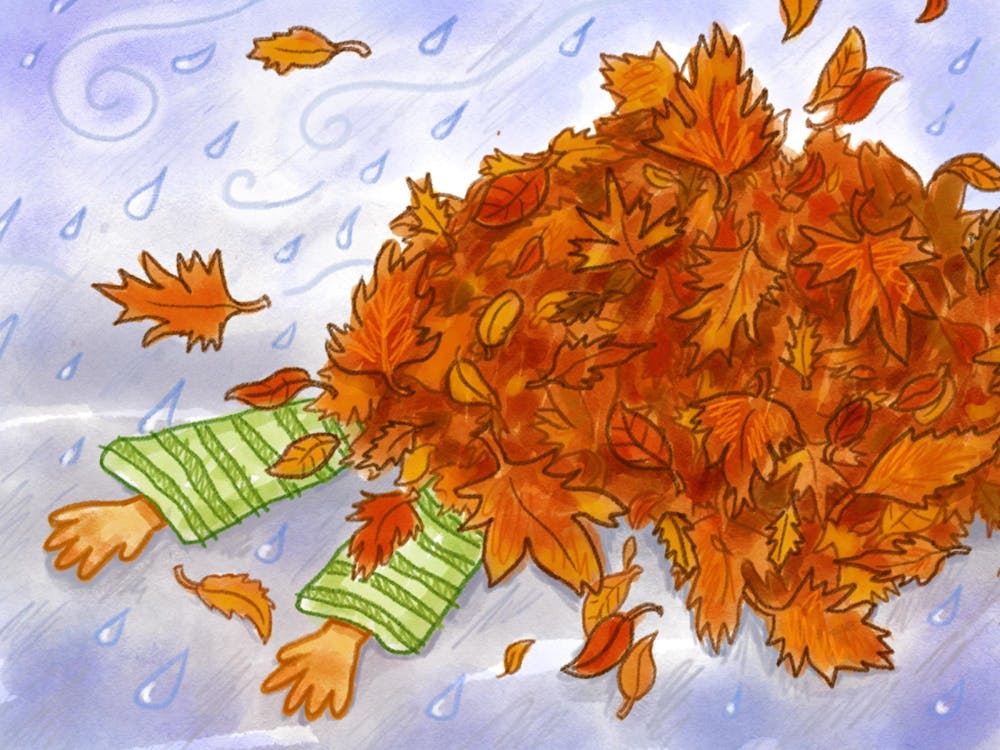
Fall enters Providence with a quiet gravity. The city’s color palette shifts as the trees along Benefit Street turn. While the foliage may be beautiful, these warm colors are the manifestation of a fleeting moment. As chlorophyll drains from each leaf, other pigments—anthocyanins and carotenoids—creep up to the surface. Reds, oranges, golds, and greens litter the sidewalks in slow motion. There’s something deeply familiar about this process, not only because it happens every year, but because it feels like a reflection of the seasonal fluctuations we experience ourselves.
The breeze sharpens. The days shorten. People stop lingering, and life begins to pick up ever so slightly, tilting towards some sort of inevitability. You can feel it in the air—not just the change in temperature but the shift in atmosphere—as a tired stillness settles across campus, like a collective breath no one realizes they are holding. The only audible rhythm is the echo of coughing, accidentally forming a chorus in the background.
Intentionally or not, students begin to mirror the changing leaves. The yellow-orange of Emergen-C packets, the muddied browns of over-steeped tea gone cold, the dull pinks of tired eyes against the green tinge on the face of that one kid who doesn’t “feel too good,” these aren’t just curated fall hues—in actuality, these shades of today are the byproduct of barely holding it together.
Rest becomes negotiable. Eating well becomes an aspiration. Health becomes performative because there’s no built-in pause between all the things you’re still expected to produce: papers, projects, ideas, answers.
-
At this point in the semester, students talk less about “staying healthy” and more about “not getting sick.” The goal isn’t to thrive, but to endure, to scrape together enough of yourself to get through the next thing: critiques, midterms, final proposals, the group project that got lost in the back of your mind until someone finally emailed. The next task on your to-do list becomes patching things together and carrying on because everyone else seems to be doing the same.
On campus, where expectations are constant and the pace rarely slows, this seasonal shift follows a schedule of its own. Your body starts asking questions your Google Calendar can’t answer. Most students won’t admit it outright, but the truth is clear in the half-smiles you’ll see across campus: many are running on empty. Their once creative minds are fogged by dehydration, and their concentration is slipping alongside their motivation.
In the midst of sickness, the semester keeps spinning and deadlines won’t bend, but still, you show up the next morning half-awake, puffy-eyed and all. You share ginger chews with your friend. Your roommate texts you a soup recipe over Instagram. You send your lecture notes to the classmate who needed the extra hour and a half of shut-eye. Someone leaves a cough drop on your desk, a gesture of solidarity.
Fall is beautiful, but it asks for a lot. It pushes you to choose between rest and rigor, to turn in a project that is done “just enough,” not because you don’t care, but because your body is calling the shots.
There’s a reason leaves fall: a tree knows to conserve its energy and will let go of what is inessential so that it can survive the changing weather. What may look like decay is actually strategy, adaptation. Rest is a medium of some sort, and although immunity may not end up on your resume, it is shaping the quality of work you produce in the long run.
-
A strange clarity emerges during these months. Unlike the brightness and inspiration that fuels the beginning of a semester, this new understanding is of limits and priorities, of practical advice: which professors are lenient with extensions, if tomorrow’s meeting is mandatory, where to find the best bowl of noodles on Thayer. Maybe this looks like disengagement, or perhaps it's a form of survival.
Students start to recognize when it's time to scale it back, when to ask for help. They begin to acknowledge small moments of peace, such as a shared laugh in the studio, a text from a friend checking in, a short walk between study sessions that helps them feel more awake. Experiences like these are reminders that wellness is not a solitary goal. Rather, it is woven through the fabric of daily life.
-
We underestimate how much of a resource our immunity is. Perhaps most of us don’t even notice when it’s hard at work. There’s a misconception that immunity works like a switch: You’re either healthy or you’re not. In truth, immunity is a layered process that rarely feels complete but is always in motion. Your immune system is like any other system, after all. It requires maintenance, occasional experimentation. Blind faith, maybe. Most of all, it requires time, which no one seems to have enough of lately. But you do what you can: sleeping in when you can, choosing water over a third coffee, getting your vitamin C in as many days of the week as you remember to. It’s hard to say if it's working, but you keep doing it anyway.
The reality of fall is not the candlelit fairytale sold by Trader Joe’s alongside their Fall Fantasy Pumpkins. It’s messier and lived-in. Damp, and a tad achey. But above all, it’s shared. Everyone is a little bit sick, a little bit tired, a little bit behind. In the honest struggle of student life in flux, there is community, which may not be a cure but is a kind of resilience.
This is how we care for each other in fall: indirectly, without ceremony.


