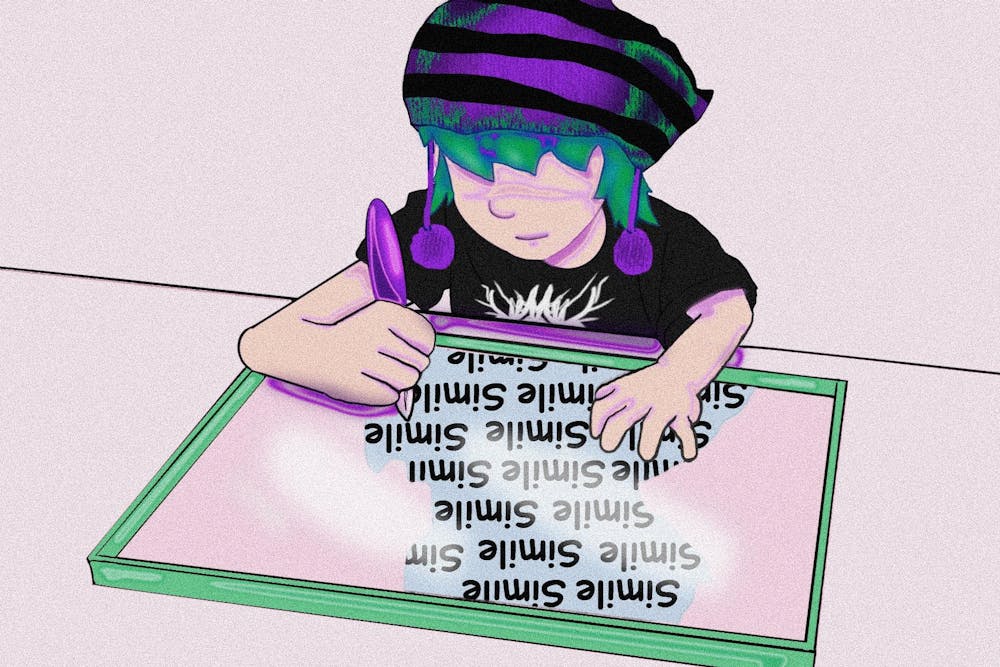
You probably already know what a simile is. I have this distinct memory of sitting in a classroom, age nine or ten, tipping from side to side in one of those blue plastic chairs and listening to my teacher explain literary devices. Metaphor. Hyperbole. Onomatopoeia. I do wonder if there’s a better way for the American education system to introduce children to the study of literature, but that’s outside of the scope of this article. What’s inside the scope of this article is the simile, which is, as I’m sure you could tell me, a comparison using like or as. Given that we know this—given that we have passed through classrooms and hallways and quizzes where we name and identify 20 rhetorical devices, given that we were raised in the institution of dreaming and also of flashcards—let’s not think about it too much. We understand what a simile is. I want to talk about what it does.
I recently encountered interesting similes in a poem accessed through a Google Sites URL with a title in flaming text—“I Knew I Loved You When You Showed Me Your Minecraft World.” In the poem, author Hera Lindsay Bird describes the overwhelming sense of adoration and fear that comes with falling in love, “the feeling of knowing / I was beyond what could be recovered from.” The speaker’s voice is conversational, somewhat melancholy, and unwaveringly committed to hitting the reader with some of the most absurd similes ever written. “The sky is firing navy shadows like a T-shirt gun,” the poem reads, “and spring is on the wind like wifi.” There’s a startling, entrancing contrast between the two sets of images: the eternal world of nature—night skies, darkness, spring, and wind—and their man-made, distinctly contemporary complements. The similes are weird and delightful, not afraid to be silly and not afraid to place “unpoetic” images alongside traditional ones. Spring is on the wind like wifi. Isn’t that incredible?
If you’ve ever taken a fiction writing class, you might have heard that figurative language should reflect the world of the speaker. An aspiring writer says the sky is dark as spilled ink, while a teenage artist says it’s the black of permanent marker. In this way, the simile lets the reader in on something subtle and essential about the speaker—their vocabulary of reference, their sphere of knowledge. We read “...the evening is spread out against the sky / like a patient etherized upon a table,” and we know immediately that this is a sad person’s poem. We read “O my Luve is like a red, red rose,” and we know the shape and shade of this love. Especially in poems, which have so few words to work with, the simile is a powerful vehicle for characterization and development of tone. It tells us what words the speaker has, what images they use to convey meaning. Bird’s speaker, reaching for T-shirt guns and wifi, is recognizably modern and irreverently colloquial. You can compare the sky to anything—the something you pick matters.


