“Where are you guys from? Oh yeah, our rail system’s shit.”
When you get lost on the Southeastern Pennsylvania Transportation Authority, commonly known as “SEPTA,” there is no shortage of Philadelphians willing to try to direct you. In the span of one short misadventure (getting off a stop early at 30th instead of Jefferson), my friend Magdalena and I were approached by four different strangers offering directions. They had overheard us struggling to decipher a multitude of confusing maps and jumped in, likely out of pity.
Likewise, as the last and most helpful advisor exemplified, there is no shortage of Philadelphians ready to criticize the city’s transportation system.
I see it all over TikTok—videos sarcastically praising what a beacon of cleanliness and efficiency the regional rail is—as well as in casual conversations at the Haverford dining center, on walks to Wawa, in debates over whether or not it’s worth going into the city that day. SEPTA has its critics.
And yet, when two quintessentially disoriented college freshmen from the suburbs couldn’t find their way, one of the first things we were asked was where we were from—the implication being that, because we didn’t fully grasp how SEPTA worked yet, we must be from somewhere else. Any true Pennsylvanian would already know how it all worked. While broadly disparaged, the utility of the city’s public transportation system makes its use so common that familiarity with it has become standardized. That’s not nothing.
By contrast, public transportation in the Bay Area (where I’m from) is far less convenient; though there are some options within San Francisco itself, transportation in and out of the city leaves something to be desired. The few buses that do run do so infrequently. Ferries, while comfortable and even pleasant, cost a hefty fare. Thus, the primary mode of travel for most residents living outside of the city becomes the car; yet, even for those privileged enough to have access to one, the bridge toll to commute from Marin County into San Francisco proper is now around $10. Pair that with the desperate and expensive search for parking, ever-soaring gas prices, and rush hour traffic—well, let’s just say that when I first discovered SEPTA, I was in love.
Suck it, Waymo.
→
Like most public transportation systems, on rush hour days, sometimes all the seats will be taken and you’ll have to stand. Interestingly enough, in 2021, SEPTA introduced an online “Seat Availability Dashboard”—information about seats on SEPTA is so important that it gets its own tracker. People like to feel prepared. Perhaps the accurate management of expectations is just that critical.
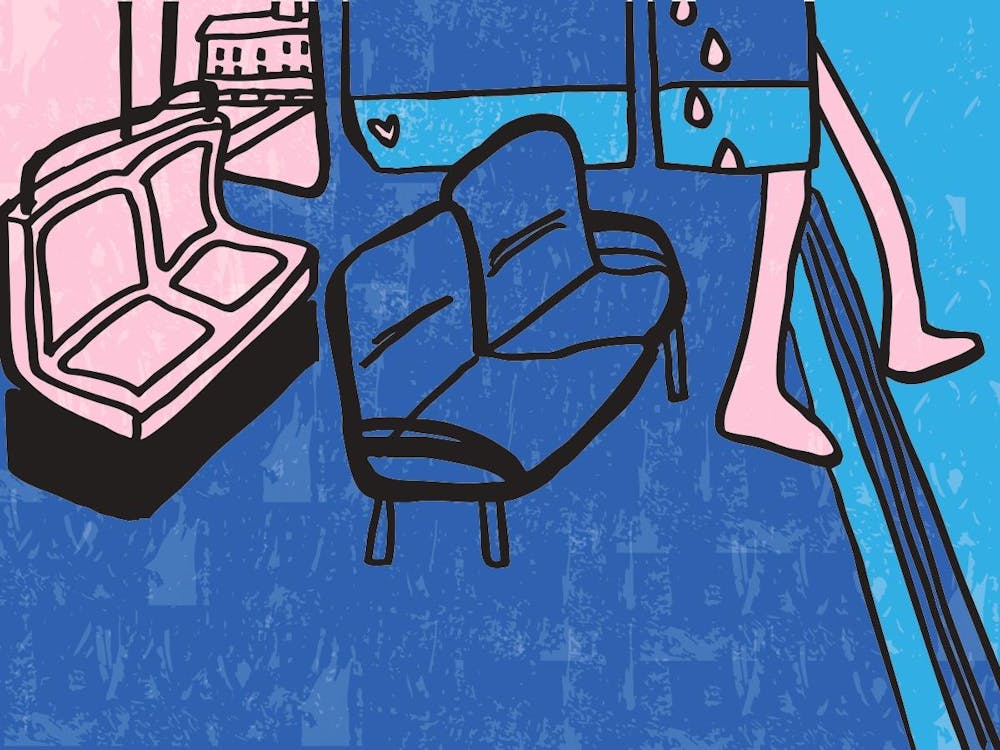
In any case, there were not too many riders taking the Paoli/Thorndale line around 1 p.m. on Wednesday afternoon, and so Magdalena and I were able to get a bench to ourselves. I like the concept of a bench on a commuter car. I’ve certainly seen plenty of individual seats on SEPTA where the divide between where one person sits and another is far clearer. But even these tend to come in pairs. Maybe, probably, it’s more space-efficient to design it that way. Yet I can’t help but extrapolate a little more—having two-person benches supports a more social way to travel. Transportation becomes pleasurable—I talk with Magdalena about how my classes are going, our love for a mutual friend, her recent artistic endeavors. Even if the benches aren’t designed with two friends or family members traveling together in mind, in a way, they still promote community.
And yet, at the same time, no one wants to sit with a stranger. Imagine, for a moment, that you’re sitting on a train that’s nearly completely empty, and a man you've never seen before in your life chooses to sit next to you. If you’re like me, your first reaction is something close to terror.
Moreover, there are two sets of tiny black plastic rectangles on the edge of each bench—easy to miss, if you aren’t paying attention. Sometimes people will leave their SEPTA cards there so that the ticket-checker can come around and scan it without ever having to truly interact with the commuter. If you don’t have a SEPTA card, when your credit or debit card is scanned in its place, the ticket-checker leaves your exit receipt in those tiny black rectangles. SEPTA seats are literally designed with infrastructure to mitigate interaction with strangers.
We crave socialization and avoid it out of well-warranted fear all at the same time. Seats on SEPTA represent exactly what Philadelphia has: the contrast between American individualism and a biological, almost primitive need for connection. We depend on and fear each other. We sit next to friends and strangers on the rail. Philadelphia’s reputation as crime-ridden and dangerous clashes violently with the phrase “city of brotherly love.” Strangers give unsolicited but useful directions to lost college students.
Regardless, when the inhabitants of Southern Pennsylvania bemoan the endless faults and shortcomings of SEPTA, I like to think that it’s in the same way a husband might refer to his wife as “the old ball and chain”: derogatorily and ungratefully, but not without the subconscious knowledge and appreciation of having such a dependable anchor; and, one can hope, not without at least a little underlying love.
→
I did love Haverford, but I had to go.
No more fencing team, Green Engine Cafe, Blue Bus shuttles to Bryn Mawr. Eventually, no more Elizabeth. Instead → Providence.
→
Municipal and regional public transit agencies throughout the country are in crisis. Ridership (and with it, fare revenue) hasn’t returned to pre-pandemic levels. Federal COVID aid, which managed to keep trains and buses going through the early 2020s, is now running out. Add that to aging infrastructure and rising maintenance costs, and the impending fiscal cliff becomes clear.
Today, SEPTA faces a $218 million deficit. A Democrat funding bill failed to pass, as did a Republican-backed plan to use the Public Transit Trust Fund. Routes were cut. Philadelphians expressed their devastation. Losing train and bus lines means commuting to work gets harder, especially for those who work odd hours. Attending classes gets harder—52,000 Philadelphian students use SEPTA to get to school. Losing train and bus lines means losing parts of your own city. Walls might as well sprout from the places tracks used to line. The world gets smaller.
On September 8, 2025, the Pennsylvania Department of Transportation approved a one-time use of state capital funds to cover daily operations, but failed to reach a long-term solution. On September 14, previously cut service came back—with a 21.5% fare increase. The fate of SEPTA remains up in the air.
→
I still have a SEPTA card even though I haven’t been back to Philadelphia since November of last year. It’s got $40 on it. I still have my OMNY card from my summer in New York too. Less money on that, though—$10 maybe. There’s an unused LIRR ticket somewhere in my backpack that I really should’ve reused; the conductor never collected it.
I thought I might use my SEPTA card some more on trips to Haverford, but I only went back once, primarily to visit Elizabeth. I took the Amtrak to William Gray Station, and then ubered from there to Ardmore. I spent the five-hour train ride back to Providence crying. She called me a day later, and I acted surprised to hear that it was over even though I’d known it was over before I even transferred. I haven’t been back since. I won’t throw away the card.
→
There are certain things you do to romanticize your time in a place you don’t love. In New York, the greatest city in the world, I turned to crowd-favorite media depicting the glamour and excitement the city never sparked in me: Sex and the City, How I Met Your Mother. Music, too. “Summer in the City” by the Lovin’ Spoonful, at my dad’s recommendation. Chappell Roan’s “Naked in Manhattan,” and of course Taylor Swift’s “Welcome to New York.” It was hard not to feel like a tourist with “Empire State of Mind” playing through my AirPods, but I played it anyway, maybe every other commute to Penn Station from the Upper West Side. “Breaking in Brooklyn” for the first time I took the C to visit a friend from Haverford’s luxurious DUMBO high-rise. I spent most of my summer missing California. I didn’t spend that Fourth of July sitting on the rooftop of the Civic Center watching the fireworks go off over the county fair, like I had done the year before. But I did watch them with former teammates over cobbler and liberal arts school gossip. Sparks fell from the Brooklyn Bridge like golden rain. The whole city unfolded before us.
→
Chappell Roan’s “The Subway” happened to come out the one summer I happened to be in New York happening upon my first Brown University breakup. It felt like fate.
→
After the fireworks ended, my Haverford friend took me and the others to a party at a different skyscraper, where, coincidentally, I ran into two people I knew from Brown. One of them was friends with Matthew (newly minted Subway-by-Chappell-Roan-ex-boyfriend). The other, I’d met on a backpacking trip when I was still long-distance with Elizabeth. Haverford and Brown, New York and Philly (and Providence, probably, if you really looked for it), all at that party in Brooklyn. I can’t remember what Elizabeth’s perfume smelled like, but I remember what it felt like to rip up the letters she scented with it. I’ve lost my SEPTA card, but I know I still have it. Fallen in the bottom of my backpack, somewhere beside my LIRR ticket, somewhere beside the note Matthew sent me with the flowers he got for my birthday, somewhere under an a cappella flyer someone handed me freshman year, somewhere beneath post-it notes with words of encouragement my Haverford teammates would write each other before tournaments.
I’ve got $10 left on my OMNY card. I’m not throwing it away.
New York is so huge it’s almost incomprehensible, like a blue whale. Incomprehensible things are difficult to love. How to wrap your head around something the sheer magnitude of which you’ve never seen? And then, how to wrap your heart around it? New York: an interlude, a main-character city relegated to a minor role in my life. But I did feel in awe of the subway. My beloved Bay Area’s division is accentuated sharply by its famous bridges, beautiful and absolute. $9.75 to cross. More to park. New York is a city completely interconnected, like a blue whale, like any animal, blood pulsing from its cerebrum to its tail fin, from Manhattan to Brooklyn, Queens to Long Island.
→
Downtown Providence is so close you don’t need a bus to get there, but the walk down is a lot more pleasant than the walk back up. I make the trek about three times a week, sometimes four. I like to think it’s making my hamstrings stronger.
Why do the Bay Area’s bridges strike me as so divisive? I’ve heard people claim it as an intentional set of choices designed to further separate Marin County from the rest of its Bay Area counterparts—the idea being that, if public transportation across the Golden Gate were readily available, it might not be able to maintain its financially elite status. A snobbish (or, really, insidious) desire to put physical space between different clusters of tax brackets. And that, if you were one of Marin’s wealthier residents, you’d probably be able to afford a car, and the toll, anyway. San Francisco and all its museums and nightlife and famous landmarks at your fingertips, Marin’s striking mountains and beaches and forests kept to yourself. And as a resident, I can tell you, a drive 30 minutes north feels a lot closer than a 20-minute drive across a bridge.
At first, College Hill struck me in a similar way, a geographic differentiation from the rest of the city. Our bubble. And, perhaps shamefully, what a lovely bubble it was. I didn’t just miss California over the summer—I missed Providence. I missed the couch in my sorority’s lounge, where I always say I’m going to get work done, and instead waste hours talking with people who claim they’re working too. I missed running into friends at the Ratty, missed running into enemies at the Ratty, missed complaining about the food, which, in comparison to Haverford’s, is really not that bad. I missed being around so many people all the time. I am constantly bumping into community here. Here, connection comes with an ease that I haven’t found anywhere else.
I even missed the Thayer motorcyclists (though, now a few weeks into the semester, I can confidently say that feeling has worn off).
With all that lives within campus borders, why bother walking down the hill?
But the more you do it, the more you realize how little time climbing back up actually takes. You start to memorize the things you see on the trip back—that one cocktail bar you want to bring your friends to try, the wine and paint place, the view of the State House from the Amtrak station. You start to realize how close everything actually is. Providence is delightfully small.
RIPTA remains free for college students. But here, I mostly walk.


