As 22-year-olds, we take ourselves pretty seriously. We’re convinced that our two romantic decisions (anything before tenth grade is negligible) indicate a lifelong pattern to which we are bound, irrevocably so. We’re sure that, despite results of an allergy test that say otherwise, we are allergic to pine nuts and cannot possibly eat them, not even in pesto. We are beholden to political memes and reels, caught in a damned-if-you-do, damned-if-you-don’t cycle of activism, or performative activism, or whatever you want to call it. We’re dressed—the “best” of us—in ivory blouses and Mary Janes, posing as demure (but somehow not downtrodden) 30-year-old women who actually know what the fuck they want in life.
In a recent survey published by Gallup and the Walton Family Foundation, just 15 percent of 18- to 26-year-olds “said their mental health was excellent.” Granted, ‘excellent’ is a high bar, but even so, the figure marks a sharp decline from both 2013 and 2003, when more than half of respondents were practically frothing rainbows. Such is the rise of teenage and 20-something angst, I suppose.
The majority of my friends are in therapy, and I am in therapy, too. My mom spends hundreds of dollars every month—a handful of dollars a minute—so I can discuss my love life and LinkedIn inbox with a seasoned professional. Sure, my dad’s diagnosis (early-onset dementia with Lewy bodies) is broached occasionally, along with my routine qualms and need to swipe out of social media apps 47 times a day. But primarily, I get to talk to a 50-year-old woman about my fluctuating emotions and [insert name of the person I’m currently seeing] monomania once a week.
So like, is this entirely necessary? Through hours of psychoanalysis, starting in late adolescence, are we becoming overly therapized? Or are we getting ahead of later issues, getting to know ourselves before it is too late? If you—yes, you, ambiguous reader—have the money for it, and it’s accessible, I think you might as well go to therapy. Self-awareness rarely hurts, and it is semi-nice when everyone in your one-mile social radius is equipped with professional language and strategies to scrutinize normal 20-something behavior. It is also semi-nice when all of the boys you sleep with are on Lexapro, attuned to noxious emotional patterns, and able to last longer in bed.
Maybe we will be better than our parents. I suppose that’s the perennial hope, the cycle of life, or whatever. The thing is, even when my dad criticizes how I sit (knee up, hunchback at the dining room table), or my mom stoically clings to the most annoying non-truth, I think my parents are pretty good, if not great. Being better than them is both undesirable, and, frankly, unrealistic. My mom published a book on date rape at age 24 and is more emotionally perspicacious than anyone else I know. She has survived 57 complicated years without the diagnosis of “adjustment disorder with anxiety,” which sits atop my insurance claims and does absolutely nothing for me.
A New York Times op-ed argues that the underlying goal of therapy is, through probing one’s past, to identify and dislodge real trauma. Doing so reduces the risk that it—whatever childhood event or attachment pattern—will go unacknowledged and pervade other realms of life. But real trauma differs from just any tumultuous event or occurrence, and “[if] we fail as a culture to acknowledge the well-established long-term consequences, both physical and psychological, of legitimate trauma, we will wind up creating more people who identify as victims, not fewer.” This isn’t a victim complex, per se, but it isn’t far off.
In other words, haphazardly invoking the word ‘trauma,’ or exaggerating one’s needs as a patient, can obscure—or even undermine—the very point of therapy. I will probably, most likely, be fine, despite whatever semi-upsetting-but-not-devastating thing happened to eight-year-old me. And so will Katie, Rachel, and every other similarly privileged girl who beats a dead (or, at least, severely wounded) horse with her therapist every week. Therapeutic dialogue and self-awareness are valuable, but not when they drift into overpathologization.
After Brown, I want to work in psychology. I want to spend my days, all of them, speaking to all sorts of people about all sorts of things: former drug addicts about their new, healthier infatuation with ginger beer; domestic violence survivors about the coercive cycle of patterned abuse; worried mothers about their not-so-nice sons who recurrently goad other middle schoolers to their breaking points. Notice I haven’t mentioned people like myself—white, post-adolescent, socioeconomically stable, privileged in most senses of the word. I haven’t mentioned my best friend Owen, who, for what it’s worth, has done a lot with the past five years of biweekly life coaching, supplemented by therapy and medication. (Owen—love him to death—is your archetypal blonde, basketball-playing Tulane graduate). It’s not that I don’t take my, or his, or our problems seriously; it’s more that I don’t yet know what to make of them.
As a ’25.5er (transfer, gap semester, long story), I have one semester more than most of my friends. It’s a buffer between college life and the real world, a three-month stretch where I get to watch my friends adjust to their new work lives, while I’m still a student. “I miss Brown” and “same old, same old” have already become commonplace responses to my queries about their days. It’s kind of scary! What, I wonder, replaces the very distinct thought patterns and communicative modes you cultivate in college? What happens when you leave your special little stratosphere—the world of Thayer street, of Blue Room rendezvous, of clustered desks in the SciLi basement—for the bigger, broader world?
Perhaps this is a me problem, but I’ve never had a job so immersive, so engrossing that I forget all else. When I imagine my friends in their nine-to-fives, when I imagine myself in mine, I’m curious about the moments in-between. The stretches between tasks, on the subway to work, when you’re not walking through the Main Green, enwrapped in a familiar social landscape with familiar faces literally everywhere. Instead of running into Professor Y or spotting Acquaintance Z, with whom you drank far too much on Saturday night, you see Strangers A, B, and C. It doesn’t really matter; there’s nothing to mull or muse over during your daily wanderings.
I worry that without the constant stimulation of Brown’s campus—or the looming prospect of returning, which keeps you enthralled in, or in thrall to, your little world—things will feel like “same old, same old.” As we enter a new stage of development, just two or three years from prefrontal maturity instead of a whopping four or five, I wonder what will replace the on-campus characters and daily musings of college life. For some of us, I imagine it will, for a while, be a fair amount of anxiety. Growing pains, maybe.
What I do know for a fact is that most people listen to music—and will continue to do so, probably forever after. Being a chronically bad texter and living in Europe, I reckon I could guess at my friends’ playlists better than some of their interior lives (give or take). My best friend, who is with me in Amsterdam now, with whom I’ve shared innumerable conversations over bitterballen and white wine, says he wishes emotions were as literal and demonstrable as a gash on your cheek or a bruise on your thigh. I’m not sure I agree.
I don’t wish my mood fluctuations were visible for everyone to see, probably for the same reason girls don’t wish for erections. I do, however, wish they were more easily expressible. At this stage in life, finding someone with a similar emotional range or calibration of reactivity to you is difficult. Friend J spirals like I do; Friend K obsesses like I do; Friend L writes like I do. But everything would feel a lot less crazy—and seem a lot less crazy, for that matter—if we had a more generationally agreed-upon form of expression. ‘Emotional’ is not supposed to be synonymous with crazy, but the two become interchangeable when emotions are expressed (or processed) without grace.
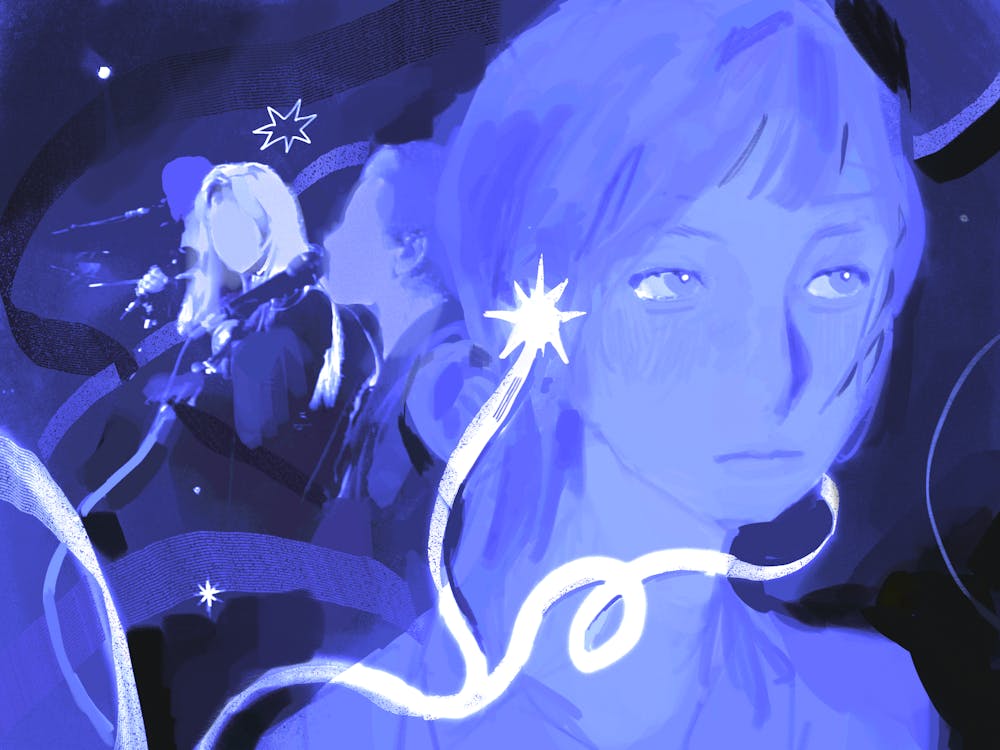
Sometimes I get hyperfixated on song lyrics. Like books, they distill complex emotional phenomena into appealing little sentences. They make you feel seen and heard and understood in ways that only art can (and sometimes, in ways that only Taylor Swift’s art can, which explains the teenage girl demographic ideé fix). My perpetual fixation is Fleetwood Mac’s “Silver Springs,” specifically the lyrics “time cast a spell on you, / but you won’t forget me” and “you’ll never get away from the sound of the woman that loves you.” Over the past few days, I’ve watched a specific ’97 Stevie Nicks and Lindsay Buckingham performance of the song upwards of 19 times. My fixation may be unsurprising, perhaps even unoriginal: Their musical rapport is coveted by thousands, if not millions, and they are widely regarded as lyrical geniuses.
But Big Sean is not, and once I listened to his song “I Know” 23 times in a school day. That’s around 104 minutes of the same song in one day. All because I liked his harmonies with Jhené Aiko and the way I felt when he sang “dancin’, dancin’ dancin’ like you fucking got a reason.” These songs become part of popular culture because they feel strangely and specially relatable. Someone like Jay-Z or Taylor Swift, like Virginia Woolf or Alain de Botton, is able to articulate and make legible the feelings of falling in love, of isolation, of loneliness—along with our daily neuroses.
It seems every girl, regardless of her romantic arsenal, can find something relatable in “And there we are again when nobody had to know / You kept me like a secret, but I kept you like an oath,” or “Carve your name into my bedpost / I don’t want you like a best friend.” My question is: If we all find these songs relatable, if we all listen to them for solace, why aren’t we better able to relate to each other? And I don’t ask this in a simplistic, grossly, and somehow sweetly condescending second grade teacher way. I’m just genuinely wondering why 20-something-year-olds, and people writ large, feel so alone in their emotions when it is overwhelmingly clear that many of our peers feel the same way.
The concept of a generationally agreed-upon form of expression is naive, but I wish that I, personally, had a better emotional outlet and more confidence in the non-annihilation of the moments in-between. I love my long bike rides with my earphones in and Frou Frou on loop as much as the next person, but I truly think over-reflection or incessant rumination—especially without a steady stream of new stimuli—can be detrimental. Maybe, as we reach 23, these moments are filled only with The Daily, Pod Save America, or even silence, set against a mental backdrop of unceasing job worries. Maybe I’ll discuss these thoughts with my therapist.


