
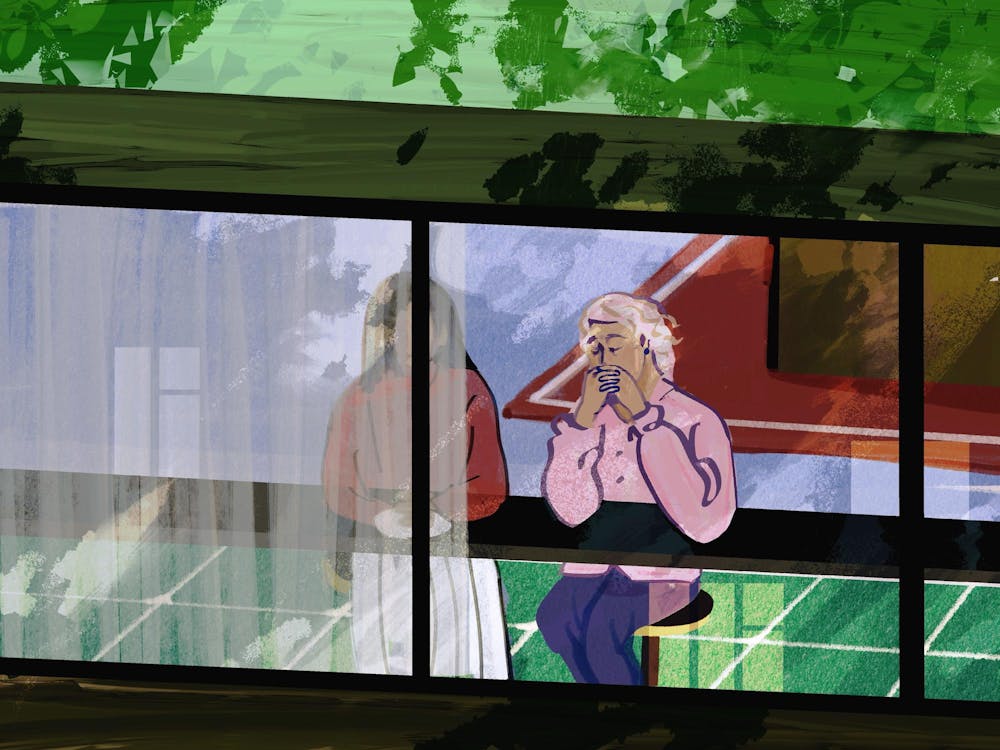
I was sitting on the steps of Hope when a woman asked to pray for me. The late morning sun peeked through a web of elm and oak leaves, and the breeze carried the springtime revival in its wisps. Shades of pink, ivory, and violet magnolia blossoms had begun to flower, enticing the beetles and the bees with their sweet fragrance.
Below the sunshade, little warblers with orange bellies hunted for seeds and sundots, while the squirrels prepared for the invasion of hammocks and frisbees. In a matter of moments, a barrage of protests, Egyptian battle reenactments, pilates classes, petting zoos, and campus tours seemed ready to sprout from the very grass. Swashbuckling pirates sang sea shanties while Wall Street wannabes, academics, and celebrity descendants lounged on picnic blankets. Even with all the action, time on the Green was still better described as languidly moseying. I was taking a brief intermission from tapping the delete key—drafting arguments and untangling evidence to convince my certainly socialist, possibly communist, literature professor that I had, in fact, done the reading.
The undisturbed morning reminded me of home: frosty windows, the old kettle, and curly steam that rose from the surface during early practice at the pool. When I moved east, buoyed by caffeine and a new beginning, I chased the early sun to outshine the things I couldn’t see. I thought it made me see clearer. I learned later that light and darkness can exist together.
This particular morning was not a joyous occasion. I had wasted hours contorted in a large armchair, hidden behind my computer, inventing new ways of writing the exact same sentence. Sitting between the tall stacks of books warped my perception of time. The hours ticked past as if they were bored too. The blueish hue of my screensaver reflected off the filters in my glasses, and sleep—or the lack of it—had collected between my eyes and left me slouched on the curb of inspiration. Deciding to cut my losses, I finally emerged from the dark caverns of the library seeking mercy. But, preoccupied with textual analysis, allegory, and metaphor, I forgot to watch the trees glimmer.
The concrete steps were still defrosting beneath me. I was wearing baggy shorts, and moved the fabric to avoid the chilly stone. Readjusting, I heard the door open behind me, and leaned to the side to let a trombone case pass. It looked inconvenient and heavy. The click of the automatic door refocused my attention to the parchment package before me: my double chocolate muffin. Ripping the corner of the paper like a gift, I remembered why my flex points always seemed to fall from my fingertips.
I began to pull the still-warm dome from the base to reveal the chocolate chips in the center. The crusty bit is the best part; it crunches and crackles from the hot oven. But its decapitation proved messier than I anticipated. Before I could take a bite, crumbs exploded everywhere. Chocolate entrails lodged between my thighs and the creases in my clothes; I snatched the edge of my crumpled napkin before it escaped in the wind. Wiping away, I looked about to count witnesses. I had chosen these steps for their seclusion, more from my self-consciousness than from those around me. The early light seemed to help me exhale.
Satisfied with my clean-up, I noticed the cavernous pit in my stomach. I had waited too long to eat, and probably to drink water. Using the parchment to protect my fingers, I tore the muffin’s base in half. As I peeled a section from the wrapper, I paused for a moment, like how one honors a deer before its sacrifice. I listened to the birds, smelled the flowers, and finally locked eyes with an older woman across the way. She smiled and began to walk toward me.
I scrambled to hide the evidence, but it was no use. The lawn was empty except for the two of us and a few stragglers. This was not the time. With a longing glance, I set my disobedient breakfast aside. She was older, old enough to have grandchildren. Tight silver curls fell loose from a tousled bun held together with a barrette that resembled a pencil, or a decorative chopstick. Delicate smile lines around her nose and eyes gleamed with traces of happy memories. A thin pair of semi-circular glasses sat on the bridge of her nose, a sign of wisdom, or necromancy. She wore dark wash skinny jeans that made her legs look like delphinium, and a long, pinkish button-down with a gold-printed “VS” on the right breast pocket. Her clothes reminded me of Haight & Ashbury, thrifty finds from San Francisco. She looked like she enjoyed eating her vegetables.
By far the most distinguishing feature of her outfit, though, was her shoes. Platform neon green slippers in sport mode—I had never seen anyone, let alone a woman of her age, wear them. Clutching a gallon-sized plastic water bottle against her hip, I determined I didn’t recognize her; she must’ve been a stranger. Finally, as she drew nearer, she whispered:
“Would pray…you?”
“What? I—uhm…sorry. I can’t,” I responded. I was too hungry to ask her to repeat herself. Chocolate-covered, I felt like a child caught sneaking candy.
“Could I pray for you?”
“Oh! Of co—I mean…sure.” My Catholic school days sent a shiver down my spine. The lesbian in me smirked. What gave me away? I shrugged the thought away and decided: I had a few assignments looming, and a shout in God’s direction couldn’t hurt. My muffin could wait.
“You can eat, if you want,” she said. I liked her. She asked my name.
“I’m Sara.”
“Thank you, Terra.” I didn’t bother to correct her. It didn’t really matter, anyway. She closed her eyes and clasped her hands at her navel. Together, we bowed our heads. She proceeded to pray for almost 15 minutes. I was frozen by how her conviction strengthened her. The rhythm beneath her hushed tone emboldened her to speak louder. She spoke with a sense of an urgency about everlasting love. Intermittently, I raised my eyes to watch her speak. Her eyes were glued shut and her eyebrows pushed together like caterpillars trying to wriggle free.
She appeared to forget I was sitting there, except that she repeated my name, over and over, and soliloquized: “Please Lord, give Terra the courage to carry on. Let the singing birds be a sign of you.” I didn’t realize until later that she never told me her name. When I went to Mass as a teenager, prayer seemed like begging. For forgiveness or guidance, I thought it was simply better to be patient. But to her, it seemed to be an ode to her faith. It gave her purpose. Confession, sin, piety, and pain—I didn’t agree, but I understood.
Growing up without a mother or grandparents, I was always a bit afraid of the elderly, particularly of older women. Wisdom hidden behind a curtain of cognitive and physical decline, there seems to be a divide between an older person’s memory and their ability to communicate about the past. But, through prayer, I could see the decades behind her eyes. Someone who grew up under the pressure to find herself. As a witness to her faith, I wondered if my life lacked direction without it. With a last breath, she said she loved me, and left. As she walked away, I noticed the trees, smelled the flowers, and heard the breeze. Finally, I looked to the morning sky, and said I loved her too.


