As we welcome the Year of the Horse, here are some of my favorite ways to celebrate the new year and some of my favorite memories! These are all based on what I have experienced over the years growing up and feature a selection of the best parts of Chinese New Year.
除夕夜 New Year’s Eve
This is the most festive and exciting night of the week of New Year’s celebrations! Before I went to college, we would go back to my grandparents’ house in Tianjin every year, and they would cook so much delicious food. Here are some of my favorites:
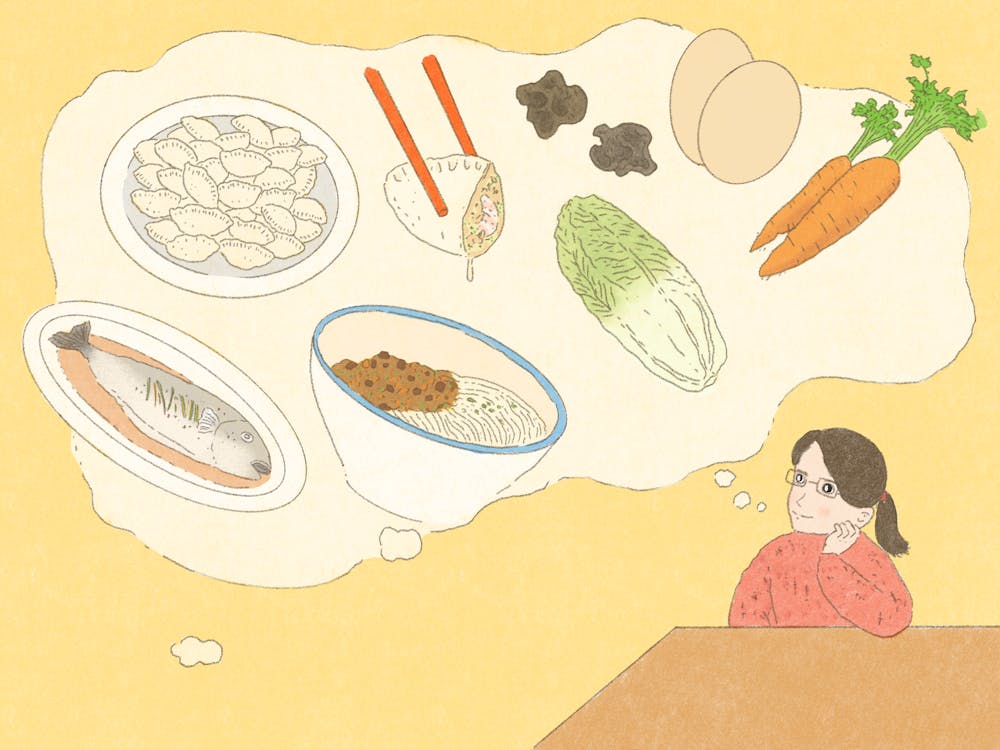
- Dumplings: Dumplings are an absolute must. Because dumplings are shaped as traditional gold ingots, dumplings signify good wealth and good fortune. My grandpa would first make two fillings, a meat one and a vegetable one. Normally in the meat one, he would add pork, chives, cabbage, sometimes shrimp, etc. The vegetable one is my personal favorite, but it’s also much more complicated. It includes chives, fungus, cabbage, vermicelli, egg, shrimp, carrots, and more. After making both fillings, the next step is to roll out the dough (that should have been prepared already) into a long, snake-like shape, then use a knife to cut it into small pieces. My specialty is rolling out the dough to make the dumpling wrappers—I’m so fast and so good at making perfectly circular ones! Once you have wrappers, you use chopsticks to put filling onto a wrapper, then close it up by pinching it closed with your fingers and tightening the edges! The last step is to boil the dumplings. Once the water is boiling, place them in and wait around ten minutes. The trick isn’t necessarily in the timing, but waiting two or three cycles of the dumplings rising to the surface (add water once it rises to let it sink back down). Then, your dumplings are ready to eat! We used vinegar and sometimes flavored garlic as a dipping sauce.
- Steamed fish: The mechanics of making steamed fish are much more complicated, and I normally leave that to my grandpa, but eating fish is a part of the folklore of “年年有余,” where the last character 余 sounds like 鱼 (yú), meaning fish. It represents hopes that you’ll be prosperous, successful, and satisfied in the new year.
- Apples: We tend to eat apples when the clock strikes midnight. It references the idiom “平平安安” (píng píng ān ān), meaning safety. Apple in Chinese is 苹果 (píng guǒ), thus acting as a homophone and symbolizing safety, security, and good luck.
While all this food is circulating around the table, we start watching the Chinese New Year Spring Festival Gala (春晚), broadcast at 8 p.m. It is an annual show that everyone around the country watches, featuring various performances including skits, songs, dances, magic, martial arts, and more. Outside, fireworks light up the night sky. Looking out the balcony from the twenty-third floor of my grandparents’ apartment building, you can see an endless number of fireworks dancing in the sky from different corners of the distance. The louder the fireworks are, or the larger the quantity, the more festive and hopeful people are for the new year.
初一New Year’s Day
The saying goes: 初一饺子初二面,初三合子往家转。
This is a saying that is most popular in the northern regions of China that translates to: On New Year’s day, you eat dumplings, on the second day, you eat noodles, and on the third day, you eat 合子 (glorified dumplings where you use two wrappers instead of one). Eating dumplings on this day signifies wealth, good fortune, and family unity. In the evening, we play mahjong or potentially cards if there are more people.
初二 Second Day
On this day, it is customary to eat noodles. Because noodles are long and orderly, the saying is that eating them symbolizes longevity, peace, and success.
- Da lu noodles 打卤面: This noodle dish is special for its sauce. It is extremely complicated, but so delicious. The sauce includes tomato, egg, sausage, chives, fungus, scallop, tofu skin, water chestnuts, and more. After boiling the noodles (we tend to get hand-pulled noodles), pour on some sauce and eat! You can also boil some spinach or add some fresh cucumbers for extra nutrients as well.
- Zha jiang noodles 炸酱面: This Beijing dish is another option for noodles; it includes a fried sauce made from sweet bean paste, soybean paste, and light soy sauce. The main flavor comes from the pork meat that you fry. Then, add all these other condiments in order to complete the sauce.
初三 Third Day
Finally, on the third day, we eat 合子, or glorified dumplings. The fillings remain the same, but instead of wrapping the filling in one dumpling wrapper, you wrap it within two wrappers so it appears like a box or flat circle. It is typically fried rather than boiled, and you have to continuously move the pan while frying so it doesn’t stick. Because of the box and full shape and the constant moving of the dumpling on the pan, it symbolizes changing destinies, the arrival of prosperity, and a complete family.
Since coming to college, I am grateful to have my international Chinese community to celebrate all these traditions with, even when away from home. They remind me of these beautiful times growing up and empower me as we remember our collective traditions and cultures together. But, just as these traditions and celebrations during Chinese New Year spark deep themes of cultural pride, it feels awkward and uncomfortable when foreigners start commodifying and popularizing our culture to fit in the digital mainstream.
On this note, I’d like to briefly comment on the whole “in a very Chinese time in my life” trend that’s been taking over the internet over the past couple of months. While I do appreciate that everyone is celebrating our culture, it still feels odd to see all these reels and comments on all things Chinese. I sometimes can’t tell whether it is appreciation or appropriation. As someone who went through the COVID-19 pandemic in China, back then, I would always look at influencers or people on foreign media and be so envious of their different experiences. To them, COVID ended in 2021, with life springing back to normal near the end of 2021. To us in China, it ended in 2023. My important high school exams were cancelled, grades were completely based on a “portfolio of evidence,” parents and teachers argued, and people were getting Ds and Es arbitrarily. I always look back on my high school times and sigh at how fast it just passed. How come things were so different five or six years ago? What happened in the media that now gives foreigners in the digital mainstream these ideas to suddenly be in love with Chinese culture? To me, the phrasing of “a Chinese time in my life” just feels wrong. Am I allowed to just take off and put on a different identity?
Regardless of what the media creates or popularizes about my culture, I will always stay true to my heritage and be proud to represent it. Chinese New Year is a time when this connection always feels the strongest, and also when I am the most homesick! Ultimately, it’s about spending time with friends and family and savoring good food while welcoming the new year! I hope everyone who celebrates had a wonderful Chinese New Year!
马年快乐!马到成功!


