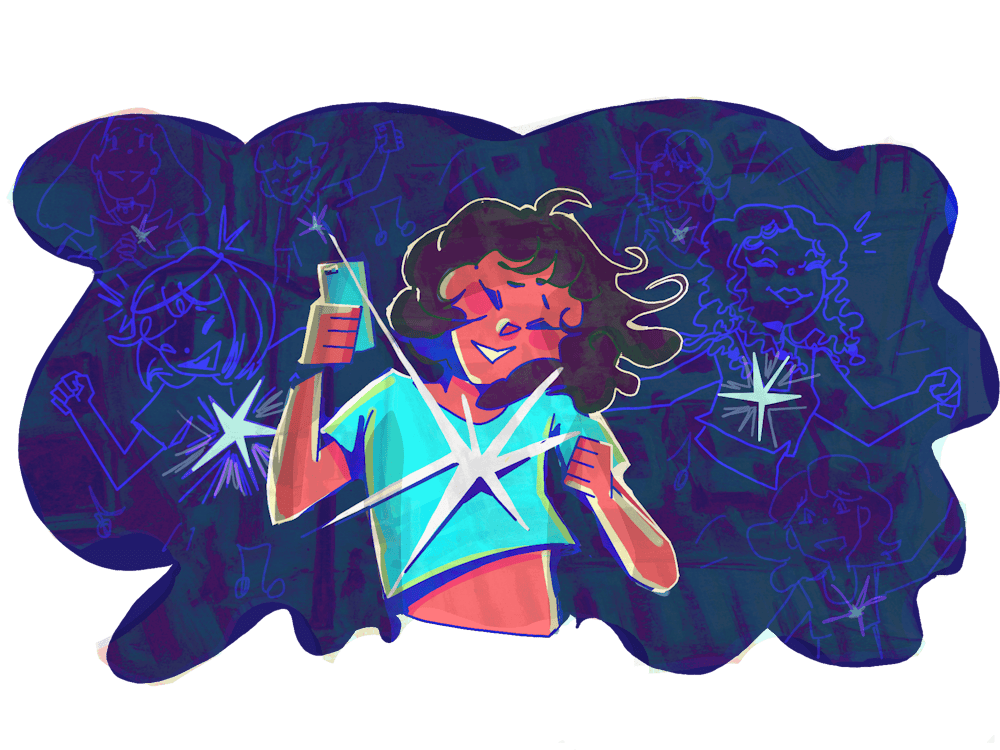
It is September 2025, and I am having a spiritual experience at TD Garden of all places. Almost 20,000 people surround me, jumping up and down, screaming, “In your car, the radio up / In your car, the radio up.” I feel beads of sweat form on my face, and I’m probably bumping into the person next to me, but it doesn’t matter. Everyone in the arena is experiencing the thrill of live music, and we are all bonded by it. I can feel the music healing my inner teenage self, who listened to these songs incessantly and longed to hear them live.
About a week prior, I impulsively decided to purchase a ticket to Lorde’s Ultrasound World Tour, knowing that I would regret passing up the chance to hear my favorite songs in person. None of my friends wanted to go, so I faced my fear of Doing Big Things Alone and braved the journey to Boston. I didn’t know what to expect from a solo concert experience. I thought it would be weird not having a friend or sister by my side, especially when everyone around me would likely be in couples or groups.
Upon arriving at the venue, a faint sense of insecurity fills me, knowing that in a crowd of thousands, I am completely alone. Around me, groups of friends buzz with anticipation, and I feel slightly disappointed that my own excitement can’t be shared. The moment the lights go down, however, I’m reminded that I am not alone, but instead connected to every single person in the room, because everyone is here for the same reason that I am. For each audience member, the music carries different meanings, yet we are all touched by the same words, and we all come together because of it.
Throughout my teen years, I found my music taste constantly changing, moving through phases that often directly correlated to whatever dramatic emotion I felt or persona I wanted to adopt. There were some artists, however, that stuck to my brain like glue, becoming ever-present in my rotation and subsequently, my Spotify Wrapped. Lorde has been one of those artists for me, her music a golden thread in the fabric of my adolescence. I recall being in my freshman year of high school, trapped in my room as the world shut down around me, listening to “Ribs” and reminiscing on pre-quarantine life. In her debut album, Pure Heroine, Lorde chronicles what it feels like to be a teenager, an experience marked equally by angst and bliss. Many songs on the album, such as the record-breaking hit “Royals,” critique society’s consumption-based culture and obsession with social status. My favorite song on the album, and possibly of all time, is “400 Lux” (I was severely devastated that it was not played at her show). It captures the sentiments of my suburban youth to such a startling degree that I almost can’t help but feel like Lorde wrote it just for me. The song sounds like driving around my cookie-cutter suburb, feeling a sense of both displacement and comfort, especially when the chorus comes on: “(And I like you) / I love these roads where the houses don’t change / (And I like you) / Where we can talk like there’s something to say.” These lyrics spoke to me as a teenager, when I was bored with the mundanity of my hometown but also incredibly scared to leave behind late-night drives, lunch dates, and spontaneous outings with my best friends.
Much of my youth was marked by fear: fear of the future, fear of the unknown, fear of doing things without the comfort of my family or close friends by my side. In the years leading up to college, I became increasingly anxious about my future, unsure of what moving away from home would be like. During those anxious times, I grounded myself by listening to Lorde’s music, finding comfort in her portrayal of teenagehood. In “A World Alone,” the final track on Pure Heroine, she sings, “I know we’re not everlasting / We’re a train wreck waiting to happen.” Feeling a lack of permanence in the world around me, I held onto these words. I listened closely to the unintelligible chatter in the background of the verses, thinking of the background noise in basement parties filled with people I would likely never see again after high school. Whereas it seemed like everyone around me was excited to begin new lives in college, I felt like “a train wreck waiting to happen.” But then again, so did Lorde, so I guess I wasn’t really alone.
The show is almost ending, and she’s about to play “Ribs.” Having seen the setlist from her previous shows, I know that it will be the last song, so I soak in the moment before its inevitable conclusion. My feet ache in my platform Doc Martens, and my bangs stick to my forehead, slick with sweat, but I could easily stand all night if it means hearing more. The crowd awaits the dreamy opening of the song, but what comes instead is unexpected. I hear the girl next to me scream into her friend’s ear, She’s playing “A World Alone!” As the nostalgic chords begin to play, I am transported back to high school. The crowd is sent into a frenzy, and when it’s time for the chorus, thousands of voices sing, “You’re my best friend, and we’re dancing in a world alone / World alone, we’re all alone.” Everyone is moving, jumping, pulsating like a heartbeat. It’s exhilarating. I’m usually self-conscious of dancing like this, all too aware of how others perceive me, especially when I’m alone in a crowd. But in this moment, it’s hard to care.
During my first two years at college, I continued to struggle with fear—this time on an even larger scale. After the novelty of freshman year wore off, the vastness of post-graduate life became a source of anxiety. The summer of my nineteenth birthday, I played “Perfect Places” from Melodrama on repeat, always turning the volume up for the lyric, “I’m nineteen and I’m on fire.” Being able to relate to that line felt exciting, like being accepted into a secret society. My nineteenth year was a particularly difficult one, but at least Melodrama was there, providing an immersive synth-pop soundtrack to my own personal melodramas. As I approach the end of my junior year, Lorde’s albums continue to provide solace in times of uncertainty. I look to Solar Power, her third (and in my opinion, most underrated) album, to reassure me that the turbulence of my early 20s will eventually pass. In “Secrets from a Girl (Who’s Seen it All),” she says, “All your dreams and inner vision / All your mystical ambitions, they won’t let you down.” The song reminds me that one day I will look back on this period of my life with greater wisdom and view my 20-year-old self with a particular fondness I don’t quite possess yet. In Virgin, her most recent album and the center of her Ultrasound World Tour, Lorde reflects on relationships of all kinds. In her song “Shapeshifter,” she discusses the different roles she has taken on in her life and the ways she has changed herself in order to feel loved. At times, this is what growing up feels like for me: attempting to “try on” different identities in order to fit in. In the chorus, she sings, “I’ve been the siren, been the saint / I’ve been the fruit that leaves a stain / I’ve been up on the pedestal / But tonight I just wanna fall.” It is a strange feeling to be a shapeshifter, constantly adapting in order to play a certain part. With “Shapeshifter,” Lorde emphasizes the importance of letting go, breaking the mold you create for yourself, and letting yourself fall.
The words of “Ribs,” the final track of the setlist, fade out, and confetti rains down. The lights come on, the veil of darkness lifts. The disjointed piano of LCD Soundsystem’s “All My Friends” spills from the speakers. I look around and feel an overwhelming sense of accomplishment, knowing that there was a time when fear would have stopped me from Doing Big Things Alone. On the train ride home, my phone dies, and I am left completely alone. Instead of being scared, I feel free, and the words of “Shapeshifter” ring in my head, “Tonight I just wanna fall.”


