
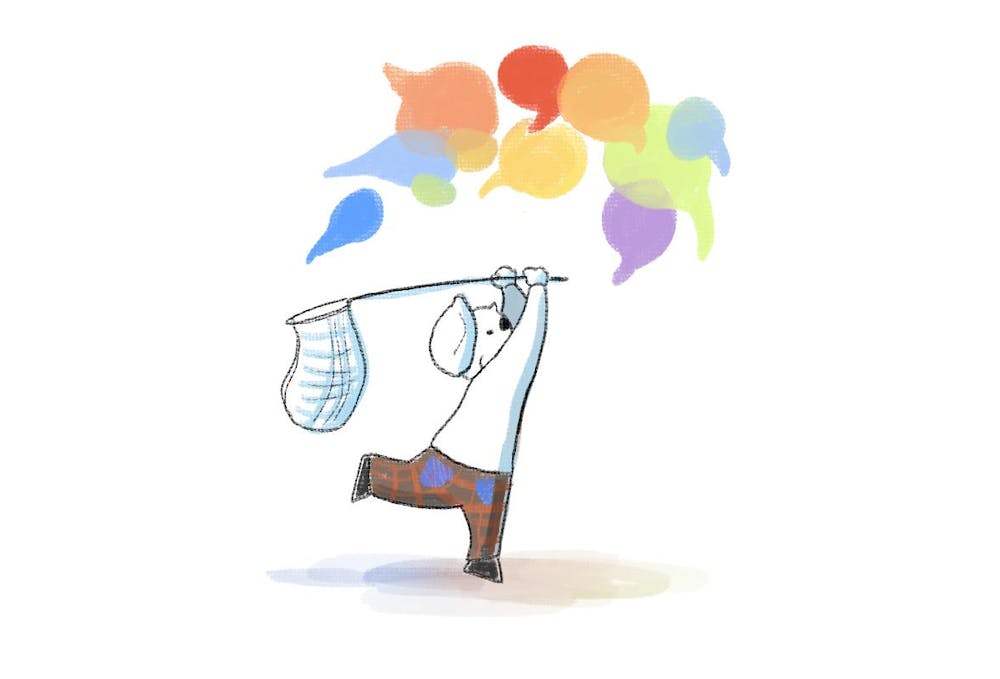
Renata Litvinova, a famous Russian actress, once called gossip an underrated genre. The novelty of this saying isn’t just about playing devil’s advocate for talking behind people’s backs—it’s also about considering a seamless act of everyday communication as a distinct medium. Categorizing cultural artifacts is a game humans love to play, but how do we know when a thing becomes important enough to be singled out as a genre?
A great definition of genre is given by James Martin, a founder of the Sydney School of writing pedagogy—which makes a lot of sense, since genre is the central concept of his theory and requires proper framing. He defines genre as “a staged, goal-oriented, purposeful activity in which speakers engage as members of our culture.” This way, genre is not only a conglomerate of items with similar traits, but a corpus influenced by a social dimension and having a pragmatic purpose.
A phenomenon that fits this definition perfectly is advice. It might sound confusing; it’s rather unusual to zoom into advice as an independent entity. That’s what prompted my fascination: Like a stitch by an experienced surgeon, advice is elegant, productive, and discreet.
Advice is not a call to action, yet it’s not just an opinion either. Neither passive nor active, it escapes a uniform definition. What is the dosage we give advice in, and who is qualified to do it? If advice is so helpful, why “take it with a grain of salt?” And, after all, if we are so generous and empathetic, why only give a “piece” of advice, and not all the wisdom in our possession?
Advice is psychologically nuanced, inasmuch as its architecture involves benefitting both the other person and yourself in varying degrees. By seeking advice, a person admits a certain level of vulnerability; by giving advice, their companion either gains a reputation of being sage and trustworthy, or recommends themself as an insensitive jerk. There is, of course, an alternative scenario, in which you deliberately give bad advice and pray for your friend’s downfall. In this situation, I would recommend taking a Dark Triad Personality Test and looking out for Machiavellianism in your results.
How does one find out if they are good at giving advice? I’ve heard people call it a personality trait, though I wonder if that’s just empathy and the benefit of a second opinion in disguise. Still, why does an outsider’s perspective appear beneficial? It would seem logical for our own judgement to lead us the right way, and yet we ask our friends if a class is worth taking or if we should text our ex.
Sometimes it’s not just people we know who we ask. Advice columns emerged as early as the 17th century, and now we’ve evolved as far as to invent Reddit, Quora, and Dear Indy. If advice is coming from someone who you’ve never met, if you are an addressee by chance, how can this guidance be of use? What makes you trust @ladybug123 in the Reddit comments when deciding whether to quit a toxic marriage? And how is the author of a prestigious advice column wiser than @ladybug123?
I am very promiscuous and non-selective when seeking advice. I enjoy gaining an absurdly wide range of perspectives, be it on topics rather mysterious to me—say, financial literacy—or on things that I am knowledgeable about—like evidently, spending all the money I have. I also come from a culture heavily based on proverbs, and not just “The early bird catches the worm”-level. It’s more of, “If you sit on the corner of the table, you will never get married,” “An old friend is better than two new ones,” and “If words are silver, silence is gold.” I feel like this tradition of folk wisdom has taught me to always seek advice, but not to always follow it—as if determining the magnitude of the angle at which I will deviate from the collective unconsciousness. (For instance, rebelliously making two new friends even if I already have one.)
This brings me to the topic of bad advice. I consider it another concept defined through relativity rather than objective and ubiquitous clues. We could call advice bad if it’s unsolicited and invasive; this type of bad advice imposes a power play, where you are forced to feel inexperienced and foolish even if you are not actually in need of guidance. Another type of bad advice is didacticism, in the sense that it inflicts a moral lesson with a purpose of re-educating and instructing. While important for religious texts, didacticism in everyday life feels suffocating and moldy. In writing, it often appears when the author assumes their audience to be stupid and feels the need to explicitly state something like: “And that’s why you shouldn’t steal money from your mom’s wallet. Trust is like a glass vase; once broken, it’s never fully repaired again.” We get it!
In Siddhartha, Hermann Hesse writes: “Wisdom that a wise man attempts to impart always sounds like foolishness to someone else...Knowledge can be communicated, but not wisdom. One can find it, live it, do wonders through it, but one cannot communicate and teach it.” That makes me think: If advice from others doesn’t work, can we give it to ourselves? It seems like no. There appears to be a dimension to advice that implies the need for externality, a mismatch in lived experience in order for advice to prompt a reaction. While wisdom itself might be intransmissible, advice has the power to challenge us and make us reason by contradiction.
Another reason for seeking advice might be the desire to maximise our efficiency. The philosopher Anne Dufourmantelle calls our world “a century ahead of time.” If we go to a restaurant and don’t check the reviews, we might not order the most delicious item; we might miss out on the signature kombucha, or—even worse—get their extra spicy soup and not like it; that’s why it’s important to do the research in advance. Dufourmantelle defines risk as a modern luxury, an act of madness in a time when it is essential to plan two steps ahead. Advice, especially from trusted sources, ensures—or creates an illusion of— the ability to avoid the mistakes other people have made. It’s a promise of certainty and security. However, even if it won't maximize pleasure or protect us from disappointments, sometimes embracing the momentum and letting it carry you might open up a whole new “unsuspected reserve of freedom.”
Am I being didactic? No matter how strongly I advocate for authenticity, there is a bewitching thing about advice. It offers us an opportunity for solidarity and vulnerability, capable of bridging time and differences in lived experiences. People read Marcus Aurelius’ Meditations and decide to quit scrolling reels; they listen to David Lynch’s interviews and start meditating; they ask each other for movie recommendations and later share their reactions. Perhaps that’s the reason we say, “Do not take criticism from someone you wouldn’t take advice from,” because considering someone’s advice is an indicator of being on the same wavelength. The best advice I’ve received always depended on two conditions: the inspiring expertise of my companion and a moment of our outlooks blending—perhaps briefly, but enough to reach an understanding, rewiring my perception.
Perhaps this universal craving for advice is truly a search for one’s identity. By resonating with the opinions of some people and disagreeing with others, we might be trying to understand what our true self wants to happen. That might be the reason people recommend flipping a coin and then seeing whether you are satisfied with the outcome; here is your answer. It’s peculiar how we need an external force to reunite with our desires and beliefs, as if we are not their only source and storage. As the writer Robert Glück said, “Students want to find their voice. It’d be like finding your left arm.” Similarly, as the musician Miles Davis said, “Do not fear mistakes. There are none.” And as I said just now, it all comes down to whether you take their advice or come up with your own.


