
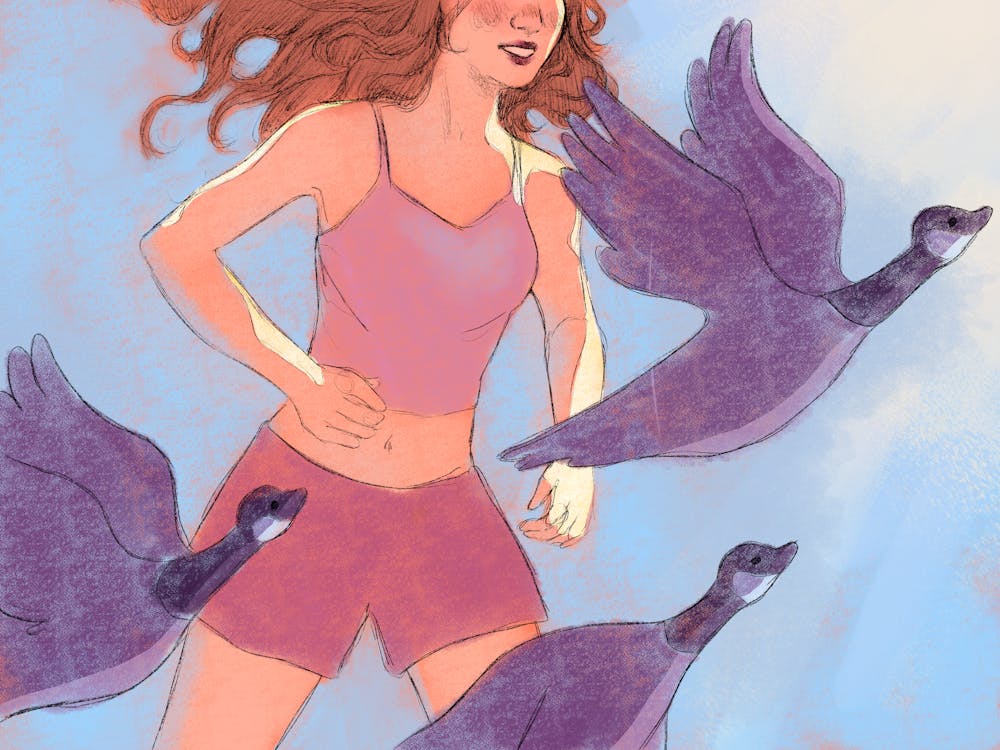
“Shorten your stride.” The phrase rings in my ears. There’s a metallic taste in my mouth. I swear I can feel each indent of the track on my heels as they pound. Thump. Huff. Thump. A rhythm I know all too well. My arms loosen from fatigue. I rein them in the second they fall out of line. Long-distance running isn’t supposed to feel like flying. It’s supposed to feel like grounding.
My lungs and slow-twitch muscle fibers in the legs must remain perfectly calibrated for the maximized stamina and energy conservation required to last two miles at threshold speed. There is an art to the training program: You must hone a hyperawareness of the earth beneath your feet and register the distance between each strike against the ground. Every stride is painstakingly manufactured; every lap a tally; every breath controlled…
Long-distance running is fiercely individual. You don’t run in a V-formation, ensuring every team member keeps up. You fight for a spot at the front of the pack. And if you fall out of line, the only thing you have to answer to is the lonely wind mocking your unkept promise: Win. Long-distance running is not a team sport.
Neither is restriction.
I used to have a knack for doing what was “good” for me. I’d bypass sugar at birthday parties and wake up before my daily 6:15 alarm for extra training: three miles before the sun came up. I’d write past the page limit just to prove something; I skipped Junior Prom for the SAT. My schedule was optimized for maximum efficiency, on and off the track. If my body were a temple, then I would be its most devout worshipper and its most unforgiving keeper. No softness. No indulgence. No falling out of line. No staying in one place for too long. I was constantly on the run.
“You do not have to be good.
You do not have to walk on your knees
For a hundred miles through the desert, repenting.”
Elite runners will venture into desert-like conditions or even mountain peaks to strain the body toward its limit and raise VO2 max. If you can run at ninety percent oxygen saturation, sea level begins to feel merciful. This type of training can get you from good to great, because endurance running rewards these quiet punishments against the body.
Nature, on the other hand, does not.
Geese can migrate four to six hundred miles in a single day. But they don’t do it alone, and they don’t do it without breaks. They are known for their signature V-formation—a group flight technique capable of cutting individual energy expenditure by seventy percent. Aerodynamics place the burden primarily on the front bird, who is replaced periodically to prevent exhaustion. The journey can take several weeks, but the slow pacing turns the effort into ease. They work with the wind to stay afloat, instead of cursing its resistance. The wind is part of the team.
One day, my body betrayed me. I let my alarm ring out at 6:15 and, in silent rebellion, hit snooze. There’d be no time for a run that day. I don’t exactly know why I made that decision. Perhaps it was my impending shin splints, or the five college rejections I’d received the week before, or the inevitable burnout from my performance of the girl who always did. Maybe it was all of those things. I expected guilt to flood in when I woke up with the sun. Yet, I didn’t feel a thing—only the subtle euphoria of lungs filled with air and eyes well rested; the quiet admittance of a streak broken and a choice made. Free will. My day’s hiatus stretched into months…
“You only have to let the soft animal of your body
love what it loves.”
What if the animal inside of you isn’t soft? What if it hisses and charges? What if it takes the wrong course? What if it’s not the best?
Maybe that’s the point.
Geese are awkward little creatures: necks too long for their bodies, protruding beaks, and gazes that make them appear perpetually confused. Their chests jut out in false bravado—an attempt to seem macho—but their stumpy, webbed feet give them away. They’re feisty, too, with a hiss loud enough to frighten even the keenest outdoorsperson, and a fierce instinct to protect their young at all costs without a shred of remorse. Careful, or they will charge. Don’t worry, though, it’s all a posture.
Geese are also strictly communal. They are among the few monogamous species in the animal kingdom, selecting partners around age two or three and remaining with them throughout their lifespan as if they made the vow, “until death do us part.” When landbound, they walk in a gaggle, and during flights, they travel in a skein. They mourn lost family members and stay with the injured until they recuperate and the skein can take flight again.
Homo sapiens are the mammal most finely tuned for endurance running. We do not flee when the seasons harden; we remain. We stay through the winter. We strike fire against the cold. We don’t leave. We run together to lighten the weight each of us carries.
Homo sapiens aren’t a perfect species. We can be absolutely vicious, vile, and cruel. We can cheat, lie, and hiss. But we also cry. We hurt and get hurt. We sweat. We sleep. Adult humans stay with their young, nurturing them into adulthood. We rely on each other to survive. We don’t migrate for the winter. We stay home, together, in these little units we call families, or with strangers we’ve brought in because of something we call love.
“Tell me about despair, yours, and I will tell you mine.
Meanwhile the world goes on.
Meanwhile the sun and the clear pebbles of the rain
are moving across the landscapes,
over the prairies and the deep trees,
the mountains and the rivers.
Meanwhile the wild geese, high in the clean blue air,
are heading home again.
Whoever you are, no matter how lonely,
the world offers itself to your imagination,
calls to you like the wild geese, harsh and exciting—
over and over announcing your place
in the family of things.”
We are not an airbound species. Yet, we find ways to fly.
It had been months since my last run. I’d moved past that era in my life, sworn off the early mornings and the aching quadriceps and the insatiable hunger. I was trying, desperately, to let slowness satisfy and to avoid mourning the what-ifs of the running career I’d willingly abandoned. A part of me missed the feeling of crossing the threshold of my house after a long run, face flushed and shoes adorned with a muddy film. There’s no feeling quite like heading home.
My first run back was with you. We raced through the streets of New York City in the middle of the night, way past my bedtime. It was probably reckless—the kind of dumb, beautiful decision you make when you’re young and feel invincible, like the world’s tailwind is propelling you forward. I ran just behind you, slightly off your shoulder. You cut the wind without even trying. My stride lengthened. My feet barely touched the pavement. For the first time in a long time, running didn’t feel like something to endure. It felt like flying. I wasn’t running to win. Splits and records and stride lengths didn’t even cross my mind. I was running to stay.
Can a person be a home?


