It was Toni Morrison who said, “Don’t write about what you know, because you don’t know anything. I don’t want to hear about your boyfriend or your grandma…I’m getting a little tired of ‘my life story as fiction.’ Please don’t tell me about your little life—is there nothing larger? More important?”
I distinctly remember that literary arts class at Brown, where my piece was being workshopped by other students and the professor. At the end of the discussion, someone asked, “By the way, how much of it is true?” I excitedly exclaimed, “All of it!” for one of my peers to cautiously clarify, “So is this…autofiction?”
Autofiction is a term used to describe texts that are rooted in or depict the author’s life, yet are categorized as works of fiction. I’ve been interested in debates and controversies around it, and, as you’ve just read, even took part in one. I felt like a criminal. Like a magician whose trick was not only unfunny but also transparent. Like a fraud! I had completely forgotten that autofiction was a scapegoat for literary critics, prompting a new set of guidelines for approaching and judging its artistic value.
The reason behind this body of criticism revolves around the cunning nature of fictionalizing one’s life. Some people consider it “cheating,” as if they are on the universal ethics committee along with Peter the Apostle. Look, they didn’t come up with a plot! It’s against the rules!
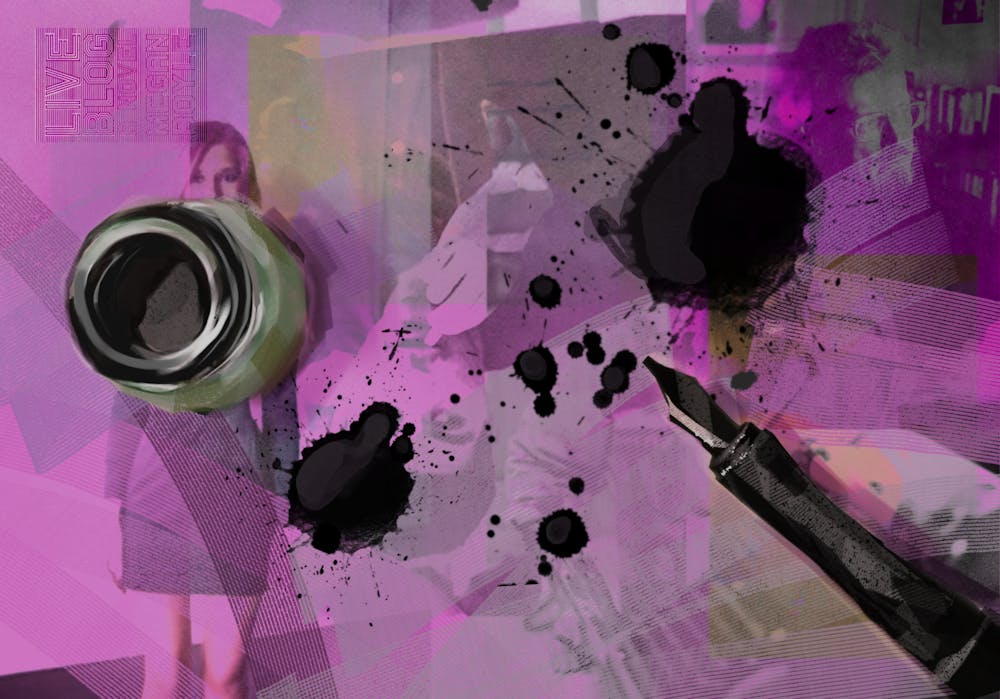
What I love about autofiction is the lengths to which some authors would go to annoy those snobs and challenge genre conventions. One of my favorite examples is Megan Boyle’s LIVEBLOG, an online experiment that was later developed into a book. In the disclaimer, she states that LIVEBLOG will not serve as entertainment, nor will it be an attempt to be likeable to the readers. Boyle’s depiction of her own life includes thorough tracking of her food intake, dosage of drugs and medications, retrospective and retroactive narratives. There is no buildup, no Freytag's Pyramid—just distilled life with its major and minor rough edges. “woke. drank leftover dunkin donuts coffee and ate maybe 5mg adderall.” Boyle plays with the idea of surprise—would a book still be of any interest if none of it were fantasy? Would we get tired of her life, and, as a consequence, of her writing?
When asked whether her book is a novel, Boyle said, “It is a novel in the sense that I made a story by seeking out narrative elements in my life and linking them together. Whether that’s based on ‘true facts’ is kind of irrelevant, because I think truth is in both nonfiction and fiction.” Boyle’s response touches on how the value of autofiction is often being reduced to its “historical accuracy,” which shifts the focus from the immersion in artistic delivery to fault-finding fact-checking.
Another captivating piece in the genre of autofiction is written by Eduard Limonov. An established Russian poet and, as it often coincides, an established opponent of the system, he had to leave Russia and move to New York, where he wrote It’s Me, Eddie. It’s a novel about a Russian émigré whose strikingly beautiful wife left him and whose country became impossible to stay in. So, he has to make a living working whichever job he finds, nostalgically reminiscing of the fame he had back home and cynically despising his fellow compatriots: “When you yourself are in a lousy fucking situation, you don't much feel like having unfortunate friends and acquaintances. And almost all Russians bear the imprint of misfortune.” His all-encompassing distress is exacerbated, or even primarily shaped, by the heartache from the absence of his wife. “I loved her, this pale, gaunt, small-breasted creature in her whorish scrap of panties, who had donned my socks to sleep in. I was ready to cut off my own head, my own unhappy refined noggin, and throw myself face down before her. For what? She was a sleaze, a pig, an egoist, a stinker, an animal, but I loved her, and this love was higher than my consciousness.” This passage leaves a controversial impression; on the one hand, it depicts the intensity and paradox of the protagonist's feelings; on the other hand, it is quite explicitly based on a real person—Elena, Limonov’s real-life wife. We, as readers, feel like intruders, and yet, no offense to Elena, we are captivated by the narration. In reality, Elena’s love story with Limonov was similarly turbulent and acidic, full of passion, rivalry, and, eventually, disillusionment and pride. She even wrote her own book, It’s Me, Elena, five years after Limonov’s novel came out. Ironically, she denied any intention of homage to the original title, blaming it on the publisher.
It’s normal for autofiction to leave the degree of authenticity unclear. But the reason I consider It’s Me, Eddie to be a fascinating case is that here, the reasons behind the ambiguity deviate from the typical ones. Limonov isn’t trying to seem mysterious—“MFA-y,” as Megan Boyle would say—or, at least, not just that. His protagonist is provocative and blunt; he willingly provides us with the most graphic details, such as his experience having oral sex with a man. Limonov denied the connection between himself and the character; however, what else could he claim, knowing that any identification between them would all be used against him, should he visit the USSR? Not only has there already been a perception of a “hidden insult” to the Soviet Union in the book, it also contained episodes that would be considered pornographic and even illegal by the Soviet standards. In a 2005 interview with a stuffy sexologist on a sketchy Russian website, there was a comment on Limonov’s book: “No matter how much you show off, you can’t hide your true sexual orientation. Limonov is clearly bisexual. When I read the novel It’s Me, Eddie, I understood everything right away…Only someone who enjoyed it—someone who had engaged in oral sex with men on more than one occasion—could describe the whole thing that way.” In other words, even though I wouldn’t attest to a complete similarity, Limonov was right to be cautious with drawing parallels between him and the protagonist, which to me appears largely a safety consideration. Bisexual or not, it was none of anyone's business.
The elegance of Limonov’s autofiction lies in the implication of truth, in the desperation of his confession. Is it a confession of a liar, a trickster? We’ll never know; there is enough evidence to support both positions. I tend to trust his narration; if he wanted to destroy or humiliate his ex-wife, he certainly didn’t have to expose the heart-wrenching pain he was in because of their separation, the extent to which he only wanted to be with her and no one else. If anyone, he is the one being unapologetically and harshly humiliated. He bitterly, thoroughly explores the inner lining of the pathetic, unfulfilling life in poverty and marginalization, the disgusting details of his intimate affairs, even going so far as to confess to masturbating to Elena’s shadow—“I wept, but what else could I do? I wept and came, and my cum splashed onto my already tanned stomach.” What autofiction grants the readers here is the discomfort, even shame, of peeking into the personal life of The Writer, Eduard Limonov, whom we learned to respect, and here he is in front of us, abandoned by his wife, sobbing and masturbating to the memory of her, loving her paradoxically and tragically, angrily and uncompromisingly. It’s almost as if autofiction adds another dimension to the protagonist, making him more layered and somewhat polarizing in his ambiguity.
Another writer blatantly exposing himself was Sergey Dovlatov. He had an alcohol addiction, which he wasn’t just open about—he sincerely elaborated on it and its destructive consequences for his health and personal life, as if reveling in his own suffering. For instance, in his novel Pushkin Hills, he describes an intense eleven-day bender (a binge drinking phenomenon for which Russians have a convenient untranslatable word zapoy). The bender happens because his wife and daughter leave the USSR and emigrate to the U.S.—a decision he couldn’t support. Boris, the protagonist, says: “But my readers are here. And over there...Who in the city of Chicago needs my short stories?” At this point, we understand that it’s not just Boris who’s afraid—so is Dovlatov.
Eventually, Sergey Dovlatov had to leave the USSR. He reunited with his family in New York. “I left to become a writer, and I did—after making a simple choice between prison and New York. The sole purpose of my emigration was creative freedom.” The U.S. welcomed Dovlatov warmly: He was published in the Partisan Review and the New Yorker, a success which, among Russian writers, was previously known only to Nabokov. He was, however, profoundly depressed: He couldn’t continue writing only about exile and immigration, nor could he come to terms with living in the U.S. and start working on something thematically different. Dovlatov continued to drink heavily and died of heart failure at the age of forty-nine.
In Dovlatov’s case, autofiction is the actual source behind my strong love for him and his prose. It’s the presumption of honesty and trust that he establishes with his readers, a certain request for non-judgementalness, in exchange for which he shares his wonderful stories. Despite all the hardships of Dovlatov’s life, he had an exceptional, absolutely elite sense of humour, essential for his style. I don’t mind that Dovlatov wrote about himself. On the contrary, I wish he wrote more. I would have read it all.
Another bold example of autofiction is Theodor Adorno’s Dream Notes, which is essentially a collection of his dreams, published with an emphasis on an almost complete absence of editing. Personally, being acquainted with the psychoanalytic approaches to dream interpretation, I would be absolutely terrified to share even a tiny excerpt from my dreams, and I’m certainly a less significant figure than Adorno (for now). However, it’s important to mention that most of those dreams were published posthumously, which probably made the whole affair less anxiety-inducing for Adorno (he was dead and didn’t care about Irma’s objection anymore). Raw notions of those oneiric experiences are not just autofiction; they are a priceless glimpse into his psyche that no biography could offer. The fictional narratives of dreamwork only appear distant and chaotic—one could disregard them as nonsense, or even a simple byproduct of sleep. However, by taking a closer look, dreams can reveal insightful wishes, ruminations, and neuroses. This glimpse into the author’s mind is amplified by the first-person perspective, which makes the dreams diaries an entrancing form of autofiction.
Toni told us not to write about what we know, but what can we write about, if not our own life? I think writing is inevitably author-centric. In his 2003 interview, David Foster Wallace said that one of the things he likes about being a writer is that, “I get to use pretty much everything I’ve ever learned or think about.” Moreover, the inescapable “author-centricity” arises from the ties our cognition creates and the way it does so. When writing, one might not realize where the images come from, yet their source is either direct exposure to such experiences or indirect processing and speculation derived from some inspiring activity. Freud used a similar technique, one of associations, to psychoanalyze his patients, with a preface, “We must, however, bear in mind that free association is not really free.” By that, he implied that even the most surprising and nonsensical interrelations are actually highly meaningful and even revelatory. Similarly, when writing fiction, it seems to me that no idea, no character is accidental; they are all inextricable derivatives from the writer’s experience. That’s why it doesn’t matter whether we are reading “classic” or autobiographical prose; in this way, all fiction is autofiction.
This is where the aspect of vulnerability emerges. If fiction isn’t always about the author, either fully or tangentially, why do we feel exposed when showing it to the people who know us best? Sure, a manuscript with the protagonist sharing your name and their friends much resembling yours is a more stressful affair than a fairytale about a small girl no bigger than a thumb or a porcelain rabbit (because humans weirdly care about how you describe them and tend to get upset if you don’t sugarcoat their antics, ugh). Yet a caring, careful reader, say, your childhood friend, would notice the traces of the toys you owned in the characters, the jokes you overheard on the subway in their replicas, and even that candy you like in a hypothetical magical snack. The imaginary dimension wouldn’t protect you from being known and dissected.
Such is my case in defense of autofiction. To me, the value of authentic first-person narration overshadows the concerns around genre conventions posed by lunatics with a polygraph and a code of conduct outside the autofiction writer’s door. As long as the fiction is tastefully written, compelling, and evokes empathy, curiosity, disgust, or any other reaction on my part, I’m there to read it and form my own opinion.
By the way, as I was writing this article, I encountered a new relevant quote. “Write what you know,” Mark Twain told us. See? Writing is easy. Just write what you know, but also don’t write about it because you know nothing. Hope this helps!


