When a poet meets their hero, they are left frank and unpoetic. I had rehearsed every moment, every word, every gesture for years. I promised my poise would be practiced to perfection. I would impress her with my words, speak naturally in metaphor and alliteration— prove that I was a poet in practice and in habit. I wanted her to be proud of who I had become without knowing who I was before. Yet, the saying goes: Never meet your heroes. Because once I saw the doors of Symposium Books swing open, words spawned uncontrollably from my frontal lobe, racing to slip off my tongue and ravaging my brain with raw excitement. The moment I had dreamed of for years was falling apart: In the middle of the bookstore, I stood in front of Sarah Kay, hand clasped over my mouth, and breathed, “You’re the reason I do this in the first place.”
Ten years ago, @DreadHeadFinay posted a YouTube video of 18-year-old Sarah Kay performing her poem, “Hands.” The ends of her hair are bleached with teenage curiosity, and young adrenaline pushes her on her toes with every crescendo of a line. Every wave of a hand is precise, every joke received with chuckled laughter. The comments section is a yearbook of passing students who give a moment to point out that they have all been assigned this video. I silently remember sitting in my middle school classroom, watching Sarah Kay perform, learning about poetry for the first time.
Sarah Kay is the root of my poetry fanaticism. Since this discovery, I have spiraled through performances of Franny Choi, Emily Jungmin Yoon, Ocean Vuong, and Rudy Francisco. I have scribbled responses in the margins of Date & Time and The World Keeps Ending, and The World Goes On. I have watched every Button Poetry video, every Brave New Voices performance posted online. I have listened to Sarah Kay and Phil Kaye explain how they met for the first time in orientation week at Brown University, so much so that I now find myself enrolled at Brown.
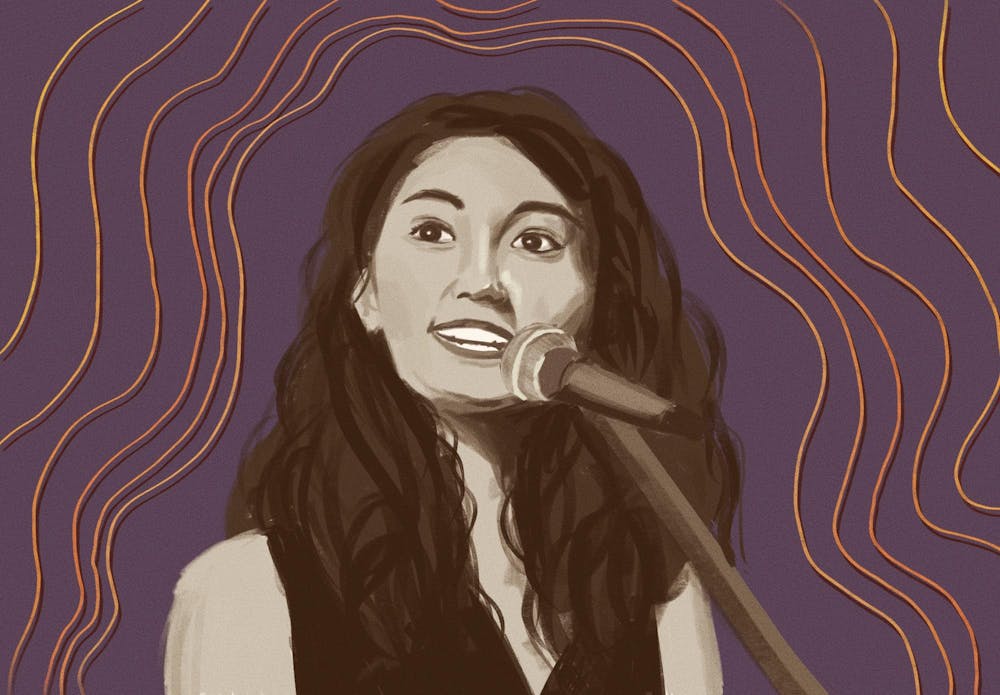
Now, Sarah Kay is two books older, and I am the age she was in that video. Two weeks ago, she visited Providence while on tour for her new book, A Little Daylight Left. While I have met her in every poem I have read and written, she met me for the first time as her student volunteer. I stood there, swallowing my awe behind a mask of futile nonchalance, as she smiled at my immature adulthood. I hope she does not remember me. Instead, I hope she remembers the factory line of books and shuffling of pages and blue post-it notes I handed out for people to write their names on. I hope she remembers calling out a name she can’t grasp. I hope I remain a blurred memory, another vague emotion. This is how I return my gratitude for her.
A Little Daylight Left is Sarah Kay’s second full-length poetry collection, published 10 years after her first book, No Matter the Wreckage. Time is not linear within these pages. Each transition between poems is a couple of years’ worth, a jump or a loop-de-loop backward, or a leapfrog into the next. There is a decade’s worth of Sarah Kay amalgamated into 42 poems, and on every page, her evolution is evident.
Sarah Kay converses in poetry. As she melted into her first poem, “Rare,” I felt the rumble of a circle closing and a 13-year-old girl let go of my hand. Beside me, I saw the chronically shy, middle school Jamie catching every word with a smile, gold dripping from her eyes. Spoken word poetry is modern storytelling, an inheritance of experiences buried in metaphor. Humor in our everyday tragedies. A collection of small appreciations that reveal the mundane quirks of our lives. Tiny kitchens and the color orange and jello cups and waking up in a cold sweat.
Perhaps these lists are also special to Kay. In her poems “Raccoon,” “Jakarta, January,” and “New Year’s Eve,” Kay values the repetition of the shortened “&.” A collection of observations, her words are an index finger pointing to different corners of a painting. The simplicity of a list and the familiarity of its rhythm are poetic in their own digestion. Meanwhile, “Orange” and “The Minister of Loneliness” are stories to be shared—loaves to be split, tendons of wheat steaming as they stretch tender.
I read poems to remind myself where I am. From “Hands” to “Repetition” to “Hangul Abecedarian,” I find certain poems connected with red string to certain stages of my life. I’m not sure if the heroes are the poems or the poets themselves, but I’m grateful to be able to thank both. Now, despite the whirlwind of the world, I somehow find myself having landed on two feet with a pencil in my hand. So, “No, I don’t think poems will save us. And yet, and yet...”


