
After yet another late arrival, I wrote this in my notebook:
I never quite stride with the length, speed, and ease I hope for when I’m in a rush. Hurrying means swinging my legs like they’re a pair of logs. In rebuke, sweat collects above my upper lip, in my armpits, on the soles of my feet. My calves whine against the effort: You’re too apathetic to push me like this, out of the blue!
There’s no time to listen to them, of course. Only time enough to swerve and sidestep the pedestrians congesting my walking route. Everyone’s so aloof! Is no one but me due somewhere—nearly overdue? Does anyone have anything to do but clog my shortcuts and muffle my footsteps with their headphones and chatter?
I lifted my pen and nearly smiled. Even as I griped, I had to admit: There’s something irresistible about tussling with time.
I
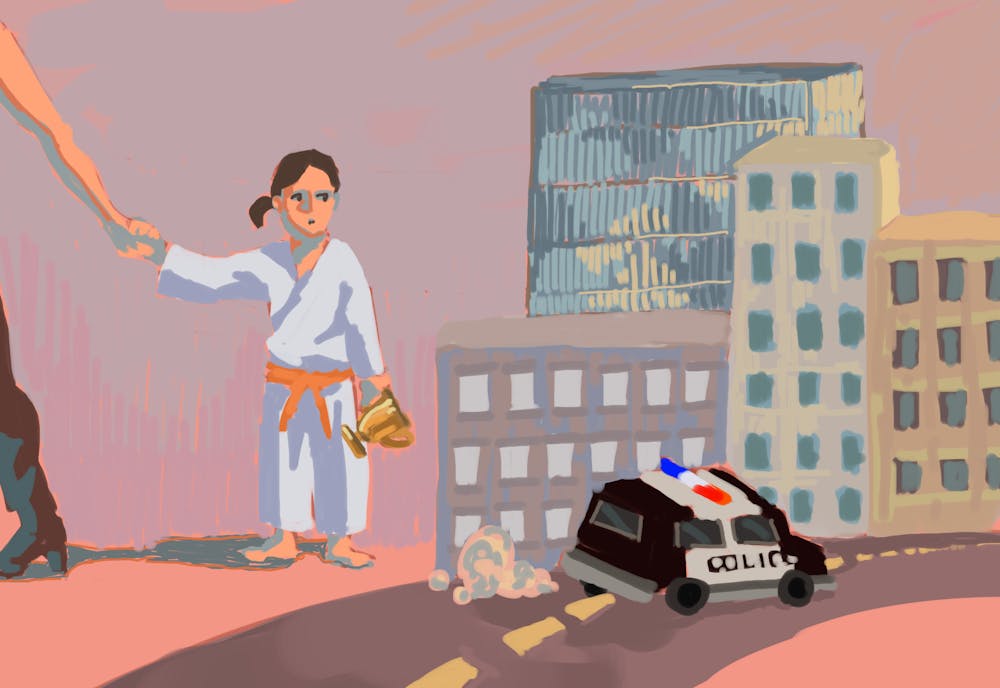
When I was seven and my sister Abi was ten, we were late to a karate tournament. We wanted to win trophies. Meanwhile, Los Angeles traffic, the things that weren’t in my mother’s purse but needed to be, and the clock’s proclivity for forward movement came together in perfect harmony. My father stepped on the gas and my mother hissed, “Oh Daniel, Daniel…”
In the back of the car, Abi and I fixed our focus on executing Carmographs, our very own highly scientific graphical system for transcribing everything there was to know about a car ride. We each dangled our pens over a page. The only forces allowed to move the pen were the car’s acceleration and judders. My Carmograph spiderwebbed across the paper; I also stole a glance at Abi’s, whose lines were more congested.
“Fuck!” (on the rare occasions my father said the F-word, it burst out like a gunshot); sirens caterwauled; our backs thumped against the seats that had scooted forward to meet us.
A big vested torso blacked out the window. The policeman’s knuckle came forward and rapped on the glass. My father inhaled and exhaled and pressed the window button.
Apparently we were going 90. I imagined the cop’s voice coming out of a robot. “That’s 25 miles above the speed limit, you know. Very dangerous. There’s some paperwork you have to do now. It’ll take a few minutes.”
I tapped my mother on the shoulder and whispered (because I still knew how to be polite, of course), “Look at my Carmograph.” I passed it up to her. Abi said, “Wait, look at mine,” and placed hers right on top of mine. I would have said something, but I remembered the policeman was standing there and knew my father’s voice wasn’t usually so deep and gravelly, so I kept my mouth shut.
My mother’s head wasn’t angled at the paper.
“Did you look at my Carmograph?” I whispered.
Abi said, “No, look at mine first.”
My mother twisted back to face us. She raised her eyebrows, nodded, and smiled.
Blah, blah, blah, my dad and the policeman were saying things to each other that sounded like nothing. What’s a registration? I’d always wanted to open the glove compartment, but whoever made cars didn’t put glove compartments in the backseat for kids. I would have filled mine with Harry Potter books and Oreos. My mom reached in and excavated a booklet from beneath a hundred napkins, then handed it to my dad, who handed it to the policeman. What were they even talking about anymore? Adults only ever seemed to have fun when they were talking to kids.
A kiai is the yell you do in karate to emphasize an important strike. I had just recently decided to transition mine from a “Hai!” to a “Tsah!” and it was even more momentous than when I decided to begin writing my lowercase As with the extra curl on top. I’d still catch myself writing the old A sometimes. I’d have to erase it and write it again, the new way. (When I wrote “Carmograph” on the top of the page, and in pen, no less, I did the As the new, right way, first try. Now I was about to debut my new “Tsah!” at the tournament, if we ever made it.)
What were we doing getting pulled over? I might not even have time to practice before we got there, before I had to do my kata for the judges.
“Abi, listen to my kiai.”
“No—”
“TSAAAAAAAH!” It came out with even more force than my dad’s F-word. The way I screeched, I felt like an eagle. Or maybe a crane, the best of the five karate spirit animals.
My mom almost had her chance to get mad, because she only got as far as an electric-shock jump in her seat and an “Oh my God, Nina!” But I was right about kids being the only way to make adults have fun. Or at least to stop being so not fun.
Outside my dad’s window, the torso sank and a head took its place. I thought he might be mad, but the policeman had on a little smile. He stuck his head halfway inside.
“That was quite a yell, miss.”
“Thank you. It was my kiai. For karate.”
Abi sat up as straight as a ruler, the way she always did when it was time to look mature. She said, “We’re both orange belts. We’re on our way to a tournament.”
“We’re gonna do Kata One, and then we’re gonna spar. I hope we don’t miss the katas, but we’re late. I like katas better than sparring. My sensei said he bets I could win a trophy.”
Abi said, “We’ve been practicing every day.”
The policeman said, “Wouldn’t want to face you two girls in a fight.” And then he said that it was our dad’s lucky day, and normally he’d give him a ticket, but we should go win some trophies instead.
My dad sang “We Are the Champions” for the rest of the drive. We got to the tournament right on time. I won fourth place for my Kata One, which wasn’t as high as third, second, or first, but it was high enough that I still got a trophy. Abi won second in her division, and I was hardly even jealous, because I got a trophy all the same, and I watched her kata and it was really good.
Also, after the policeman left us alone, my dad waited until he couldn’t see the police car anymore, and then he stepped on the gas until we were going 90 again. My mom still said, “Daniel, watch it.” But she had also seen our Carmographs by this point and said “Wow!” like she really meant it, and she realized that the faster you go, the better the Carmograph, so she didn’t mind the speed, after all.
II
For many years, I sang in a choir. Often, the conductor would pause us during rehearsals. “You’re rushing!”
He’d look at us intently, clap his hands and say, “Bum, bum, bum, bum,” a tempo, and gesture at us to begin again. We’d all breathe into our diaphragms together. We’d be slower, our voices fused in cleaner harmony; we’d stop rushing. We’d sing for a little while longer, palms patting our thighs in time with his conducting. And then, our focus would diffuse, some singers’ eyes would follow a fly’s figure eight around the ceiling light, other eyes would notch into place on the face of a crush, others would travel back down to the sheet music, and our hands would pat limply and then not at all, our tongues would hit our teeth in staggered formation, and the conductor would bring down his hand and say, “Stop! Stop! You’re rushing again!”
III
My mother was late to bring me into the world. Everyone always talks about babies coming early. But what about mothers and doctors misunderstanding the baby’s agenda?
Of course, that’s not how it works. But that’s how it felt to my mother on that blizzarding Friday in Toronto when the snow turned to slush under her feet and she realized it was because her water had broken. It was the baby who had decided to come. She’d had nothing to do with it.
A minute earlier, her arms were stretched wide around bags of groceries and her bulging stomach. She had no shot of seeing the ground. Stepping from the car onto the curb, the most she could do was hope that her waddle would deliver her to the thin lane of shoveled pavement, but a shock of frigid wetness seized her toes instead. Such was her fate, though she permitted herself a string of conciliatory expletives: her feet plowed two new troughs through the snow. Up the stairs she went; down plunked the bags; back out she went for the second load.
I shot into the world in the form of a lesson: Life doesn’t wait for your permission to launch its cannonballs right at you.
My mom’s Motorola cellphone jingled. She shuffled her second load of grocery bags into a precarious single-armed embrace, shimmied her cellphone from her pocket, made to flip it open, then heard a faint whoosh where the snow sucked it into a wet abyss.
Out flew a new string of expletives and down went a new set of parallel, if slightly more haphazard, troughs in the snow. Down went the bags in the foyer, out spread their contents on the floor, around pivoted my panting, cursing mother, back outside she hobbled to crane her neck over her humongous belly in vain hopes of excavating a waterlogged Motorola cellphone.
Where was that damn phone? If she leaned over any further, would her belly take mercy on her poor core, or would it conspire with gravity and take her down, face-to-snow? Did any of the eggs or peaches survive the unloading? Could these two weeks until the due date be over already?
And I opened my eyes and stretched wide my little arms and said, HUZZAH! I AM COMING!
I punched through the amniotic sac with a fist destined for the orange-belt seven-and-eight-year-old-division fourth-place kata trophy.
IV
In the minutes before my first date with my now-boyfriend, I couldn’t get my heart to slow its pumping. It kept on as though, if it pumped fast enough, it would beat a new tempo straight into the clock’s cogs. The seconds would have no choice but to tick by faster. And then I’d get to the good part already—I’d get to the date.
Now, when I’m with him, my heart slows. It tries to tug the clock in the other direction. It wants the seconds to stretch out and relax. “Bum…bum…bum…bum…” Time doesn’t need to keep moving, does it? When we could stay right here?
V
The sun rises to the middle of the sky on a Tuesday and catches my shadow slipping around the side of the house.
People lean back against their headrests because they don’t need to watch the road when no one’s car is moving anyway.
Runners pick a faster song: encouragement to their legs to move a little faster, too.
Babies come and peaches bruise and couples hold hands for the first time, all in the same day.


