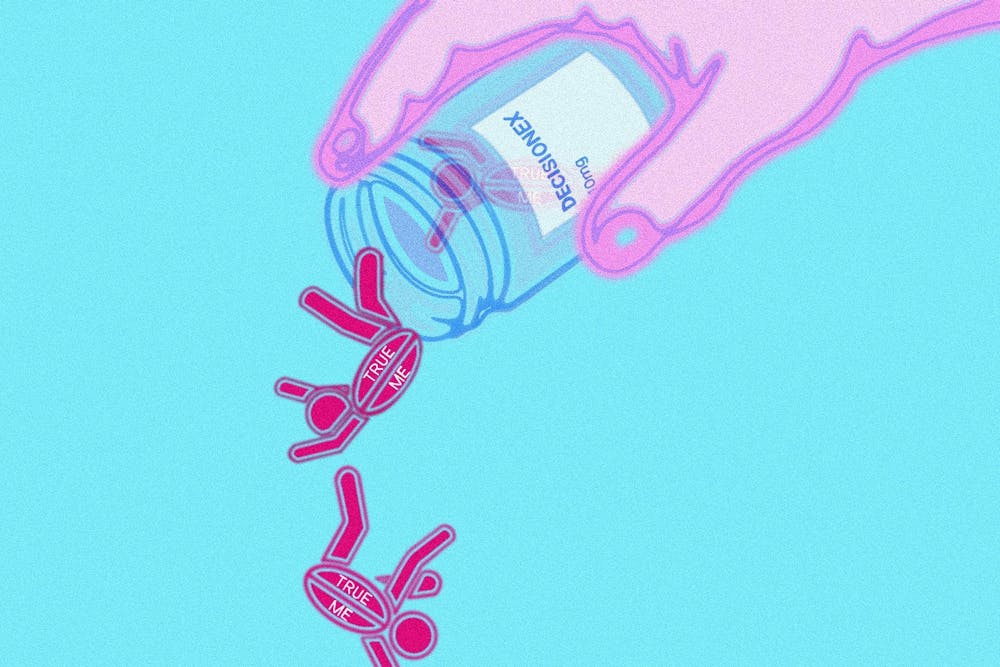
Lands of opportunity are frequently co-inhabited by lesser-known creatures: decisions. Opportunities gambol and frolic around, but if you look closely, tailing each opportunity is a little decision or two, nipping at its heels, encumbering it just a tiny bit. This ecosystem is more complex than we may have been taught. It’s difficult to make a decision, that’s for sure, and as of yet, we don’t really know where these critters come from. Regardless of their provenance, they’re notably difficult to deal with. Decisions tend to run away from their assigned handlers, taking more time to be pinned down than anticipated and generally putting things behind schedule, or on a different timeline entirely. A siege of decisions is incredibly effective at inducing fatigue, and can even overwhelm a poor, lone opportunity with their superior numbers.
⠂⠄⠄⠂⠁⠁⠂⠄⠄⠂⠁⠁⠂⠄⠄⠂ ⠂⠄⠄⠂☆
Presented with so many decisions, it’s common to experience paralysis and fatigue. This, that, and even the other all appear to be reasonable choices, and often, truly no amount of information can settle the matter. College, in particular, is a favorite habitat for decisions. They like to trickle in slowly, and then rush in all at once, incapacitating their prey when they’re already somewhat down. Course registration, next year’s roommates, or even the dreaded j-o-b (usually only referred to in hushed tones) are especially strong phenotypes. Like I said, most don’t know how to make decisions. Decisions tend to appear semi-randomly, and one deals as best they can. Some try to handle each decision individually and with care, while others prefer to tackle all of the decisions in a big batch at once and hopefully buy time before the next round shows up. I, at one point, almost didn’t have to make any decisions, until one was made for me. Today, I’ve decided to tell that story and introduce the decisions that followed me after.
⠂⠄⠄⠂⠁⠁⠂⠄⠄⠂⠁⠁⠂⠄⠄⠂ ⠂⠄⠄⠂☆
This year, I was put on a stimulant for a narcolepsy-like disorder. It’s been a long time coming, but I don’t like acknowledging that, saying that there’s some inevitability to me ending up taking Armodafinil. It’s really funny to me that they’re called stimulants. I understand this is the language of the brain—of regions and active impulses and electrical signaling—but seeing as we don’t fully understand the mechanisms of this particular drug (true, concerning fact), I feel justified in interpreting the term colloquially. Stimulant. As if in our chronically overstimulating world, I’m somehow understimulated. As if I sleep, then sleepwalk, through my days out of boredom. If anything, it’s embarrassing. I feel that by accepting the stimulant, I concede that I am incapable of propelling myself through the day. I wasn’t always like this. I long for the particular engagement with stimuli that my slightly younger self had, unfettered as she was by internal obstacles—she read, she wrote well, she spoke with some degree of articulateness. I don’t. I feel a loss there of some “real,” truer version of myself.
I’d like to introduce you to True Me. True Me is most easily identifiable around age 14, in my case. True Me kicks butt. Sitting at her desk, she comfortably vanquishes essays, conquers problem sets, and fortifies debate cases. Commanding the necessary inner drive wasn’t always easy, but it was relatively painless and definitely doable. True Me is likely anxious, too, but it’s the kind of anxiety that’s shown on TV: successful junior lawyers drumming their perfectly lacquered nails on the desk too much, eyes still laser-focused on the courtroom proceedings. It’s tidy. True Me has worries and True Me has fears, but True Me is also a machine that kills uncertainty by racing ahead of it and getting the job done, establishing a reality ahead of time instead of catching up to it. True Me didn’t know what she wanted to do in her life, but that’s fine because whatever it is, she’ll be prepared and on top of it and handle it all just fine, thank you very much. True Me is someone outside of just a work ethic too. She’s confident, funny without being biting, stylish—the whole package.
I think True Me would have really liked college, but unfortunately, she’s not here at present, because I’m not her. I had thought my semi-regular dozing that occurred throughout the tail end of high school was more so a general malaise than anything else, and that I’d perk back up once I had everything I wanted: Brown. Unfortunately, this was not the case. Across both semesters last year, I slept through about 40 percent of my lectures. These were courses I loved and seats I’d stalked Coursicle for, but you wouldn’t know it if you walked into the room. I can play it out for you right now: I’d be listening, following the content without issue. Thinking to myself, this is awesome. Going great. Wait, I missed that? Oh no. I’d jerk awake and try to blink myself into alertness. These “sleep attacks,” as I’ve heard them called, aren’t restful, true sleep. You wake up far groggier than before, unable to concentrate on your surroundings or anything beyond staying awake. Thus, while I may appear to be awake, I couldn’t tell you anything that happens in a class after that point. I get a pulsing unilateral headache, the pain always behind my left eye, perhaps compromising my hemisphere of rational, orderly thought. The throbbing spot is heavy like an actual stone, how I imagine a malfunctioning Neuralink might feel. It’s all-consuming, yet somehow not a physical pain, rather a neurological one. Tylenol doesn’t fix it.
I felt pretty worthless, to be honest. Here I was, disappointing what felt like everyone, but was primarily myself. I didn’t attend any lectures that spring for one of my biology courses—it was too embarrassing to sit there slumped over, hoping the professor wouldn’t notice. I was so far from True Me. A series of sleep disorder tests revealed not all that much. The one thing I could try, the doctor said, was a stimulant.
“It’s not an amphetamine, so it’s not addictive like Adderall,” she said. “And it works pretty immediately—we could start you on it next week. It’s very common.”
I’ve usually been hesitant to embrace treatment courses of indefinite duration, but my doctor made it sound so easy. I’d just go to the pharmacy, pick up a little pill, and go back to being myself, right? This was a core component of my thought process around the stimulants—I would go back to being myself again. I thought that this narcolepsy “cure” could somehow holistically reset my present self to True Me.
⠂⠄⠄⠂⠁⠁⠂⠄⠄⠂⠁⠁⠂⠄⠄⠂ ⠂⠄⠄⠂☆
I think many of us tote around a True Me, distinctly not an inner child, but a reference from which we identify specific losses and deficiencies. Perhaps you know it as an “ideal self.” It is far easier to locate losses than gains within ourselves. This is a nebulous thing, this ideal self imbued with more potential than we have now, and I find it to be a companion on a permanent guilt trip. I know there’s a version of me out there who could have already done the tasks that I’ve been shuffling from list to list for five weeks at this point, yet I’m somehow here instead of her. I don’t think I would now be me if I were True Me, though. See, the thing about True Me is that she never really had to make decisions.
Unquestionably, True Me was going to walk home from school and open her notebooks, finish every assignment that evening, and then do not much else. She didn’t need to think about it—there were assignments; they would get done. She would do them well, neatly, and in a timely fashion, and that would be that. Yet now, from my False Me vantage point, I don’t think that’s what it’s all about. Don’t get me wrong, this narcolepsy business sucks. But it forced cascades of decisions out of me, ones I actually had to deal with one way, or deal with by doing nothing: skip this class, don’t take that one, go to the doctor, et cetera. A new story. Inching closer to taking the wheel of the ship of my life. And this one “decision” that isn’t really a decision, this perhaps different creature of narcolepsy, is one that I can dissect. It’s fatiguing to think of handling future decisions, but this one has come and gone.
Under the assumption that I wasn’t always like this, I’m free to wonder what triggered the disorder. I unravel the months of my calendars, looping September to June and back over again, round, and round, and round. I trace these threads to a note from my junior year history teacher, remarking on my penchant for naps. I see my first positive COVID-19 test, six months earlier. Before even that, though, I see a 9 a.m. elective sophomore fall, the last 20 minutes of which I reliably slept through. I remember a not-quite-concussion incurred while sailing, and while I think it was later in this sequence, I remember thrashing underwater and sitting oddly at the bottom of the boatramp, unable to climb up the 18-foot incline. I later called my father to pick me up, strangely, and now see it as portending more to come. I hit my head lightly a few times a week and aggressively a half-dozen times in each racing season. Hmm. Farther back, in the depths of my watery memories, I see a trip to New York City with my mother at the very tail end of February 2020 and an odd cough she had. I think of my memories as stacked up vertically in my body like shoeboxes, immersed in some kind of vital soup that makes up the corporeal me. The most recent are at the top, and in order to reach the dregs at the bottom, I swirl a ladle round and round, scooping up rough-hewn primordial bits that I think of like vegetables in stew. I use the word waterlogged a lot when describing my body, my thoughts, my experience of waking and alertness. There’s a lag on many actions for me, as if I need to let them drain out before I can proceed. You wouldn’t put a wet plate on the dinner table, right? You’d let it drip first. So it wouldn’t be waterlogged.
The very first day on my stimulant, early this summer, I felt as if a magnet had been pressed into my brain, right at the top, and it was pulling me up towards the sun, if not wholly into it. I was literally buzzing, talking faster than I could think. I was actually energetic, not just awake enough. I was thrilled, so excited to see True Me come out, to give her a chance to try her hand at college and at being 19. The opportunity passed. By day three, everything was pretty normal.
Today, I remain waterlogged. I’ve slept through just two classes this term instead of last fall’s ninety-two, but I feel not all that different. I don’t actually nod off. I can’t wake up in the morning anymore. That’s new. I have, however, somewhat learned to deal with decisions. They still follow me doggedly, alerting me to their neglected condition quite frequently and exhaustingly, but they are admittedly fewer in number. When you can’t do it all anymore, you have to make some choices. In this one case, it taught me something: not how to make the decisions, that’s still up to the scientists in the Land of Opportunity, but that you do, in fact, need to make some.


