My political awakening, like many in my generation, emerged less from a genuine pursuit of truth than as a performance shaped by the constant scrutiny of social media. Every opinion I shared was quickly disseminated, retweeted, or critically examined, leaving me trapped in an endless cycle of public evaluation. The pandemic years intensified this experience. My beliefs shifted leftward, becoming more radical and tinged with a quiet resentment for the liberal friends with whom I had once knocked on doors and dialed voters for Joe Biden.
That resentment became a kind of depression-tinted cocoon. I immersed myself in dense left-wing texts, growing steadily more cynical about American democracy. Every conversation became an opportunity to rail against the empire, dissect the cruelties of capitalism, and dismiss the incrementalism of liberal organizing. Over time, I grew rigid—unyielding, suspicious of dissent, and increasingly isolated in my activism.
It was during this period, in early 2021, that I picked up Gregory Maguire’s Wicked: The Life and Times of the Wicked Witch of the West. I had long cherished the musical adaptation. For me, “Defying Gravity” was a pop anthem of queer resilience, a song I clung to as a closeted gay teenager in a scrappy, Catholic, working-class suburb just west of Philadelphia.
The novel startled me with its stark disillusionment and unvarnished political themes. For readers unfamiliar with Maguire’s work, the land of Oz appears not as a realm of whimsy and magic, but as a fractured Greek tragedy. Elphaba, marginalized for her green skin, seems destined to become Wicked. Oz is riven politically, racially, and religiously by suspicion and fear. The Wizard rules with an iron fist, using Animals as scapegoats for the country’s anxieties; they are surveilled, rounded up, disappeared, and confined to camps. Even the Yellow Brick Road is recast as a symbol of unfettered industrialization: an infrastructure project that destroys local economies and displaces indigenous communities in the name of progress. Mistrust gradually intensifies, ultimately culminating in graphic violence as the narrative progresses beyond the confines of Shiz University.
Wicked is, in large part, an admonition against the seductions of radicalization. Maguire’s parable suggests that revolutions driven by anger or violence rarely fulfill their promises and can even betray their own ideals.
In 2021, I saw parts of myself in Elphaba. Driven by idealism, she grows ever more distrustful of Oz’s political order, withdrawing into academic study and ultimately joining a clandestine terrorist cell in the Emerald City, bent on resisting the Wizard’s regime. Her story reads as a cautionary tale about the perils of radicalization and the loneliness of hardened convictions. Elphaba’s radical cell accomplishes almost nothing. Her attempts to assassinate both the Wizard and Madame Morrible fail, and in the chaos, she inadvertently leads her lover, Fiyero, to his death. Elphaba’s grief transforms into paranoia; everyone becomes a potential threat. Unable to distinguish friend from enemy, she retreats into complete isolation, her ideals succumbing to suspicion and bitterness. By the end, she is alone in her castle (save for the flying monkeys), defeated, and estranged from the very Animals she once hoped to liberate.
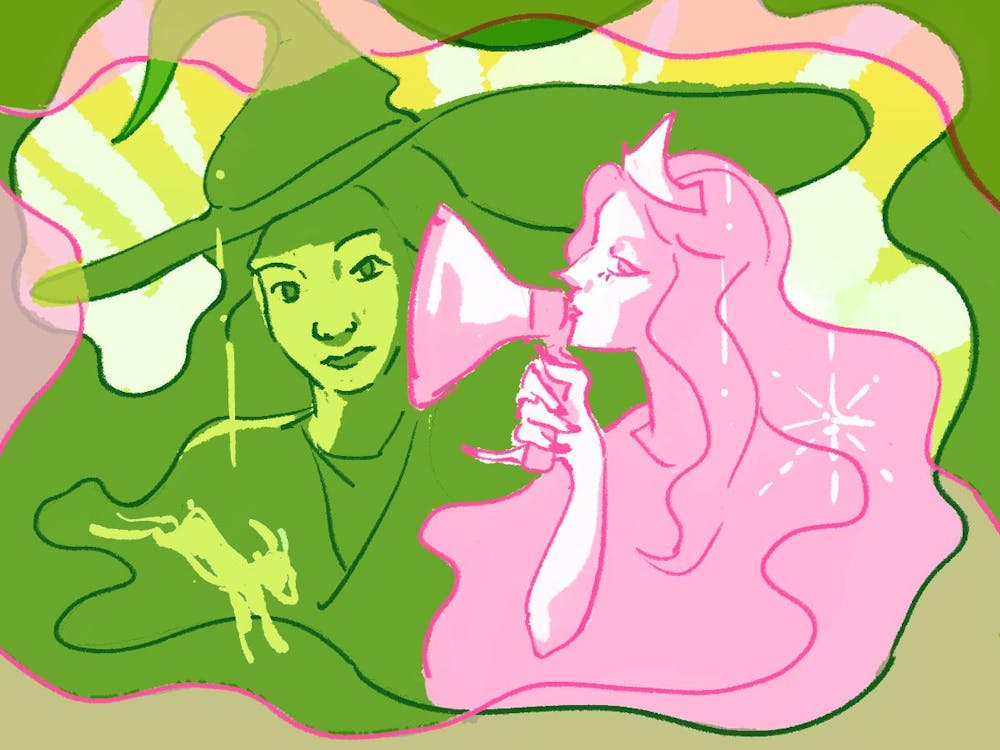
The musical offers a different, more positive vision of change. Glinda, operating within institutions she did not create and benefiting from privileges she rarely questions, nonetheless accomplishes more than Elphaba’s insurgency ever could. She ultimately repels the Wizard from Oz, safeguards the Grimmerie, rallies the Ozians toward renewed hope, deftly manages Dorothy’s disruptive arrival, and brings Madame Morrible to justice. Glinda begins insulated by privilege, her self-interest as bright and buoyant as her signature bubble. Yet the musical, wickedly attuned to the alchemy of subtle politics, charts her slow awakening. Glinda eventually acquires a conscience, learning that real power in Oz can be wrested from the Wizard. In comparison, Elphaba’s insurgency flares with moral clarity, but burns out before she accomplishes her goals, undone by the system’s inertia.
The path Glinda walks, however, is one Elphaba can never claim. From her first uncertain steps at Shiz, Elphaba is marked as other, her green skin a visual shorthand for all that is inconvenient, foreign, and undesirable. Glinda, on the other hand, floats upward by the circumstances of her birth. She is conventionally attractive, effortless, fluent in the language of social ease. Glinda serves as the peak of the social hierarchy at Shiz, and is thus offered the latitude that Elphaba is denied.
This unevenness complicates the neat moral split between the two. Elphaba does not choose radicalism so much as she is cornered into it by the system that bars her from participating on any terms but its own. Elphaba and Glinda’s paths reveal an uncomfortable political truth: working within the system is a privilege for those it deems palatable, a power tied to appearance, identity, and the art of politicking, granted unequally from the very start.
Maguire’s novel, however, deliberately denies Glinda the same justice-oriented arc. Book-Glinda enters the aristocracy by chance of birth and gains proximity to power, yet she accomplishes almost nothing with it. She is the embodiment of institutionalism’s comforts rather than its potential—adored, insulated, and politically inert. If musical-Glinda represents a hopeful scenario for insider reform, book-Glinda is the leftist critique of that premise: she exposes how institutions often reward pleasantness and conformity without requiring meaningful action. Yet even as musical-Glinda is propelled by self-interest, her willingness to learn from Elphaba and ascend to a position of power ultimately leaves her better equipped to pursue justice from within.
This contrast is precisely why musical-Glinda is the more compelling figure for an institutionalist reformer argument. She demonstrates what institutional power could achieve under idealized conditions, while book-Glinda shows how easily that same power collapses into complacency.
***
As Philadelphia's streets filled again in the spring of 2021 and the hush of lockdown faded, I found myself setting aside Karl Marx and Angela Davis and drifting back into the orbit of old friends—the same liberals I once regarded with an adolescent scorn. In their company, the anger that had animated my earlier politics began to dissolve, replaced by something almost like purpose. It was a quiet, almost imperceptible shift, but it felt like stepping out of Elphaba’s storm and into Glinda’s steadier light.
Yet the world, newly reopened, did not offer everyone the same reprieve. Camila, a friend whose path once paralleled mine (we met through political organizing), only seemed to become more disdainful, moving steadily in the opposite direction.
I saw Camila’s arc become a mirror of Elphaba’s. As I gravitated back to the familiar rituals of liberal organizing, Camila seemed to slip further from reach. She spoke of revolution and reconstructed herself in a way that felt both deliberate and inscrutable. Her rhetoric intensified, her social media posts became increasingly incendiary, and the distinction between protest and provocation diminished. She began openly calling for violence against civilians she considered complicit in “American imperialism,” thereby justifying the same brutality she once condemned. Witnessing this transformation was deeply unsettling. I searched her words for any trace of the friend I once knew, but she was gone.
Camila has since disappeared from the world we once shared. She left the United States and later reemerged in Iran; her image now occasionally appears on Chinese state media, where she criticizes the United States and echoes Russia’s war narrative.
Reconciling her current actions with our shared beginnings feels impossible. We met as idealistic high school students, opposing wealth inequality, campaigning for Bernie Sanders and Elizabeth Warren, and maintaining a cautious belief in electoral politics.
None of the causes she once embraced have materialized, and her politics seem to have swallowed her whole. She is now a fugitive from the state and widely condemned online. Camila never wore the label “wicked,” but she now resembles book-Elphaba with her growing absolutism and warped sense of justice. Her spiral illustrates why this pattern matters: as in Wicked, moral certainty can transform into fanaticism, collapsing movements from within. What begins as righteous conviction can quickly metastasize into isolation and symbolic “resistance” that achieves nothing except reproducing the very injustices it sought to confront.
In contrast, I still think change can happen from within if one is strategic, persistent, and willing to work with imperfect people. The difference between musical-Glinda’s optimism and book-Glinda’s complacency mirrors the tension I now feel in my own life. My decisions to work on Capitol Hill, pursue degrees in political science and public policy, and spend years on campaigns all reflect a belief in the eventual power of institutions. Still, I have seen how working inside institutions can make people more like book-Glinda: comfortable, insulated, and slow to challenge the very systems they want to improve.
Since relating more to Glinda, I’ve found that it brings both pride and worry. I still believe in the value of institutional power, but I am also aware of its risks. My challenge is not becoming complacent like book-Glinda, while maintaining the moral imagination that first drew me to Elphaba.


