In my creative nonfiction class, we were asked to read Notes of a Native Speaker by Eric Liu. He starts the essay with a laundry list of declarations and negations, saying, “Here are some of the ways you could say I am ‘white.’” It made me wonder which identity everything in my life spun around—which identity held the gravity that everything else had to contort itself to. I settled on being American.
—
I am American, though likely not the first image of American that comes to mind. I am American in the sense that my parents were dirt-poor immigrants who docked onto this promised land when they were my age and now provide a comfortable, upper-middle-class life in the suburbs for their Ivy League-attending daughter. I am American in that, over and over, I can recreate who I am. I can leave my family and dress it up as following my dreams. I can leave a city, a community, and call it chasing opportunity.
And because I am part of the race that is closest to being “white,” because I am part of the so-called model minority, I am as close as can be to the crux of American power—something that comes through in the way I speak, the way I walk, the way I assume I can customize my identity, free from roots, free from the culture that binds my parents, free from expectation, just free.
—
Maybe the most distinctly American product I see in myself is that I dream of leaving. Not a day goes by that I don’t think about what it would feel like to just leave—leave the country, leave my school, leave whatever corner of my life I’ve carved myself into.
The thing is, leaving is in my blood. You can tell by the way my parents both fled their home countries when they were my age, by the way they decided the allure of a new life was worth the pain of creating one. You can tell by the way I can’t stay in one state for longer than a month, by the way I’m starting to subdivide my year based on the next time I’ll be on international soil.
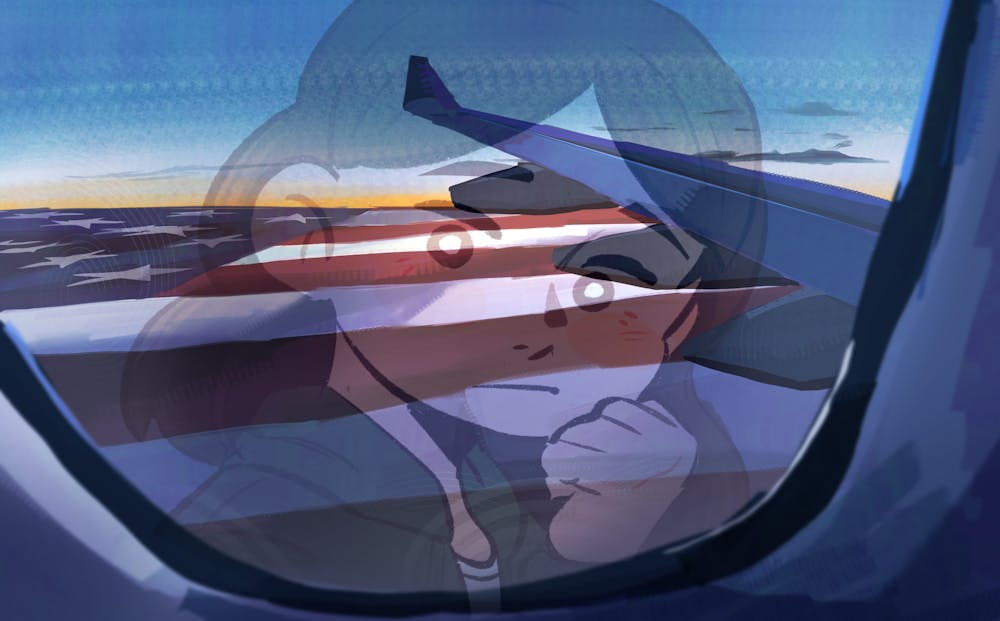
Lately, I’ve been finding myself in airports more and more frequently, as if I can’t bear to be on the ground for too long. When I hold my solid navy passport in hand, though, with its gold lettering boldly proclaiming that I am of the United States of America, it occurs to me that all I’m doing is leaving. What's the difference between that and running, really?
—
On my flights, I think about how big the world is. How it could swallow me so easily if I asked it to.
—
The first time I left, truly left, was when I packed up and flew across the country to Brown, resolving never to come home for breaks unless I had no choice. Yet after the rush of orientation and the blur of the first few months, I found myself facing the November chill with a new sensation tugging at my lungs: homesickness. As I packed up and drove to New Hampshire for Thanksgiving break, the not-quite-right mountains whizzing by in a car window that wasn’t mine, I wondered for the first time if I should have gone home instead.
When I did finally go back to Colorado, back in my childhood bedroom with my high school friends, I was disoriented. It occurred to me that my friends’ voices were different, lower in the wrong places. It occurred to me that the mountains were paler than I remembered, the house colder than I thought, my mom a little grayer than she had been before I left. What I expected to be a perfect fit was twisted, awkward, strangely shaped, and eroded by time.
I thought I was the only one changing. I thought I was changing relative to my hometown, rotating around the origin. It never occurred to me that the origin itself could also move.
—
A while ago, my brother told me to keep him updated about my life. When I told him it would take a novel to catch him up, he told me he didn’t care; after all, he used to be a reader, too.
Maybe he meant it as a throwaway statement, a reflexive rebuttal to what I said, but I took it as a promise. A promise that it doesn’t matter how many times I leave. I can’t shake him, can’t tear myself from him. He’s chosen to stay, regardless of what storms may batter at him or how bleak the land becomes.
—
When I visited China for the first time, the summer before my freshman year of college, I could taste freedom on my tongue in the way that every local glanced at my friend and me, dressed American with dyed American hair and speaking American.
I haven’t yet visited Vietnam, but I can feel the same acrid tang when I walk into a nail salon, or my mom’s restaurant, or her Christmas parties. I feel the half-accusatory and half-envious stares when I show any sign of my American privilege, whether it be a Brown University hoodie or unaccented English. I can sense that as much as I am scorned for having lost Vietnamese, I am also admired for how American I am—admired for how well I could change, adapt, contort myself to this new life.
—
I often think about the difference between freedom and loneliness. In almost all of my politics classes, we touch on the idea of freedom from and freedom to. Applied broadly, it’s the idea that a government is responsible for providing its citizens freedom from insecurity, violence, etc., and freedom to pursue their goals, to realize their potential.
Each time I flutter away from a person or a dream or a place, I wonder whether I’m pursuing my freedom to flee towards new land, fertile soil, or if I’m exercising my freedom from having a place to call home, a warm nest to return to.
—
Recently, my mom has been saying “I love you.” Not through a plate of fruit, or an exchange of cash, or even by asking if I’ve eaten yet. No, these days, she’s been saying “I love you” verbally, in English, followed by a hug. My other brother tells me it’s because he’s been talking to her more frequently, long conversations where he explains to her what he thinks his siblings need when they come home after months of trying to figure out how to live on their own for the first time, or from a semester of New England cold seeping into their bones.
—
I’m never sure if it’s more American to dream of being something great, or to throw it all away in the pursuit of a life free from expectation.
—
The problem with leaving is that the more I do it, the easier it gets. Every single change, whether it’s the new friends or the new clubs or the new dreams, they’re all so brilliantly shiny every single time. Every single opportunity I chase after feels like a blatant expression of my own manifest destiny—because of course I can dream of something new. Of course I can go somewhere new, of course I can become someone new; after all, it’s part of what I deserve as an American, isn’t it?
It isn’t until the new thing dies that I come face to face with the price of it all.
I pay the price in the corner of every new room I find myself in. It whispers to me, chilled and eerie, reminds me again and again that I’m losing something too. It’s a loneliness I’ve learned to face, paradoxically, by leaving yet again to the next bright place that calls my name.
—
The first time my mom said “I love you,” I was unnerved. I couldn’t trust it, couldn’t trust this new change that I hadn’t engineered myself. The second time, I said it back. Most recently, when I came home for winter break, I said goodbye to my mom twice so I could say “I’ll be back tomorrow” in Vietnamese the second time, a phrase I had recently learned in class. My mom laughed, surprised, and then corrected my pronunciation. I drove a little slower after I left.
—
Maybe I’m scared of what it would feel like to come home to the same four walls, to stay long enough to notice how the sunlight hits the kitchen counter at the same angle every day. To stay long enough to see the cracks in the drywall, to see them and decide I want to live here anyway. Maybe I’m terrified of the origin changing, of deciding I will let myself fall into its orbit, of accepting whatever direction it’ll hurl me in.
Or maybe it’s part of being American—maybe the inability to stay in one place, to sink with one ship, to build a history anywhere before razing it to the ground in pursuit of unexplored land—is the closest I’ve gotten to being American.
—
The flip side of it, though, is that the final Americanism I’ve acquired is my ability to change. To learn, endlessly, relentlessly, and always with hope. To decide, for once, that there's a strength in staying—a certain freedom, even, in turning around to tell your mom that yes, you'll be back tomorrow.


