
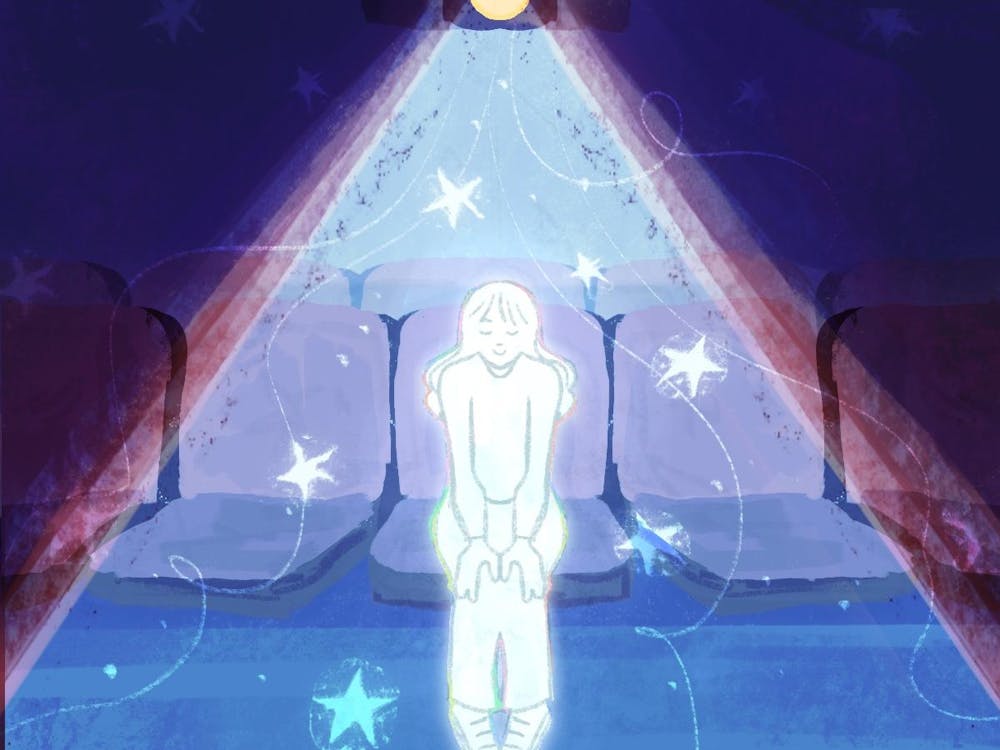
You sit in a carpeted row, knee clanking against knee, elbow sharing armrest with elbow, like a curious line of bony wind chimes. You sit in the soft disquiet of a room full of people trying to make their little noises as noiseless as they can be. But breaths become louder when you pay attention to staunching them; hearts beat faster when you hold them close. When you push yourself down, everyone else’s spirits seem to float to the surface, oil rising in water. What is it about this place that puts you so deeply back into your body?
You don’t know how or when it happened, but, at some point, the credits begin to roll. You look to your left, then to your right. You shake your head as if to say did you guys see that too? As you gather your popcorn and your coat, you unintentionally nudge the person next to you. You lock eyes, and then you both smile simultaneously.
Last summer, I was living by myself in Providence and for the first time in my life, despite having been alone innumerable times, I felt truly lonely. And believe me, I tried not to feel this way; I’ve been an admirer of “loneliness as time still spent with the world” for years. But no matter where I went—work, a cafe, the park—no matter how crowded the world was, I still felt like a person with a cloak on, a layer that no one could cut through or completely dissolve. I felt that my loneliness was inescapable. I wish I could say that I barrelled through it, but I didn’t. I wallowed in my loneliness, swam around it even while the sun was high and lovely. But it was when I was freestyling in circles, waiting to rattle round the drain, that I discovered the delightful art of seeing-movies-solo.
On my nineteenth birthday, I embarked on an expedition to the sweaty, crowded mall to see an IMAX screening of Ryan Coogler’s Sinners. I shuffled past couples and families and huddles of friends and fretted that I was the only person alone in this world. I noticed someone else by themself and nodded to them out of solidarity. The moment the lights went down, I let out a sigh of relief. Eureka, I’d done it! I’d made it through the awkward bit, and I hadn’t even been caught!
Sinners was a good movie, a really good movie, but what I liked most was that I could hear the sound of my own laughter rattling around with the laughter of other people, my soft sighs dancing in a galleria full of soft sighs, could step out of the room and feel the hum of shocking understanding. If I am giving you my most full and doting recommendation, I would say that to dull the sensation of loneliness, you don’t even have to see something good, or beautiful, or heartwrenching. It can be awful and trite. Sometimes, a terribly obnoxious movie is as igniting as a masterful one. The magic of seeing a movie all by yourself is that it’s a lie. You never can watch a movie by yourself, certainly not at a public cinema. You can’t watch anything alone.
I went back to that crusty theater, then the Avon, then the cinemas in neighboring towns, and even once I had returned home to my comfortable, lazing Tennessee, there too I delighted in seeing movies by myself, all because I had found something uniquely enveloping.
Going to a movie theater, however dingy, however plush, means taking part in an exercise in moving and being moved. Especially when you take a risk and go by yourself. Because then, at the end of the day, it is not about just you seeing something and experiencing it. It is about all of us at once, responding to a call a writer began years ago, and an actor months ago, and to a whole series of lives and moments lived to come into fruition.
We are living in the loneliest of eras. According to the APA, a third of the adult population of the United States identifies as lonely. I pose the question: How often do we feel together? Not necessarily feeling the same thing, but how often are we all so glaringly plugged into the same machine? Entertainment used to be a destination. A place you walked to, either arm in arm, or shoulder to shoulder. The theater is now an artifact of connectivity, one that we must seek to resurrect and then preserve. Between 2020 and 2023, over 3,000 cinemas closed, turning what was once the most exciting and unifying pastime into something somewhat novel. These third spaces, their liminality and their illumination, are vital and persistent. The promised impact of keeping cinemas alive is far grander and more necessary than just the monetary support of a business, or the keeping up with cultural swings. It is the community they bring and the mental health benefits they promise that demand our attention and intention. In her article “Movie Therapy: Using Movies for Mental Health,” Denise Mann outlines that “cinema therapy” has the capacity to improve and regulate our mental health and raise our spirits. Going to the movies is not just a meditative or liminal experience, but a scientifically useful one.
People poke and prod at whether or not a movie is a valid way to spend time with people, to get to know them, to romance them. Many go so far as to say that without conversation you cannot learn a thing. But to them I say, try to sit next to someone who, in the most simplified manner of phrasing it, is feeling for two hours. Sit next to them and try not to feel an ounce of connection, nor a smattering of understanding. Try to ignore the simultaneous thrums of heartstrings, the clever adjustments of hands. Try and you will fail.


