
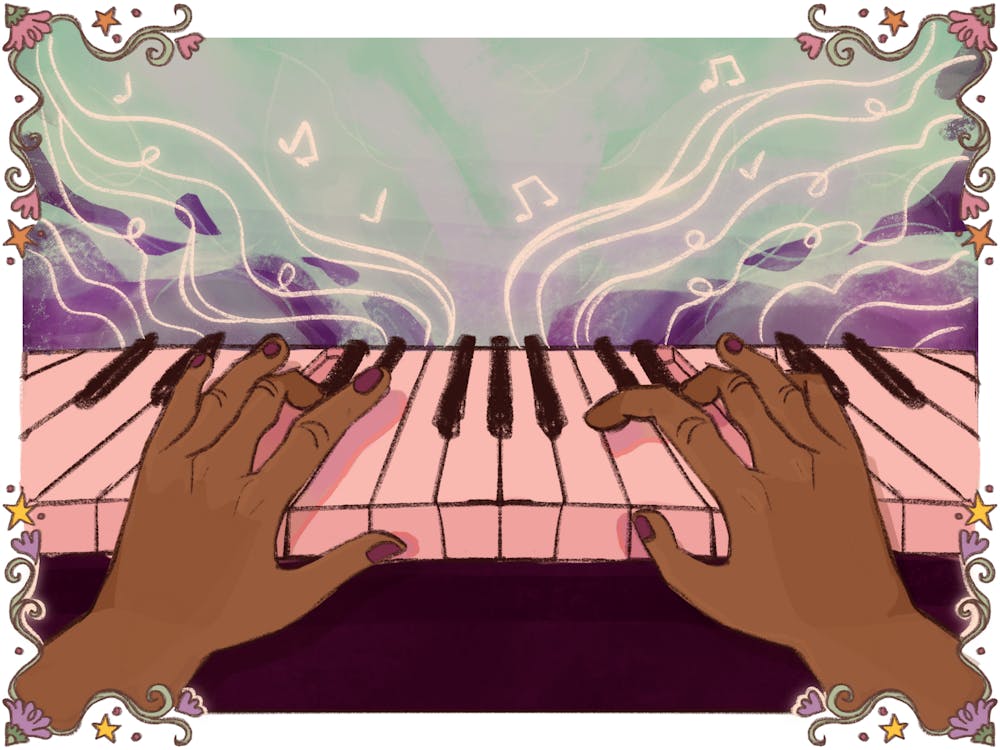
Lately I’ve been in Steinert, trying to figure things out. My fingertips hover over the piano like anxious crows waiting to land. I drop them, slide my hands up and down the keys, trace a path from black to white to black again. Still the notes don’t sound right. Still, I am hunting for the rhythm.
There’s a concept in music theory called rubato: “robbed time.” To alter the tempo and then reel it back in, to speed up or slow down, and return. In high school I’d douse my music in rubato—pause one measure, race forward the next—and I’d do it without hesitation, without overthinking it.
But recently I’ve been fighting with the finer details. I’m trying to play Franz Liszt’s Concert Étude No. 3, better known as “Un Sospiro”: a breath, and it sounds wrong, too emotional, without conviction. I’m trying to measure out the ritardandos and the accelerandos. To space my tempo changes just so. But the pulse judders and spikes and flatlines. The étude pulls me from measure to measure; I lose my footing on the keys; I go home dissatisfied.
-
Our difference became a permeable membrane between each person and the whole.
Even though my mind focused within bounds, it's indivisible from sky I see, because seeing is as a field.
Looking is an innate impulse toward wholeness.
— Mei-mei Berssenbrugge (from "Consciousness Self-Learns")
-
I am a person who likes certainty: the interlocking rainbow blocks in my Google Calendar, the different sectors of my life partitioned and color-coded just so. I know that during the nonstop six-hour sprints between my classes and the Herald office and back, I have to kick my tempo up to allegro. I know that within the yellow boxes I’ve categorized for dinners and movie nights with my loved ones, I can slow down to adagio.
But I’ve always been a little bit lost in the midpoints of things. In the spaces that gape in between. In my spare half-hours I often find myself hovering at the intersection of the Main Green and Simmons Quad, wondering if I should return home and call my parents, or pick up a latte from the Blue Room, or swing by Rhode Island Hall to greet friends. I can agonize over future plans and pore over the past; when I live in the present, the present is a limbo.
It’s spring now, maybe the midpoint of all midpoints. The trees are halfway in bloom, their flowers all in the messy process of unfurling. The weather seems to be swinging steadily in between 60 and 80 degrees. In the mornings I awake to the sounds of birds, quiet but insistent. I imitate their song in my own whistles but it doesn’t land quite right.
And as a second-semester sophomore, I’m about to mark halfway through my time at Brown. How to even begin to fathom my experience here, so expansive and warm and overwhelming, flashing by at breakneck speed? Main Green afternoons, late nights to early mornings in the SciLi, Blue Room coffees and Jo’s dinners, Caswell fire escapes—already, halfway gone.
More so—how to inhabit this experience, this moment, hesitating in the breath after adolescence and before adulthood?
-
On the quiet walk home from Steinert, across the green and between the lamps, I listen to “Réminiscences de Norma”—also by Liszt, also the only song that I’ve yearned to play for years and yet have never had the courage to attempt. The song cascades and ripples in a long series of arpeggios. At 13:30, Marc-André Hamelin drapes his notes in rubato, producing a positive waterfall of sound. I listen to the notes tumble over each other. It never fails to make my own heartbeat quicken.
-
Is it a crime to be unsure?
In time we’ll find
If it’s sustainable
You’re pure, you’re kind
Mature, divine
You might be too good for me, unattainable
— Daniel Caesar (“Who Knows”)
-
There was a boy who lived across the hall from me in my freshman dorm. We didn’t share a bathroom but we ran into each other again and again, until his face changed from a stranger’s to a friend’s. We’d come home hazily from different parties and stand in the no-man’s-land between our rooms, talking, whispering laughter so as not to wake up our other hallmates. One time, a friend and I heard snatches of violin music floating through the corridors and followed it to the very end of the building, where we knocked on his door, and to our delight he opened it, bow still in hand.
We fell out of touch after we moved into different buildings our sophomore year, but I still have a Polaroid photo of him from when my roommate and I attempted to start a “visitor wall” for our dorm. I’d invited him in and we sat on the edge of my twin XL, our feet dangling in the air, and we talked about our hopes, our homes. When I held up the camera, he posed for the picture and squinted and smiled.
Recently I found out that he’d passed away. Now I find myself clutching desperately at those memories. My first home away from home will always be that corner of EmWool: carpeted, green, and dingy, with his violin singing through the air, his shoes at the door when I came back at night. Our halfway point rendezvous. Hanging in between one doorway and the next. A mutual understanding, an insistence, of just one more minute of conversation, one more laugh before sleep. The seizing of time.
-
I spent most of my teenage years trying to understand sadness. I cried over my AP Calculus test grades, believing they put all my university dreams out of reach. I studied my body in the mirror, disdaining its curves, its stretch marks. I despaired over a boy when my first real relationship ended during my freshman year of college.
But now I’m just a month away from turning twenty, and I wish I understood grief. Because despite all of my attempts to sift it through, to weigh it in my fingertips, I still don’t. Not the individual kind that gnaws at the edges of my stomach, pining always for some past era of childhood or adolescence, when I believed that time was ever-giving and infinite.
And what’s far more elusive, the community kind of grief we have all wrestled with—in our own ways—this semester. How to encompass the Brunonians we’ve lost in a few simple phrases, or a handful of pictures? How to wake morning after morning, knowing that the world is irrevocably dimmer? Words fail. There is no other way to say it. Words fail.
-
But there are freeways between me and the person I love, God. And I don’t have enough time to travel all of them. I worry that I can’t bend them all into a giant circle from where I begin to where she begins. God, I don’t know what I believe in except the shrinking of distance. God, do you worry about the things you can control? I am enough in love to worry about everything that might cast a shadow over it.
— Hanif Abdurraqib (“On Seatbelts and Sunsets”)
-
And it’s a mess, all of it, really. I try to sort through it, but it’s beyond my reach. The heartbreaks: the tears in a place we once called perfection, unquestionable, safe. The immense losses that we’ve felt and continue to feel. The way the world keeps turning, turning anyway.
At the very same time: the joys. The pile of my friends’ forgone sweaters as we sprawl out on the grass. The glow of faraway lightning from my warm bed. The delightful soreness, walking home from the gym, that radiates through my shoulders and chest. The barely-there freckles on her cheekbones and the burst of her laugh.
The things that terrify me and the things that I love exist in disharmonious tandem. I’m trying to live in between them—to pluck the moments from life’s infinite and spiraling web, to make sense of everything. We grow, slowly, around our grief. Our hearts keep beating anyway, through it all.
-
I am ready, run from fear
I'm from somewhere far from here
So tell me when the coast is clear
Wanna kiss you ear from ear
Can I take another year?
Must I be so damn severe?
From the valley to the pier
I'm beset with what we could become
— Bon Iver (“From”)
-
I’ve been chasing perfection in “Un Sospiro” since I was seventeen. I’ve tried metronomic practice, and separating my hands, and going phrase by phrase. I’ve tried practicing for hours on end, and taking a break for weeks, and pure robotic staccato touch with no dynamics at all.
I’m nineteen now, and I don’t have any tricks left to employ. Instead, I just begin. First at a painstaking lento, tiptoeing my hands across the keys. Gradually I gather conviction, dipping and weaving, inhaling and exhaling, and I let the song follow suit in a wild cascade. I know these notes well enough to lose control over my hands, the sound; the music bleeds blue and red; I give it room to breathe.
I think there’s an inherent sadness to rubato—a pining for the past, a clutch at what used to be. But it too exists alongside a quickening: to leap to the next phrase, to reach. The next beat will come, and the beat after, and the beat after that.
Now I remember violin music; I burn it into my mind. I let the fasts and the slows play out. I sink my hands into the in-between.

Michelle Bi is a metro editor covering City Hall & Crime and State Politics & Justice. She is a sophomore from Oak Park, CA and studies English and IAPA. In her free time, you can find her playing guitar, the LA Times crossword or one of her 115 Spotify playlists.


