
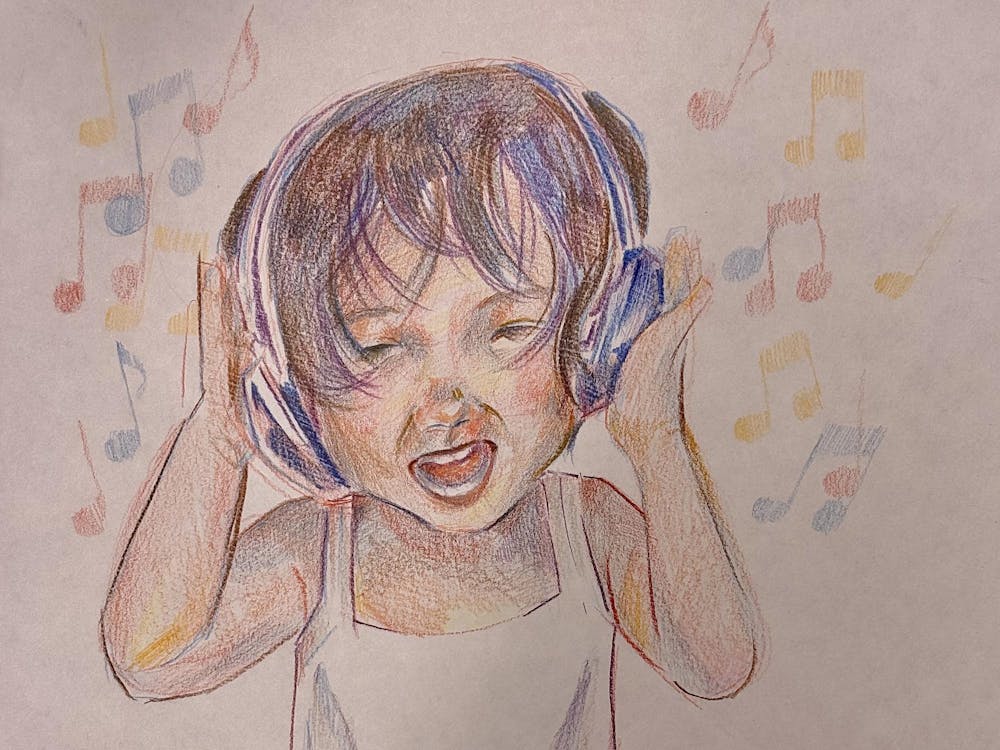
At the grand age of five, I didn’t have many talents, but I could do a lot of things mediocrely. For instance, I was a very musically inclined child, but not in a piano competition child prodigy way—I was mostly just constantly humming to myself and loudly singing in our K-12 choir. “Take her to the music school,” they said to my mom. So we went.
Music school appears to be one of the most universally hated experiences, and I’ve met more people who have quit than have actually graduated. Unless you build up the accountability to practice regularly, piano lessons are a semi-voluntary humiliation ritual. (You sign up for them, but you never know exactly what you are signing up for.) When I was six, I made an entry in one of my diaries: What am I afraid of? Death, darkness, and my piano teacher.
There was, however, a character trait that helped me persist in my pathetic piano attempts. (Apart from my parents’ unconditional support, of course; they had so little relation to music that it allowed them to praise me for what I could do, rather than pushing me toward a hypothetical asymptote of neurotic virtuosos and prestigious contests. The only piano competition I’ve ever participated in was called “Our Hopes,” after which my mom kindly asked whether there was one called “Our Hopeless Ones.”)
But I had one skill. In my introductory solfege class, where you learn how music works from a perspective of harmony, rhythm, and melody, I was singled out by a teacher. She made me look away and pressed a key.
“Which note is that?”
“A,” I told her.
“And this one?”
“F-sharp.”
She looked at me and enthusiastically declared, “Well, now we know that you have perfect pitch!”
Let me explain myself. You know how they say we could all be perceiving colors differently because we would never know that our “blue” is someone else’s “red”? We could look at the same thing, call it the same word, but have different subjective perspectives. It’s called the “inverted spectrum” or the “qualia problem”—some first-person experiences cannot be fully understood through third-person objective science. Well, my qualia problem is my perception of pitch. Before that class, I never realized that other people hear music very differently from me. Which is quite a reasonable assumption to have about your perception of the world!
Apparently, perfect pitch occurs in 1 in 10,000 people. To me, music is words. Whenever I hear a piano note, the humming of the saxophone, or a squeak of the violin, I hear a word. Music quite literally speaks to me. Every melody is simply a sequence of words. In the car with my family, I would sing “Ti-la-sol-mi-sol-mi-fa,” and everyone thought I was saying those words randomly; in reality, every word was tightly, inextricably linked to a pitch. Calling one pitch a different word made my brain short-circuit, which is why it was always hard for me to transpose the melody into a different key in the choir and call the new, lower notes the initial names. I wanted to scream. This is wrong, guys! This does not make any sense!
So whenever people are surprised by my ability to recognize or pinpoint the pitch correctly, I feel slightly confused. It’s not even that I make a correct assumption or listen carefully; I just know it, the way you recognize the smell of vanilla or distinguish a salty taste from a sweet one, a rough surface from a smooth one. Each key is a word. I don’t need to ask; notes reveal themselves to me straight away.
As you may guess, this carried me through music school. While others had to sweat during solfege dictations to write down the melody correctly, for me it was like writing down a sentence. This helped me make friends in every music school I went to. While my piano skills were quite average, there was no one as passionate about music theory as me. At some point, I lived in Perm, a city next to the Ural mountains—often called the last city in Europe because the Urals separate Europe from Asia. It would get very cold in winter, which didn’t necessarily indicate no classes. There was a rule: If an agreed-upon weather forecast website said negative sixteen degrees Fahrenheit, classes resumed, but if it was negative seventeen degrees and windy, school was cancelled. Picture me, an eleven-year-old, at 8 a.m. in January, making my way through the snowdrifts to get to my music theory class on time. It seemed my teacher was one million years old; I was confident she had witnessed Bach in his prime. I still cherish the notebooks from that time, because the stories she told us about composers I would never be able to find anywhere else… Alexander Scriabin’s synesthesia, Sergei Prokofiev’s childhood, Mikhail Glinka’s relationship to Alexander Pushkin through their lovers; she seemed to have known them all on the level of close friends, because if Schumann didn’t tell her all about his love life over a cup of coffee, how did she find out?
And then there were music theory competitions, where you had to memorize a hundred pieces of music and be able to recognize the composer, the original source (like the name of the opera or ballet) and sometimes, for concertos and sonatas, the specific part, say, Allegro molto moderato. To me, it was just recognizing word sequences and naming them with other words. Finally, I had found a niche where I didn’t have to be humiliated and could put my weird ability to good use.
The reason I have so many thoughts about perfect pitch is not because I’m particularly proud of it. Realistically, I’ve done nothing to earn or train it; I was simply born able to recognize notes. To me, it represents something much more symbolic—because, frankly speaking, there really isn’t much use to it other than when playing piano by ear or desperately trying to come up with a party trick. Perfect pitch frames how I hear the world. The street to me is a fusion of sounds and semitones: Car horns are often F or F-sharp, EMS sirens are augmented fourths, and intercom code is a funny sequence that you can memorize and hum to yourself. At some point, I discovered that the keys of my push-button phone are tuned to different notes, and spent hours playing melodies on it by ear by pressing the keys in the correct order. There isn’t a sound that doesn’t speak to me.
But it gets overwhelming. At some point, I realized I can’t study with music on. Usually, people tend to only get distracted by music with lyrics, because our phonological loop in the short term memory model starts to process them as language. This interferes with your attempt to read, but might not disrupt your math problem set drill, since that isn’t as much of a language-heavy activity. But to me, every instrumental melody, even classical, even lo-fi—especially lo-fi, actually—is a constant flow of syllables and words. Re… F-sharp… centripetal acceleration… mi… law of gravity… sol…
A similar thing occurs at classical music concerts. I wish I could let music envelop me, dissolve me, enter into my consciousness, and it does on some level, but there isn’t a way to zone out. There isn’t an outlet to “turn off” the conversion of sounds to words. You can’t escape it, can’t run away from your own head, and the more you think about it, the more overwhelming and stress-inducing it becomes.
None of my neuroscience professors knew how perfect pitch worked. That’s the philosophical part; what is the purpose of this ability in my life? Why me? What makes my brain different, and is there an explanation for this weird machinery behind the connection of sounds to words? What would have been different if I had never learned the names of the notes?
I think that a remarkable characteristic of perfect pitch is its atypicality to the human experience. We very rarely know things with confidence. This absolute degree of correctness is alien to how we operate. Consider the culinary area: When you blindly try a new dish, say, a new soup, you can list some of the ingredients, but would you know all of the spices used? Or in perfumerie: If there were an analogous ability in smell recognition, we would be able to confidently break down the fragrance pyramid. Even though some people are more inclined to precision in those activities, such as acclaimed chefs or experienced perfumers, the detail I’m emphasizing here is the absence of hesitation. The almost automatic recognition. The lack of need to think about the answer.
While explanations of those examples are heavily rooted in the neurobiology of taste and smell perception, it’s all just helping me paint the bigger picture: Humans are not quite wired for immediate knowledge. We tend to process information and our degree of confidence varies. From small things like guessing the outside temperature to describing the subtones and flavors during a wine tasting, the beauty of the human perception is its arbitrariness, relativity, and the range of sensations uncertainty provides us with. I am glad that I don’t immediately know if my coffee beans are from Nicaragua or New Zealand. I am grateful that I can’t say straight away what marzipan reminds me of. (Macaroons!) I am happy that I can’t instantly tell if I’m in love. It’s the process of pondering, assessing, comparing and figuring out the answer, because there isn’t a correct one, and marzipan could also remind me of the filling of the almond croissant, and my coffee could taste both earthy and floral, and I could cherish someone and think that I love them only to realize later that love is something entirely different.
I’m glad I don’t always remember my dreams, that I don’t always notice the cameo in a movie. I’m excited about the ability to experience the feeling of eureka, whether it’s after figuring out a hard physics problem or remembering the name of that one cartoon I watched as a child. And you know what—sometimes the clang of a metallic object is not distinct enough, and I can’t tell if it’s an E or an E-flat.
And that’s okay. Because in the human experience, nothing is perfect—not even perfect pitch.


