
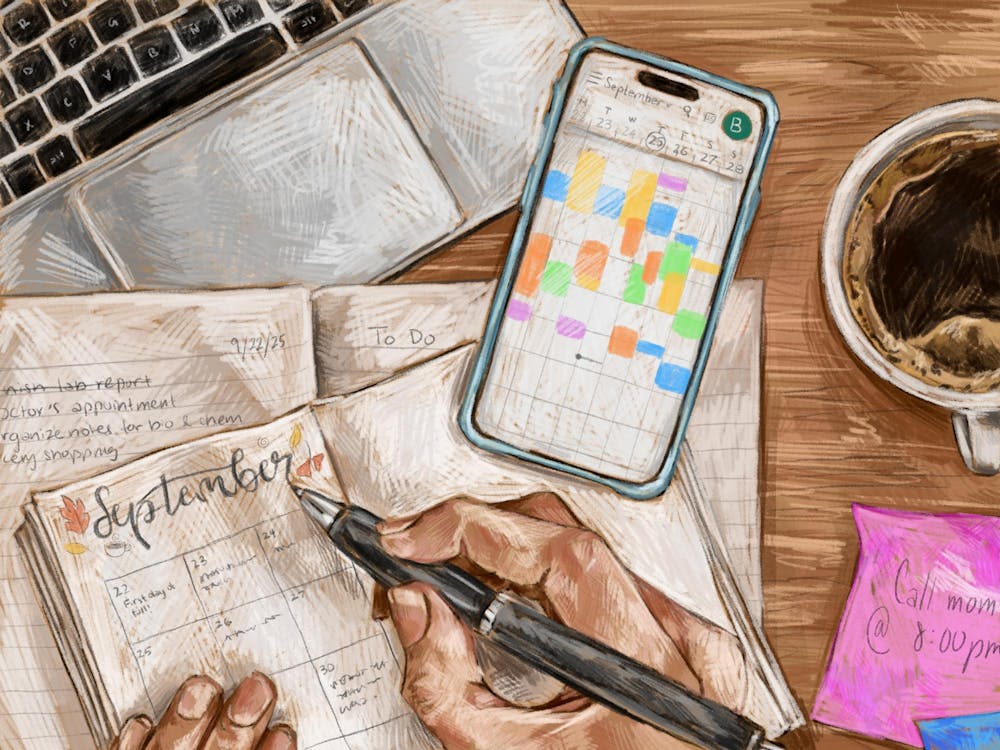
When I was in middle school, my friends and I loved to bullet journal. Each of us bought our own personal dotted notebooks that we carried around to class like little trophies, paired with pencil cases filled to the brim with felt-tip brush pens and mildliners and Zebra Sarasa pens. Taking inspiration from multiple online sources—Pinterest and AmandaRachLee’s YouTube channel being our favorites—we meticulously drew every line and detail, essentially creating our own planners complete with carefully placed decorations. Each spread, perfectly detailed and aesthetically pleasing once finished, would take us hours to complete, and we giddily compared our finished results with one another afterward, marveling at our artistic prowess.
However, middle-school assignments and activities started racking up; time for bullet journalling started to decrease. We’d fall into the pattern of completing a month’s spread, forgetting about the journal for the rest of the month, and taking the hobby back up once it was time for next month’s spread. After an unspoken agreement, we abandoned our hobby altogether once we became more preoccupied with making the eighth-grade club basketball team. Our bullet journals began to gather dust in the bottom drawers of our desks.
Why had we labored for so long over those pages of calendars drawn out to razor-straight perfection, stickers, and decals tediously placed in order to best frame the spread, only to neglect the journals once it came time to use them? Was watching dozens of “bullet journal with me” videos and drawing along to them for hours simply a means of procrastinating my actual homework? Though I started to realize the futility of hand-drawing my own planner near the end of eighth grade, I couldn’t make myself buy a store-bought one. It felt like accepting defeat. After my bullet journal phase, I tried out different organizational platforms, expanding my reach online: Notion, Apple Calendar, even just a stack of sticky notes piling up on my desk. However, everything I tried seemed to reach the same result: As life got busier and assignments stacked up, I’d end up neglecting the platforms I spent hours organizing. Planning out the perfect semester with the perfect organizational system was the easy, exciting part; committing to the act was a lot more difficult.
Each academic phase of my life can be recounted through my attempts to plan them out. Sixth through eighth grade marked the Bullet Journal period; ninth through tenth the Notion period; eleventh grade the Notes app and Sticky Note period. Though each of these eras started with the same bouts of initial motivation, the end results were the same. Notion templates detailing habit trackers for the next six months went unused; sticky notes with unchecked tasks started to pile up on my desk. By the time senior year rolled around, it was obvious that I’d hit some sort of planning wall—I’d entered the Memory and iPhone Reminders era, where I’d rely solely on my memory and the occasional iPhone reminder to get schoolwork done, a strategy further encouraged by senioritis. Fueled by the excitement of starting college, my first year at Brown marked the beginning of my Google Calendar period; though, admittedly, my calendar went blank with disuse near the end of each semester. (This was before I found out about the “repeat” option for events, but even then, I’d scarcely open the app.) Was it purely planner burnout that I was experiencing? Was it something deeper, as if not following through with using my organizational platforms was a way for me to further procrastinate on my tasks for the day? Was I simply destined to be a naturally unorganized person, no matter how hard I tried to present myself otherwise?
This year—my sophomore year—is the first that I’ve approached planning without an end-all-be-all approach. In other words, I’ve started to use planning for its convenience—not as an ultimatum determining my worth as a student, but through the “I’ll use this because it gets the job done” approach. Ironically, it’s only been through this method that I’ve been able to stick to planning consistently. The green hardcover planner I bought on Amazon for this year, coupled with Google Calendar for events and post-it notes for urgent tasks like “WRITE PAPER” in red ink taped on my desk, have been extremely helpful so far for planning out my year. Writing this almost four weeks into the semester, and given my previous track record, it’s honestly quite impressive that I’ve been able to stick to this system for so long.
Taking out the aesthetics and perfectionism from planning—check. Yet even though I now don’t associate any special meaning to my physical planner, I sometimes feel bittersweet when writing down reminders within the printed-out pages, marveling at how simple the task of planning is when it doesn’t also entail enacting a DIY, custom-built vision. The journals I hand-drew in middle school still sit on my shelf, and I leaf through them from time to time, marveling at the labor and precision folded into each and every hard-pressed page. Though the planners I made didn’t end up actually helping me plan, perhaps they served another purpose: creating memories with my eighth-grade bullet journal buddies, giving myself motivation for a hectic semester ahead, or making use of the dozens of fancy pens and mildliners I’d ordered off of jetpens.com, my favorite stationary site. Perhaps they were the stepping stone to finding a method of planning that worked for me. Regardless, I’m grateful for these keepsakes, which seem to teleport me into my eighth-grade self doodling sunflowers while zoning out in Algebra II. Perhaps this was the purpose of them in the first place.
At Brown and elsewhere, you’ll come across the occasional GCal-er (i.e. person that uses Google Calendar religiously) with limited-to-no blank space in their weekly calendars, and events color-coded so their calendar looks akin to a rainbow or a very colorful tapestry. But an important lesson to learn is that packed GCal or not, each and every planner is different, just as each and every person has a different method of organizing their tasks. Our own “task,” therefore, is to simply find a method best suited to our own needs; the act of planning doesn’t have to be a task in and of itself. An organized, hand-drawn planner with dozens of decorative stickers along its borders can work just as well as a plain Amazon-bought one, iPhone reminders, or even no planner at all. Happy planning :)


