
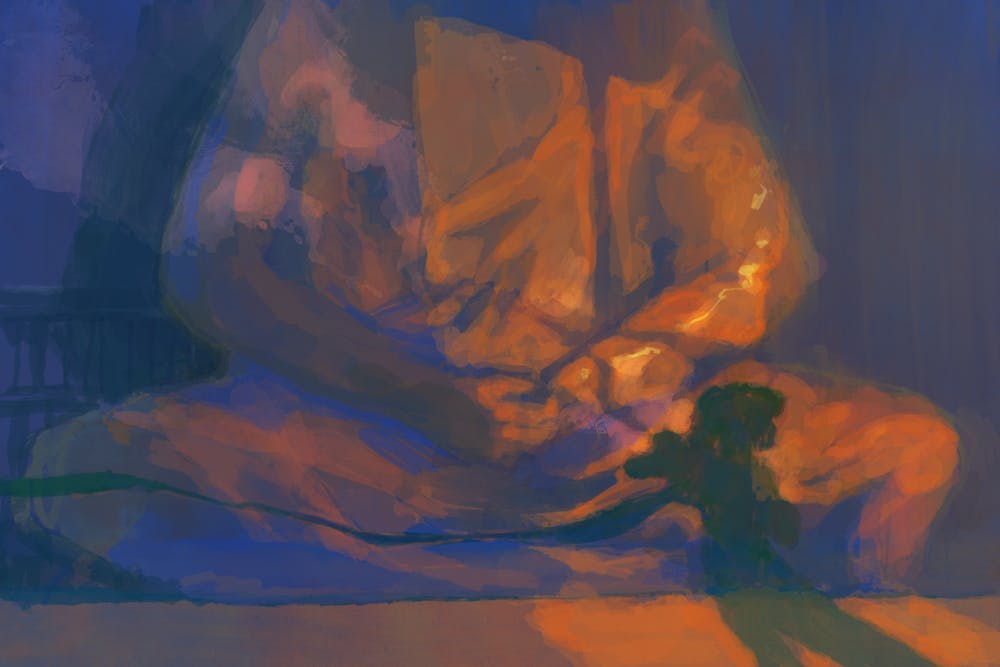
I turn the doorknob.
Careful now, don’t let Buddha hear.
The hinges protest, and I ignore them.
I’m hunched over.
Mother forbids me from watching
the Hunchback of Notre Dame.
She said churchgoers are always virtuous.
I begin to crawl. My knees are sore
and stinging.
Floorboard ridges dig into my palms. My hands are strawberries,
pockmarked with seeds.
I stop and peer up. Draw a hopeful breath. It is no use—I am always tiptoeing under watchful eyes.
. . . . .
I’m afraid of Buddha’s eyes.
He affixes them to me as soon as he hears the rasp of the Blue Room’s door. We call it the Blue Room because of the cerulean paint slathered over the walls and its deep, cool cast when evening falls. I suppose when the last owners painted this room, they wanted us to imagine we were in heaven. I feel only as if I have been plunged into a deep pool, the kind with an uneven finish that snags at your feet and leaves soggy white cuts.
My room is the Pink Room, although the walls are really a shade of lavender. You would think the master bedroom was called the Red Room, or the Orange Room, but no, we call it the Big Room. We like naming objects this way too—Big Car, Small Car, Big Daughter, Small Daughter.
The Blue Room is different from the rest. It is like comparing the sun to the moon—only one can be the center of orbit, drawing in other bodies with its irresistible pull. It is a place that belongs to no one but itself.
The Blue Room is different in other ways too. For one, the walls are lined with Yellow Books—texts, teachings, scriptures that knit an elaborate constellation of celestial realms and cosmic renewal. They have faded to the color of discolored teeth, whether by time or sunlight or the oil of too many fingertips flicking through pages. I imagine that the very secrets of the universe have been sealed and stoppered carefully in these books. To stand before them must be like perusing aisles of a rundown Asian supermarket. Pick some ginger, cloves, Szechuan pepper, grab a bottle of lao gan ma, but rush to leave because the children are crying for dinner.
Of course, this is all just how I have pictured it. I have never flipped through most of those old-teeth books. I have never heard their voices and the way they fight to drown each other out. I once tore a page in one of them just to see whether angels, or demons, or even the guardians of purgatory would descend through the window panes along with the warm breeze and drag me down to hell. But it only ever became a torn page.
Now look at Buddha, who is perched against the left wall in the Blue Room, framed snugly between those golden books and melancholy-coated walls. He is the centerpiece: no need to visit the Louvre, the Met, or the State Hermitage. He watches from the moment I creep inside to the moment I scurry out again. Some say his downcast eyes are serene, drawn into a smile with the tender wisdom of the all-seeing deity. I say they are like the eyes of a cold herring, mournful and unblinking.
In fact, the entire room watches, waiting. Think of a lion overlooking his domain of grasslands, of the Bayside State Prison warden examining his unwilling tenants while twirling the key ring round his thumb, of children’s faces piercing through Sea Life at New Jersey’s filmy aquarium glass (“Mom, look at that upside-down fish! Is it sleeping?”). Stepping into this room, I am the soon-to-be-dinner gazelle, the seething prisoner, and the choking fish.
Across Buddha is a window with panes that have never been opened and shutters that have never been closed. Perhaps if I entered more often on those lazy July mid-afternoons I would’ve caught the hot, thick dollops of sunshine that poured through those shutters. But I did not enter; the sunshine went uncaught. What must this room look like to those standing outside the panes, squinting in their struggle to see through the accumulation of dust and prayer? What must it look like to the common starling and tufted titmouse that flit overhead—are they reminded of Prince Siddhartha nursing their brethren, the wounded Sarus Crane? Or do they pass it as I have: one moment, one more, they’re gone.
Still, the Blue Room cannot be avoided forever. Step past the walls, the books, the statue. Tear your gaze from Buddha’s eyes and toward the sliding closet doors. They are white, worn, and always complaining, rattling on their hinges. Here is a small storage space tucked away, a shrouded secret within a room that reveals nothing. It is a soft, warm secret that whispers of childhood and the lovely ownership of a child over her playthings. Here is a teddy bear with an orange sash, a worn woolly sheep, a plastic dog that squeaks in protest as I drag it along with purple yarn. The sheep and dog do not lay at Buddha’s feet, however. I think they, too, are afraid of entering the Blue Room.
Once a year, I am bidden to enter. And unlike during my rescue missions for my stuffed companions, I cannot avoid Buddha’s eyes by pretending they are not looking. I must meet them, with incense smoke in my hands snaking toward the blue ceiling and a film of sweat that pools in the ridges of my palms. I wonder how I can cup fire and water and remain unscathed.
Listen to the murmur of chanting by mother, father, sister. Their melody coats the air as sweetly as that incense. I fasten my own voice beneath a limp tongue and gritted teeth. I am a Christmas caroler with a sore throat, armed with droll certainty that my music could bring nothing but dissonance.
It's at times like these that the weight of the Blue Room turns my entire home into an unfamiliar landscape, a semi-reality that you only stumble upon in the places between dreams and waking.
Watch your step now; keep your hands and feet inside the ride at all times.
Green is for stop and red is for go.
Your home is a shrine, and you are its keeper.
A liminal borderland that is just short of either euphoria or horror.
But perhaps it was only ever the incense getting to my head.


