Evening breeze winding through my small, soft hands. Tall grass tickling my ankles as I passed. It was just after sundown in the summer, and I was sprinting through a field, and I was still young enough to be unafraid of stumbling.
During childhood, my mom would regularly take me to the playground. Even today, I remember the sound of the kite flapping in the wind, the spool trembling in my hands. To my seven-year-old eyes, it seemed that the nylon had come to life, as if Southern California’s very first native scarlet macaw had decided to take up residence in the chaparral behind my elementary school.
It became a dance, me and the breeze. I chased the kite around and away and over the hill. As the air and I tangoed, I followed its every move, dipping and turning until I grew tired and flopped on my back into the grass. Still, the wind played with me, chasing itself through my hair, its rustle against the earth like laughter, and there in the field I was content.
ⴵ
In 2022, the Cleveland Clinic found that the global average life expectancy is 72 years. In the United States, it’s 77.
Right now, I’m barely 19. So, to me, those numbers are too large to comprehend. What does it feel like to genuinely grow old? For my entire lifespan to repeat again, again, again, and even again if I’m lucky?
The average American spends 5 hours and 16 minutes on their phone every day, according to a 2025 survey. That amounts to—and please bear with my math here—about 80 days in a year, or almost 17 years in a lifetime.
Meanwhile, the average person spends about 26 years of their life sleeping, with an added 7 years of simply trying to fall asleep. 10 years spent working. 4.5 years spent eating. 6.7 years spent simply waiting around.
And here’s where I’ll stop doing math, because adding up all of those numbers scares me. None of us know how many years we’ll get—and how many of those are whittled away by things as banal as sleeping and doomscrolling. How long do we have left, after that, to holiday with family and pursue our hobbies and hang out with friends? How much of our lives is wasted on doing everything but living?
How much time do we have?
ⴵ
I moved back to college for my sophomore year a month ago, and instantly, my Google Calendar kaleidoscoped. Rainbow blocks of commitments stack on top of each other, week after week, like a child’s LEGO city.
And I don’t say this to brag, in some twisted sense, about how busy I am. I am trying to express that the past few weeks have felt more like decades. That at night, I can barely remember the morning.
I like this life, truly. Each time I found myself bored and aimless over the summer, I’d yearn for days with ever-changing schedules, responsibilities to fill my time with, the sensation of being stopped by four different friends and exclaiming “we need to get dinner!” to each of them on the way to Andrews. My classes and reporting assignments fulfill me; my friends make me feel loved.
But there’s something curious about being busy so much of the time: You start to feel worse when you’re not.
ⴵ
Much has been written already about the pre-professional, perfection-focused rat race that is higher education. Multiple Brown faculty expressed concern to the Brown Alumni Magazine about the fact that first-years walk through the Van Wickle Gates already considering internships. We apply for organization after organization, cram five classes into our schedule, complete mounds of p-sets and readings, all in pursuit of some nebulous, lucrative future.
Workaholism is a vital part of the conversation about collegiate mental health. But in my opinion, we are overlooking another factor: FOMO. There’s always something happening on campus—club socials, weekend functions, birthday parties, meals with friends. A 2023 study of 323 university students found that 15 percent reported feeling FOMO at least once a week, while another 35 percent felt it about one to three times every month.
At Brown, workaholism and FOMO have this curious way of morphing into one. Everyone somehow always turns their assignments in on time, and no one ever seems to be not working. Career opportunities are social events. Being social advances your career.
And so often it seems like we are being swept forward by a pressure to be in constant motion. Neither our time at Brown nor our precious lifespans are infinite. In that sense, slowing down—even for a moment—feels a little like wasting the limited resources you’ve been given.
ⴵ
Allow me to set the scene: Jo’s at 1:50 a.m., for the third time this weekend. You’re swaying on your feet, and the tiles feel sticky. You’re a little tired of trying to crack jokes and engage in conversation, but you’re glad you went to that party—it was okay, you suppose, and what if you’d missed something life-changing beneath those strobing lights?
Or the EmWool hallways, a very long time after midnight and just a little longer till sunrise. The silence of the building seems to rise. There’s more orgo to study. There’s an exam to pass, and packets to finish, and an entire biology concentration that will be money-making in the end, you tell yourself. You just have to make it through one more hour of studying, one more hour.
Or your eighth club social of the semester. Or yet another night out, or another tutoring session, or just one more club, class, extracurricular, p-set—just one more. But you never have enough time for it all.
You never have enough time.
ⴵ
This past summer, I found myself aching to return to campus. My days consisted of going to work, going to the gym, and sleeping. Many of my best friends were spending their vacations at their respective college campuses doing research, which meant that I had heaps of alone time and jealousy that hissed in the back of my skull. In the hot California haze, my life felt aimless; I drifted without direction.
The clock dragged through a month, then two. My calendar faded to empty. Even as I grew closer and closer to returning to Providence, my excitement was tempered by bitterness—while my peers had been researching and interning, I’d done almost nothing worthwhile with my summer. Who was I to walk back onto my Ivy League campus and mentor first-years, pretending I was capable when I felt anything but?
ⴵ
A week before my return flight to Rhode Island, my friends finally came home and demanded a beach trip. We spent the day hunting for the city’s best lobster rolls, jumping waves, basking in saltwater air.
Even stretched out on the sand, I found it hard to shake the intrusive thoughts that chased themselves around my mind. I didn’t truly deserve this break because I hadn’t done anything productive to warrant it.
At the end of the day, after we’d all loaded ourselves back into my car, I drove us along the edge of the beach. My friends insisted on rolling down the backseat windows, and we put Katy Perry on aux.
And as cliché as it was, I raised my voice to sing with them. We belted off-key down the Pacific Coast Highway; I eased my foot onto the accelerator. My world narrowed to the four of us, the thump of the bass, and the unrolling road. Me and my friends, shouting about California girls and golden coasts. I wondered if I could fold open this moment, climb inside, and live in it forever.
Then, the music seized me. So I cleared my mind and stopped wondering. I opened my window and let the wind come in.
ⴵ
I get it. I do. It’s cool to be busy because it means you’re in demand—countless friends and events jockeying for the privilege of having you in attendance. And it’s fulfilling to be busy, because it provides a sort of perpetual motion: Nothing can slow you down from your goals or ambitions.
But all of this fails in the face of the real-world effects of being overbooked. Yale psychologist Dr. Laurie Santos refers to this phenomenon as “time famine”: the inevitable feeling of being overwhelmed by responsibilities. In a 2018 study, four out of five employed U.S. residents reported that they felt “time poor.” Being overly busy has been associated with a slew of negative health effects, ranging from anxiety disorders to reduced medication adherence to compromised immune function.
At the heart of chronic busyness is denial, according to Dr. Kristen Beesley. When we push ourselves to be constantly productive, we deny our own limitations to others. And we deny to ourselves that we have emotions and needs beneath the surface. Our obsession with filling time bars us from truly living it.
ⴵ
So how do we reclaim it all? Our time, our mental energy, our ability to understand and stand by our own boundaries? I would be lying if I told you I knew exactly how. The hardest part of being at Brown for me hasn’t been academics or social life. It’s been accepting the fact that I am not invincible and that I have limits; we all do.
We were sitting under a tree on Prospect Terrace, me and my orientation group, and the day was cooling into a breezy dusk. Despite feeling exhausted from a week of training and sidequests, I sailed through most of the questions they’d written down. The best study spot on campus is Rhode Island Hall, specifically the second floor. First-year friend groups fall apart sometimes, and that’s okay. Always run to Andrews for the dry noodle bowl, but never get the vermicelli.
It wasn’t until near the end that I stalled. Oddly enough, I remember becoming keenly aware of the sounds of the birds in the trees, the grass tickling my calves, as I looked down at the question scrawled on the sticky note. What’s something you wish you’d done earlier at Brown?
The first thing I said was something along the lines of “used S/NC,” and that garnered approving looks, so I kept talking.
But it didn’t feel completely honest. “One more thing,” I said, even though I really didn’t know what I was about to say. “I wish I hadn’t made myself feel guilty about missing out on things.”
We were nearing the end of Orientation at this point. Looking around the circle of bright eyes trained on me, I was reminded of what it’d felt like to step onto campus for the first time, and the second, and the third. That unbounded, ceaseless energy, that desire to be part of everything. Then I thought of four lowered car windows and storming bass, a few minutes of bliss, of letting yourself feel it.
So I told them to make sure to reserve time for themselves. That it’s okay to take breaks and prioritize your well-being, that the world will still keep turning and that’s alright. The sun will rise again tomorrow, and you’ll be alright too. There are a lot of tomorrows.
ⴵ
As I often do when I write for post-, I have already pushed the word count far beyond its limit. Here is where I start trying to narrow it all down to a punchy conclusion, to convince you that I have it all together. Our time is coming to an end.
I could throw statistics at you about how leisure time, far from being a waste of resources, actually improves quality of life. I could extol the virtues of intentionally scheduling time for your hobbies and self-care rituals, committing just a little bit of energy a day to recharge without stressing about the outside world. I could tell you to outline what’s essential in your life, and focus on the quality of your engagements instead of the quantity.
But I won’t (I packed it all into that paragraph instead). And now I’ll set the scene just once more.
I came back to my dorm from Prospect Terrace feeling drained, but happy. It’d been a long week, with my calendar blocked yellow and blue every day. I had a few minutes before dinner with my friends—some old, some new.
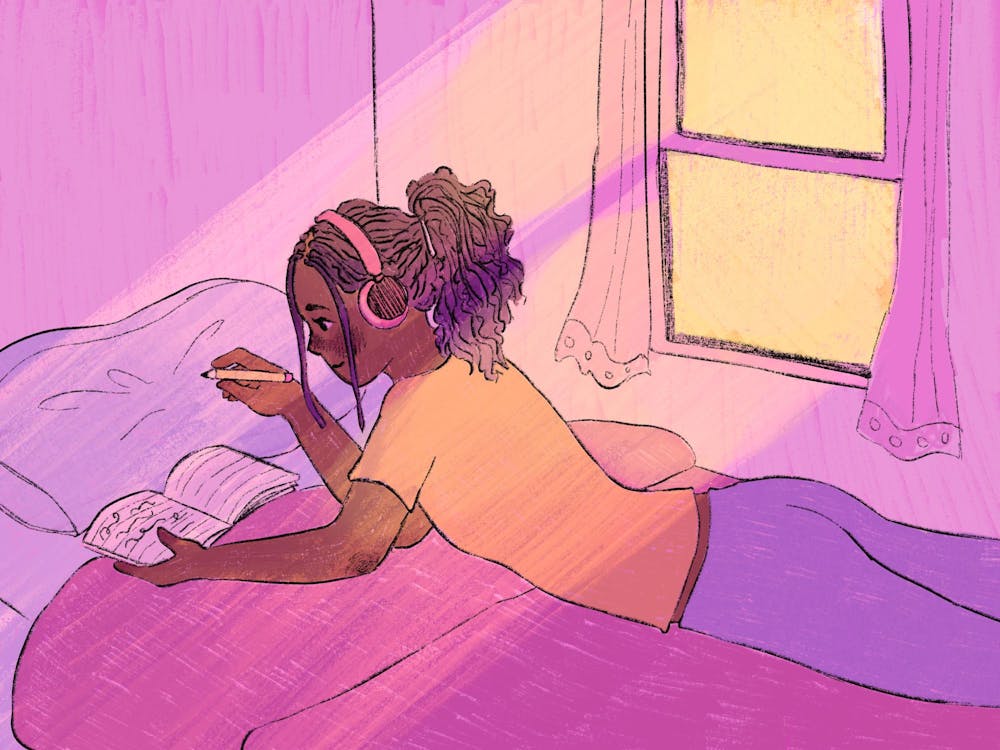
So for once, I decided to take my own advice. I rolled up my curtain to watch the sun slipping beneath Sayles, and I sprawled out on my bed with a notebook and pencil. I put on some music. I let my thoughts ramble out of my mind and onto the paper, and I didn’t bother organizing them.
I think we all yearn for moments in which we are fully and completely present; we had a lot of them back when life was simple, and then we got busy. But all that means is that sometimes you have to intentionally partition them out instead, to step back from the rat race and carve yourself an hour or two of joy.
And other times, beautiful moments can flutter into your lap when you aren’t paying attention. The best you can do then is cradle them, love them while they exist, remember them after they’ve faded, as everything does. Even now, all grown up, or at least partway there. The scratch of my pencil against paper. The crickets sounding the first beats of their nocturne outside. The evening breeze, gamboling through the open window to caress my sunworn hands.
Michelle Bi is a metro editor covering City Hall & Crime and State Politics & Justice. She is a sophomore from Oak Park, CA and studies English and IAPA. In her free time, you can find her playing guitar, the LA Times crossword or one of her 115 Spotify playlists.


