
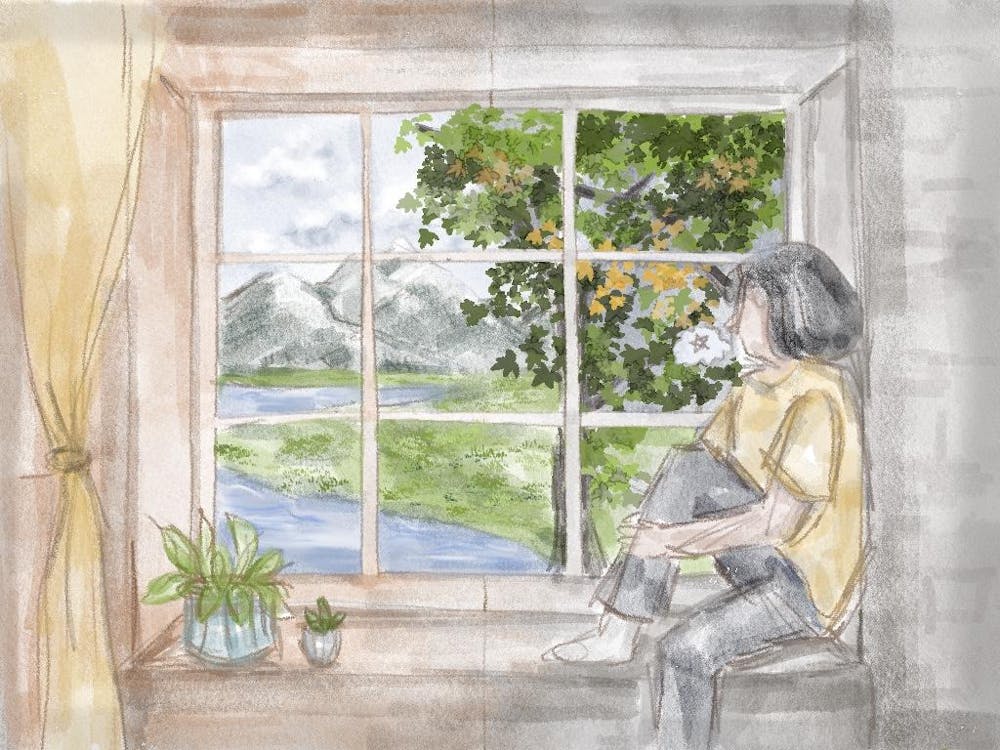
A gap in the calendar. A kind of pause that hovers as the months bleed into each other, when leaves flow in the wind and daylight thins into dusk. From a windowsill, the gap is like the pause between inside and outside, connecting what is still clinging to what has already stepped away.
A windowsill reserves a seat for me to spectate as October melts into November. Here, the past skims over the glass before disappearing into the streetlight muddle. Unlike doorways, which require crossing, a windowsill advocates hesitation. It’s a pause that signifies neither arrival nor departure. A surface that solidifies the perimeter between the drafts of air, the hue of light, and me. A surface that draws me in with the way it intertwines two atmospheres without insisting I choose a side.
In the heart of the Yellow River, a six-year-old me is perched on the windowsill of my grandmother’s apartment. The sill overlooks the river, and my younger self is engulfed by the scent of momo (a type of dumpling). I press my nose to the pane. I am able to fog over the glass and draw a star before it evaporates. As Grandmother calls me from across the apartment, I hold onto the balance of the warm scent of dinner and the sting of damp earth.
A place where comfort and restlessness are able to be propped against one another, tying the shelter inside to the curiosity outside. As the inside stays secure, the outside feels more mesmerizing. Held together at the sill, each feels more lively than if they stood apart.
Entering college and embracing the reality of communal bathrooms and dining hall food, I found myself at a newly presented ledge. This ledge, however, was one where the abrupt realization of adulthood came into play. In my dorm room, I begin sitting on the rim of my wooden sill unconsciously. Barely wide enough for my thigh, the mature wood creaks under the weight of my mood. My view of the cool trees and street contrasts the radiator’s hot breath.
Holding contradictions, the ledge interprets life inside while maintaining its framing of the outside. The cold outside air, full of anxiety and frenzy, kept separate from the cozy essence of the inside, where connections with others run about.
The angle framed by my window is that of two trees. Each tree latches onto the other by its branches. As they embark on the colorful transition into autumn, I entangle myself in this period of my life.
The days stretch on, lectures and late snacks hover against the life we left behind outside the glass, and the warmth of home, moments of belonging, and the comfort of routine lingers. From this seat, I see parents and children standing by their own windowsills, caught between the warmth of their homes and the outside world that they gently keep open for us. I see students walking out, half attached to their phones and half caught in the essence of their own unfurling lives.
The windowsill develops a social hinge. This border invites a natural gathering place, leaning into its edge to connect, breathing in the outside without leaving the warmth of the inside.
In my grandma’s residence, the windowsill is a portal of community. Neighbors pass to exchange greetings, resting elbows on the ledge as the scent of butter tea consumes the room. Conversations loom between departure and arrival. Yet the windowsill is always watching each passing moment.
Staring at the slab of sun-bleached and chipped wood, my mind finds room to wander. My dorm room windowsill, although new to me, reminds me of my grandma’s apartment windowsill. Even if the scent I smell is that of clean laundry, the window still calls for balance. There is a lesson within the structure of the windowsill: To lean out is to risk the cold and to lean in is to risk staying the same. The ledge provides a place for both, staying open for the draft of the undisclosed to meet with the warmth that holds onto you.
A windowsill is able to provide a stillness, forcing one to perch, to balance between leaning in and out. This balance is reflected in my current stretch of life, where I tilt between the freedom of independence and the warmth of returning home, letting the air of ambition and the coziness of familiarity coexist. Late nights under library lamps to return home to the scent of my mother’s cooking create crisp airs of ambition against the coziness of familiarity, both finding room to exist.
~~~
Every summer in my tween years, my family made it a point to make our way to the Amdo region to visit. It has been five years since I have been able to smell the fresh air of the Yellow River. But I remember not only the river, but the night of my departure. From a long pandemic to struggling to reach the doors into the Plateau, 13-year-old me had no clue of the obstacles that would revoke the opportunity to see my family each summer.
The airport terminal became its own windowsill. Here, I faced the pane of glass where the night stretched along the runway. I witnessed the blinking lights of parked planes in the midnight air, the travelers in the terminal lugging suitcases across the polished floors. Between the tarmac and the terminal, I felt that to lean toward the outside was to enable the ache of absence and to lean inside was to risk conformity. The windowsill, although unable to solve the dilemma, provided a ledge where I felt both the essence of departure and the tether of safety.
The ache of absence in my departure was sourced from not only leaving my family but the weight of their identity on mine. No longer surrounded by the aroma of fresh grass and momos, I was now left with only unfamiliar scents. Entering the airport that night meant I was unable to return to my family, only left with my household of three back home in California.
But to stay pulled just as much on my heart. To stay stagnant meant to leave the crashing waves of California, the constant reminder of nature’s patience, and to forget all that my family had built in the Golden State.
At the moment, I wasn't able to decipher the gravity of what leaving the airport meant that night. However, when given the moment to linger along the windowsill between family and comfort, I was provided with the privilege of a place to say goodbye even with a conflicted heart.
~~~
I will continue to search for windowsills during my time at Brown, some literal and some not. I hope to find new places where presence and absence, warmth and chill can share in their characteristics while providing a place where each can be understood in its magnitude. Now, as my fans hum softly in my dorm room, I am greeted with a warmth that brushes against the city air outside. It is a place that does not demand attention, but rather invites the solace of reflection.
There is freedom in the choice to lean on the ledge—letting your back stay in the warmth while you lean your eyes out on the edge. Both choices hold validity, but the tension between them continues to beat. Sitting at my desk, and reminded of the airport terminal years ago, I can still picture my longing. The glass I looked through reminded me of a windowsill ledge that did not provide solutions, but invitations to reflect and inhabit the spaces between the world that people hover against each day.
As I hope to return to the Yellow River one day, I am grateful for the time I was able to share with the windowsills I experienced there, those that allowed me to inhabit the simplicity of being present.
Windowsills, glass, and doorways constitute those small spaces that invite intimacy. Here, conversations flow differently, as a ledge provides air and a stage for observation. The active noticing of the inside and outside cultivates the patient border that does not force either side to overtake. It is often that we gather in evening lulls, while the sky meets the moon, hovering against ledges that let the outside and inside meet.
Even now, while I watch October turn to November, I find remnants of many windowsills in my life that have borne witness to my contemplation. I can remember the reflections that meet change, and the warmth that meets the cold.
As I finish my deliberation on what windowsills represent, I continue looking into the pane and carrying this quiet tension. I watch, with the fan hissing, the cars that pass, and the trees that grow into each other. The sill tolerates my half-formed observations to teach patience and humility that comes from watching through the frame as others negotiate their own ledges.


