Dear Amber,
I wasn’t wholly truthful with you. I know the assignment said “FICTION.” I saw the word standing proudly at the top of the page, clearly heard you say we were here to invent and imagine. I know that’s what this class was about. I know this was supposed to stretch me. I know it’s important to write fictions, and read fictions, and learn from them. But I choke up when I see that word. It’s quicksilver down my throat. I’ve tried to put pen to paper and boldly go it alone, and I’ve tried to map more elaborate plans as an amulet against the tides of uncertainty, but neither works. I cower when confronted with the wide-open expanses of fiction. It could be anything, and that is the problem.
—
Amber, I should note, was my high school creative writing teacher. Present Sophomore Me thinks of Sophomore Me of High School as, well, sophomoric. An aspirational “writer,” whatever that means. Because it’s important, because it’s noble, because it’s interesting, defendable, or any other adjective with heroic potential. A mink-lined cloak to shield me from the pedestrian. So superior, yet so insecure. I either knew or felt I needed to improve my writing, to render it impregnable to the assaults of criticism. In hindsight, the class didn’t necessarily achieve those lofty aims, but so few things do. Realistically, I thought it would maybe be an outlet for angst, perhaps where I’d find an inlet into myself, or even—forgive me—a safe harbor. I don’t believe I’m alone in thinking that Amber’s were daunting tasks to be assigned, however. “Write something.” It must meet some minimum standard of originality, be consistent in voice, work towards a plot, and, crucially, make sense to someone outside of your head who definitionally suffers from the chronic condition of having fewer details than you, the writer. Young writers think this is curable. It is not. Too many details suffocate a story. The writer will always know more, the reader will be left wanting, and the quest to resolve this fundamental imbalance is one you will always lose. Grown-up writers, I think, don’t try so hard to resolve it. After all, a good story wants to be chased.
—
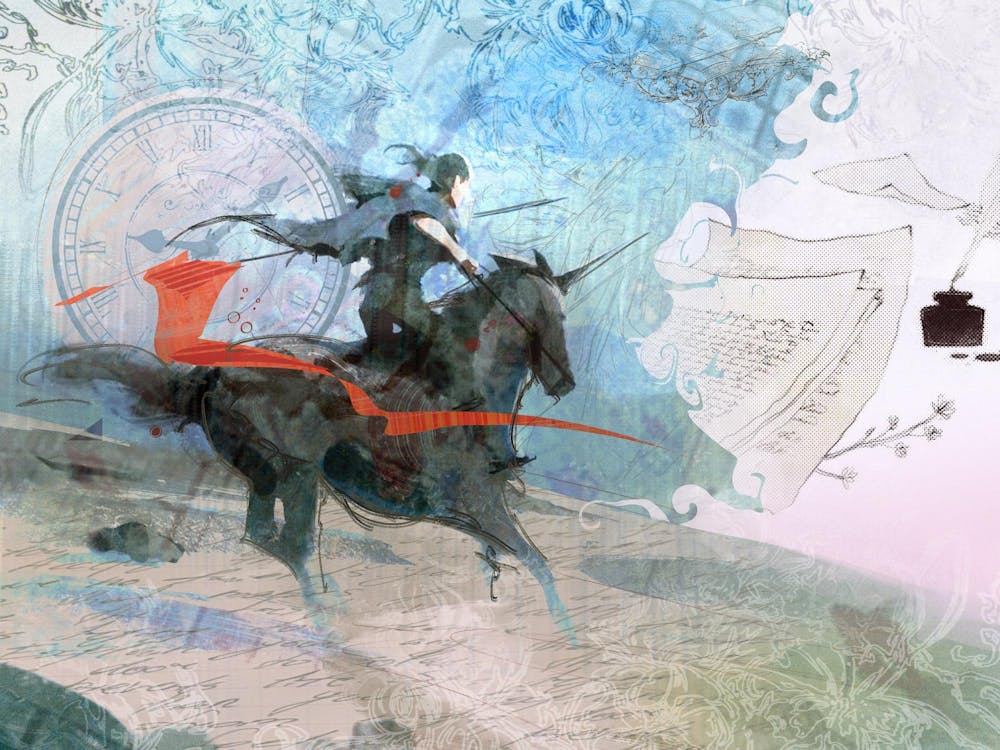
Even now, the hunt is on—I know this is not a piece about creative writing. I’m just trying to figure out how to tell you that. This is a piece about The Once and Future King. I read T. H. White’s elegiac tome for the first time at age 11, a notably larger undertaking of my school’s “lit club.” Published in 1958, The Once and Future King is a retelling of the legends of King Arthur, as all Arthurian texts are, and particularly inspired by Thomas Malory’s 15th century Le Morte d'Arthur (shockingly, an English-language text). Odysseying through it week by week, I equally suffered the devastating blows of “Six other years passed by” and reveled in the joys and suspenses of “Queen Morgause stood in the moonlight, drawing the spancel through her fingers.” If you’re looking for world-class fiction, The Once and Future King might be the definition of it. Yet as I read White’s treatment of the Arthurian legend, it seemed like he was cheating. He had the contours of the story already and thus I presumed White’s job was only to color them in, making the genre assignment of "fiction” feel somewhat unearned. Color them in he does—White sprinkles quests throughout Arthur’s previously unremarked-on upbringing, renames him “the Wart,” and exposes the proto-king to theories of war, virtue, and societal organization to render him a more robust character. And sometimes, White floors you:
“The place in which he found himself was absolutely flat. Here, in the belly of the night, the illimitable, flat, wet mud was as featureless as a dark junket... In this enormous flatness, there lived one element—the wind… In the human world, the wind comes from somewhere, and goes somewhere, and, as it goes, it passes through somewhere… This wind came from nowhere. It was going through the flatness of nowhere, to no place…”
This is how I feel about writing fiction. I am thrust with no warning into an oddly-dimensioned expanse, too large and strange to comprehend, too foreboding a place to even scent a hint of future triumphs. Told to write a short story, I produce either a blank page or a diary entry. I’d never seen my feelings characterized so deftly before. Some would quibble with me here, say this passage isn’t evidence of my true cosmic bond with T.H. White, that actually, any kind of novel experience and its accompanying uncertainty would be similarly aptly characterized by this excerpt. I beg to differ. Were this just a description of something merely new, it would not be so vacant. A novel experience isn’t this terrible blank void, it has at least some ridges, influences, schematic bleed from other life experiences. White insists that here, this is not the case: “the total features of [this] world…darkness, flatness, vastness, wetness: and, in the gulf of night, the gulf-stream of the wind.” The only features in this odd world are generally ones that humans try to pretend we can master—inventing walls, lights, and dehumidifiers to assuage our fears. Frightening. I should again make mention of the fact that T.H. White isn’t the protagonist of this story, and thus not the one experiencing this blankness. “He” in this passage is, of course, the Wart. He’s just been told by a talking owl that it’s time for him to try living amongst the wild geese, and the above lines are what immediately follow. These are his only touchpoints—yet rather than being concerned about his new avian nature, he observes his anomalous surroundings. Yet this blinding blankness doesn’t phase the Wart as much as it phased me. No, the strangest thing in this alien goose colony for the Wart is that he is told of the absence of War. I think it’s because it’s paralyzing. As a squire, his job is to serve knights, and knights serve War. He is the footsoldier of the footsoldier, to an organizing scheme he’s now being told doesn’t even exist. Please understand this—transforming into a goose? No biggie. Enormous, illimitable flatness? Not his problem. But the absence of war, the unthinkable potential of a world less bellicose, arrests this future king. Much as I feel fiction rushing by me when I try to write, a harsh stream forever out of reach of my ever-trying pen, so too is the Wart swept up:
“The Wart, facing into this wind, felt that he was uncreated. Except for the wet solidity under his webbed feet, he was living in nothing—a solid nothing, like chaos. His were the feelings of a point in geometry, existing mysteriously on the shortest distance between two points…It was power, current, force, direction, a pulseless world-stream steady in limbo.”
It does feel like I am an unbelieving point that lies on the shortest distance between two points—the start and end of a story. I have a hard time finding those points, and it feels like there would be less resistance if I assigned them nonfictionally in a grand proclamation, but this is not the quest I’m on. What comes out of the writer is fast and uncontrollable and the only thing they could have produced, but it is not to be taken uncritically. The “flow” state of the writer is far more literal than it’s generally taken to be. After finding where the water is coming from, and opening a faucet to let it out the other end, the job of the writer is to hold steadfast. The Wart isn’t a writer, but he does cultivate fortitude and resistance to the immense pressures rocketing by him—hunger for power and the hegemonic belief in “Might is Right.” We later learn that his “shortest distance” should produce justice, but to traverse it, the Wart must resist the seemingly easier path of battle, of deciding what is Right preemptively. The resistance of this moment is visible in the novel, as these windswept passages are entirely distinct from their textual surroundings. Much of the preceding chapters’ airtime was taken up by encounters with knights and falconry and hay-making, a kind of blurry, inconsequential background. (Perhaps it’s intentional that the knighting and squiring all feels so small in comparison to this one moment of wilderness.) When the Wart returns from the geese, it is with a store of fortitude he will later tap. When I left my writing class, I had perhaps written no fiction, and the Wart had engaged in no War, but we were both better prepared for any future encounters. Reading this passage just the one time mapped it indelibly onto the surfaces of my brain, elevating it above any of the more topical installments. If I were to recall any passage from the story, it would begin here.
—
If I am to be read as the Wart as well as White—for we have outlined my quest, preparations, and sent me off on it—and I am similarly thrust about, then I too must encounter something even stranger in this limbo than the limbo itself. My “absence of War” moment in this strange land, my unthinkable alternative, is something, then, that I bring from my world to the realm of fiction, only to fail to encounter an analogous concept. I lose my envisioned lifelong purpose—my particular noble conception of writing—somewhere. The Wart brings his squirely upbringing and romantic fantasies of battle to the peaceful geese (peaceful being a misnomer, for they have no alternative disposition) and finds no Wars to win with them. I bring my fear of fiction, my aspirations of writerhood, my need for guidelines in this featureless expanse, and am met with the uncomfortable reality that fiction or not, life has no pre-existing contour. So perhaps my homegrown War is both my fear of all this and my lust for Write. The Wart learns that War is not the way—the everpresent axiom “Might is Right” is wrong. I learn that fear is not what I need—knowing is not knowable. There is no track to uncover for my characters and truly, there isn’t one for me. My corruption, albeit perhaps a less visible one than literal battle, was believing that Write is Right, and that there’s a winner after feats of Write—whether it be me, triumphantly writing better and more muscularly than everyone else, or whether fiction would best me in the end. But eventually the Wart stops looking for War, and I must stop looking for certainty. The Wart’s life is somewhat inseparable from Might, and all he can do is try to resist its heady allure, employ it only where good and necessary. This is my goal with Write.
—
Nestled in this eldritch passage is a brief glint of relief—“Two miles to the west, there were three spots of light in a triangle. They were the weak wicks from fishermen's cottages, who had risen early to catch a tide in the complicated creeks of the salt marsh. Its waters sometimes ran contrary to the ocean.” Not so flat and featureless as it had seemed earlier. The horrifying expanse is not such an invisible labyrinth, and perhaps, I can find somewhere to start a fiction. The inhospitable two-dimensionality of this plane becomes 3D enough for me to inhabit it without being crushed. Yes, the idea of each miniscule moment of a fictional text being intentional is terrifying. Or each moment of any written work, actually—this included. But there’s a balance between fully writing nonfictions, as I admittedly did for Amber (sorry again), and just bringing a little touchpoint along to align my earthly dimensions with that of the story. If I’m not going to War, I don’t need the armor of a story having “actually happened” to defend my plot choices. It is beautiful to make a home for wayward Fictions, which, unlike Nonfictions, are only accountable to the self. Where else would they live?
—
Today, I’m largely uninterested in writing fiction. Though I am interested in not being afraid of it.


