Who am I?
Dora Jar is asking and I don’t have an answer. January and the sky is huge. Twilight and the snow is on fire. Twenty-two and I’m wrong about everything. There’s ice crusted on the hem of my jeans. The wind wraps its fingers around the backs of my eyes. My fingers blush.
I have to pay attention to these things. I have to catalog all the details in order to feel them. So it’s bitterly cold in New Jersey and yet I’m out in the forest behind my neighborhood wearing far too few layers, letting the cold bite me. I’m listening to Dora Jar’s “Timelapse” on loop, her slow question fading into guitar, a strumming pattern that feels like afternoon sunlight on a windowsill. My old Uggs, waterproofed back in 2015, slip against the snow. My cuticles are bleeding.
Wonder, wonder, who am I? She keeps asking, and it’s too big to keep inside my head. I try saying aloud, “Who am I?” which isn’t enough, so I try shouting it to the empty woods. Then: “What do I want?!” The trees don’t have an answer either. They’re so obstinate, still and quiet. I feel, stupidly, like I want to cry. But for a moment, I pause to watch the sun burn neon between their silent trunks, slipping towards the horizon, amber slicing divots into the bark. And that’s the best answer I get all afternoon.
*
Knowing myself used to come so naturally. Whenever I’m home in New Jersey, I sit in my childhood bedroom—still so purple, still so decked in fairy lights—and read my middle-school journal, which overflows with confident assertions about exactly the kind of girl I was, exactly the kind of girl I was going to be: I was going to get out of my hometown, I was going to get the best grade on my geometry test, I was going to write a bestselling novel, I was going to get the boy who sat in front of me in English class to ask me out because my friends liked boys so I should, too. I never seemed to have any doubt or room for ambiguities; I was certain about what I wanted, and I was hell-bent on getting it. I was bright and optimistic, tough and headstrong and blunt and self-righteous.
Knowing myself feels so challenging now. My OCD makes sure of that. It’s nearly impossible to know which thoughts really belong to me—nearly impossible to tell the difference between a comically unrealistic intrusive thought (My hand is itchy because a bat got into my room and bit me in my sleep and now I’m going to get rabies) and a good gut instinct (My hand is itchy because it’s winter and my skin is dry). Nearly impossible to know what I meant to think.
In “Timelapse,” Jar sings, “Don’t stop twinkling, red light blinking / Break my mood ring, friendship sinking / Keep on going like a worm in the dirt, don’t give up now.” Break my mood ring. I always liked that phrase, hoping that one day I would be able to trust myself rather than depending on something external for guidance—that I alone could dictate how I thought, felt, and responded. I wouldn’t need reassurance from a mood ring or the Internet or a sign from the universe. I wouldn’t over-assign meaning to every little detail I encountered. I would simply know myself.
I’ve lived with OCD my entire life, but it always gets louder when I’m standing on the precipice of something massive. What if I’m making a terrible mistake? What if it’s forever? What if one choice ruins everything?
I struggle to draw a distinction between what I am afraid of and what I simply do not want. And so I am always looking for something and never finding it.
*
I started going to exposure therapy last fall. Early on, my therapist says that learning to tolerate uncertainty is my only way out. She says that whenever I feel like something awful might happen, I should tell myself, Maybe that will happen, maybe it won’t. I don’t know, and I’m not going to try to figure it out right now.
I drive home after that appointment, back up I-95 to Providence. October and wet red leaves are plastered on my tires. October and the interstate is soaked blood orange. Earlier, I had touched a door handle—not even with just a finger but full palm splayed out, fingers curling around the cool metal like it was the hilt of a sword, like it was something dangerous—and it set my hand on fire.
My playlist has already looped through when Spotify decides that Indigo Girls’ “Closer to Fine” is next. I let its familiar tune wash over me as I switch lanes—there’s a familiar tune to switching lanes too, the click of the blinker and the rhythm of the car. That’s when I hear it, right there in the chorus, lines I’ve listened to a thousand times and never thought twice about: “There’s more than one answer to these questions / Pointing me in a crooked line / And the less I seek my source for some definitive / Closer I am to fine.”
More than one answer: Maybe, maybe not. The less I seek my source for some definitive: I don’t know, and I’m not going to try to figure it out right now. Closer I am to fine.
Once I get home, I touch everything. With all of my fingers, both of my palms.
*
Two Aprils ago, I watched I Saw the TV Glow and first heard yeule’s cover of “Anthems for a Seventeen-Year-Old Girl” on the film’s soundtrack. It would later become my #1 most played song of 2024 (just as “Timelapse” became my #1 song of 2025). I kept coming back to the moment when the bass and synth kick in for the central refrain, and suddenly the quiet song gets loud:
Park that car
Drop that phone
Sleep on the floor
Dream about me.
I lied earlier, when I told you that my middle-school journal was full of confident assertions about exactly the kind of girl I was. I can be a bit of an unreliable narrator. It’s true that many entries were brave and unencumbered. But for each entry like that, the next day, the tone would shift: “I threw out my lunch today because I was afraid it had E. coli.” “I almost made Mom pick me up because I was too scared to use the school bathroom.” “I panicked during my field hockey game because my mouth guard fell on the locker room floor, so I played like shit.” Afraid, afraid, afraid. I had been so sure that my OCD was protecting me, keeping me in control of my own life, yet it really only made me feel lost.
But then I look at the girl I’ve become in spite of being afraid. I moved to Providence and later to Copenhagen completely on my own. I eat eggs again now, even though they fundamentally freak me out, because I also really like them. I write for this magazine, and I play club field hockey, and I am running my second half-marathon in April, a few days after I present my honors thesis. I drive my friends to get frozen yogurt, and they make me laugh. I go on adventures with my girlfriend to random cities like Milwaukee and Columbus, and these places turn out to be pretty cool.
I once told her, “I don’t think I’m the kind of person who leaps. I think I’m the kind of person who looks for reasons not to do things.” I think now that was a deeply unfair assessment of myself—I am constantly leaping. Doing anything at all is a total leap of faith when you can never be quite sure of what will happen next. So I know that my 17-year-old self could only dream that I would become exactly the person that I am now, scared shitless but doing it all anyway. Sleep on the floor, dream about me. She was so afraid yet so, so fearless. I am so afraid yet so, so fearless.
*
Knowing myself feels so complicated now. Not only am I trying to figure out what I want as I face one of the greatest transitions in my life, but I am also learning to disentangle who I am from what I fear. Yet there isn’t any urgency: I don’t know exactly what it is I’m looking for, and that’s okay—I don’t need to figure it out right now. Things can change. Things will change. Things have to change. Maybe it’ll be great, maybe it’ll be terrible, but either way, I’ll survive it, just like I always have. As I was once told, “The only thing worse than coping is not coping.”
*
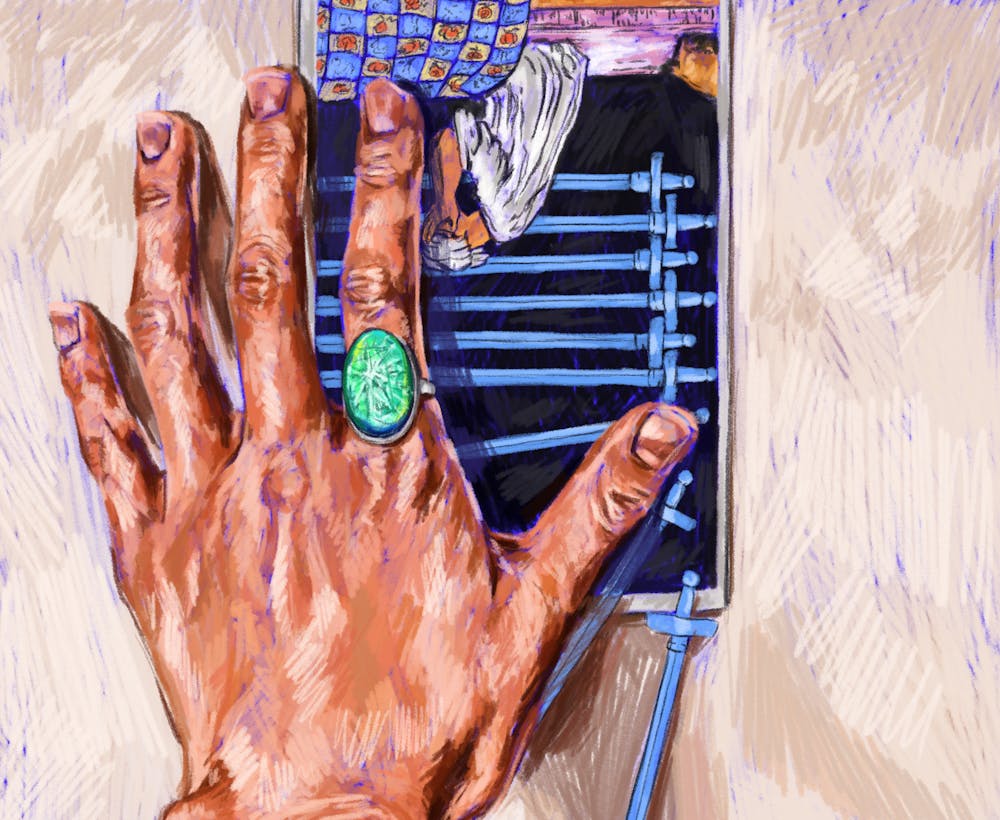
On my 22nd birthday, my mom and I are in New Orleans to celebrate. November and Louisiana is humid and alive. November and my hair is frizzy, curls like wires. One of the shops near Jackson Square has a tarot vending machine, dispensing a card in return for a quarter. I don’t know much about tarot, but I know lots about soliciting a sign from the universe, so I pay the quarter, crank the handle. Out comes the Nine of Swords, upright. The card displays a woman, face in her hands, sitting up in bed against the backdrop of nine swords. Six of them seem to cut right through her. She is immortalized, eternally impaled.
Oblivious, I look online to find its meaning, and I’m instantly confronted with: “Fear, anxiety, terror, negativity, deep unhappiness, stress, burden, overwhelmed” (thetarotguide.com). “This is the card of 3 a.m. anxiety, racing thoughts that won’t stop, and the mental torture we inflict upon ourselves through worry and catastrophic thinking” (theselfgazer.com).
I read these descriptions out loud, take one look at my mom, and instantly we burst into laughter at the sheer absurdity of it all—what an awful omen for my twenty-second year! When I get back to my apartment in December, I Fun-Tak the card to the wall right above my desk as a reminder: Don’t become the Nine of Swords.
Each day that I look at it, though, it unsettles me. It reminds me of all of the times I’ve been awake at 3 a.m., stuck in the loop of my fears: What if I get nauseous? What if I have brain cancer? What if I wake up tomorrow and accidentally make a decision that ruins my life? I might not quite know who I am yet, but I do know that I am not someone who has ever let my fear govern me, or who has held back from chasing whatever it is I think I want.
Dealt upright, the Nine of Swords is a terrible omen. But a friend taught me that tarot cards take on new meanings when they are dealt reversed, flipped upside down. When the Nine of Swords is reversed, it inverts the ominous message, instead symbolizing a release from worry, the light at the end of the tunnel, “overcoming shadows” (elliotoracle.com). Trusting yourself, embodying yourself, knowing yourself.
So I flipped the card, Fun-Tak’d it back to the wall, this time reversed. Break my mood ring. I don’t care how the card was dealt to me, I don’t care about the fate it imposed upon me, I don’t care if the universe was trying to freak me out. Sometimes there is no higher purpose encoded in the signs we receive: Sometimes things are just fucking random. The Nine of Swords now hangs on my wall upside down, the woman sitting up in her bed dangling suspended like a bat, the swords ready to drop straight down and out of frame.


