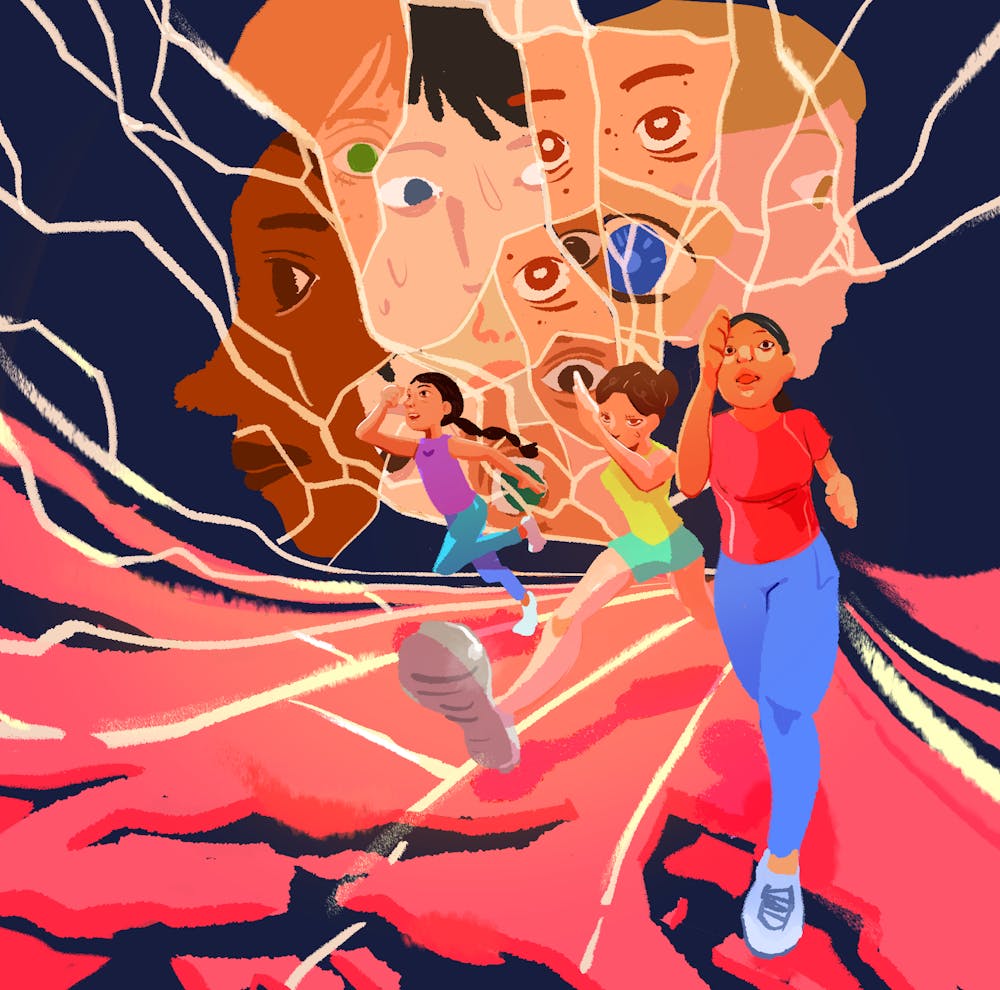
Unathleticism has a way of creeping into your identity. Growing up, I was surrounded by athletes, most notably my mother, who ran D1 in college and then stumbled into a marathon addiction in post-grad life. Both of my younger brothers are gym rats, with the youngest having run his first marathon at age 15. I am the only member of my family who did not run track and cross country in high school. Hearing my mother tell the story of how she and my father got together, I think it was in large part due to running: he was one of the only people from their company willing to run with her on early mornings following late-night boozy work functions, leading to their eventual union.
In stark contrast, though I was forced into more sports as an elementary and middle schooler than would be productive to list, I wasn’t good at any of them. I thought of myself as clumsy, slow, and untalented, sometimes even a liability to the team. By the time I gained enough autonomy to be able to quit, I did so with great enthusiasm and disdain. I hated running and most forms of exercise, even though I desperately wanted to be the kind of person who was disciplined enough to have a daily fitness routine. Being unathletic and unfit became more than just a characteristic of the hobbies I chose to pursue, the ways in which I allocated my time, and the metrics of my overall health. It was a piece of my identity. It was something that separated me from my family, and from an idealized version of myself.
In theory, exercise should just be exercise. It should bestow the benefits studies have shown it to bestow—no more, and no less.
In practice, exercise and identity are deeply intertwined.
In the case of my high-school self, my relationship with fitness reflected the overall patterns of how I engaged with myself more broadly. Every skipped Chloe Ting Ab Challenge video was evidence of a lack of discipline, every inability to follow a workout class was telling of general incompetence, and every quickly fatiguing hike was a sign of a poor work ethic. Exercise existed, it felt, to prove me unworthy—not just of the benefits exercise can provide, but of a whole host of seemingly unrelated virtues. While this conflation of self-worth and fitness is not solely experienced by women, gender does impact some of the specific ways in which it plays out. I frequently found myself comparing myself to gendered exercise archetypes, and falling short.
Eventually, this would change, as I discovered a true love for certain types of movement, and, just as powerfully, I realized that I could skip the ones that didn’t resonate. And yet, the identity politics of exercise remain.
Gender is not inherent to any form of exercise, and yet the ways in which we engage with certain types of fitness are difficult to extract from the stereotypes surrounding them. It is not just a matter of fit or unfit; society has created new sub-identities.
The way I view myself in relation to the fitness world did not just change as I went from what I would call unathletic to what I would call athletic. My self-perception changes with every different exercise I do. I am a different person on a yoga mat than I am on a track.
And, unfortunately, the way I see other women changes too.
I. Pilates Princess
I came to Pilates, as many do, in a moment of desperation.
I had considered getting into it for years, intrigued not just by the purported physical and mental health benefits, but perhaps also by what Vogue calls “a trend of Gen-Z and millennial women who have made Pilates not only a lifestyle, but an aesthetic too. Picture Stanley Cup-wielding, tote-carrying women dressed in matching Lulu Lemon sets…grabbing an iced matcha on their way out of the studio.” Sounds close enough to modern-day royalty to me. I wanted to ascend into that elite ring of women with lives going as smoothly as the slow, controlled, repetitive movements they practiced.
But aspirations aside, I never actually managed to sign up for that first reformer class until both my love and athletic lives began to sputter at the same time. I’d fallen into a rut in my running, my speed plateauing for the first time since I’d begun doing it seriously. So when my boyfriend dumped me right after a failed set of 800s, I finally downloaded ClassPass. If I wasn’t going to start the next semester with a faster marathon time, then I at least wanted lean legs and abs. The kind of toned physique that says, I’m better off without you.
This is, of course, a well-documented myth. Pilates is good for improving core strength, strengthening posture muscles, promoting balance, reducing back pain, and a whole host of other physical benefits. It does prevent injuries, boosts immunity in older adults, and may even reduce symptoms of depression and anxiety. It’s really fun. The carriage on the reformer reminds me of structures I would find on playgrounds as a kid.
What it doesn’t necessarily do is make you lean, or toned, or any of the images that come to mind when you think “Pilates body.” The reputation of a Pilates physique likely came into existence around the 1930s, when professional ballet dancers (some of whom were former clients of Pilates founder Joseph Pilates) began touting its rehabilitative effects. Many of those same ballerinas went on to become Pilates instructors or start studios of their own, and thus the strong association between Pilates and a particular body type was born. Pilates—while useful for a wide variety of other reasons—“didn’t make these early adopters long and lean; they were simply long and lean women who happened to practice Pilates.”
And yet, my awareness of all that didn’t stop me from filling my water bottle, donning a purple sports bra that matched my leggings, and walking to the studio. I had lost control of my ability to run at a particular speed, as well as my ability to make a particular boy love me. Booking a class seemed much easier than dwelling on a failed relationship and a failed sub-3:20 attempt. I texted my mom the night before, “im going to be a pilates princess im so excited.” And she responded, “Does that make me a pilates queen?”
Truthful marketing or not, there is an aesthetic surrounding the “Pilates Princess” that is difficult to shake off. Some of it has to come down to the term itself. Why call someone who goes to Pilates a princess? Alliteration, obviously. But alliteration alone can’t account for the fact that there are far fewer Pilates Princes.
Of course, that’s not to say there were no men at the Pilates classes I went to, but there were certainly fewer of them. The data seems to agree with the anecdotes—one June report claimed that 72% of Pilates-goers are women. Though the benefits of Pilates apply to people of all genders, much of the messaging of Pilates is targeted towards women. Some of this may be changing as fitness spaces become more inclusive and common misconceptions surrounding Pilates are debunked, though often the sell of the Pilates Princess is that of the sophisticated, graceful, elegant figure. Fit in a feminine way. The princess, with her matching sets and aesthetic water bottles and air of togetherness, was born and continues her reign.
Maybe that’s all overthinking it, and the real meaning behind the term is simply that a Pilates class can cost anywhere from $10 to upwards of $100. Princesses are not just women, but also rich. How much of elegance is femininity versus wealth? Or, alternatively: in our current society, how much of femininity must be bought?
Perhaps there is accessibility to be found in stretching your two-week free ClassPass trial to the full extent of its potential. I signed up for as many classes as I could, testing out the various studios of Manhattan, and even purchased the cheapest month-long new client class bundle I could find once my free subscription expired. Even so, I don’t think I kept up with the discipline long enough to truly reap all of the benefits.
And yet, there was something oddly calming about lying under the soft warm lights on the reformer, watching myself stretch out and back in the long mirrors lining the walls, slowly, smoothly, over and over again, alongside all these sophisticated New York women (with a few members of other genders, and a few that seemed not so different from who I had been before walking through the studio doors). There is something about going to a class, placing your body in the trust of an instructor, and leaving feeling as though you’ve accomplished something. The aesthetics of the studio pull you in—immersed in sleek wooden floors, silky high ponytails, and flowery logos inundating everything from the sign above the door to customized $20 grip socks for sale next to the reception desk. You can’t help but feel as though you’re a little bit of everything that was advertised to you—the picture of aesthetically hydrated grace, style, and wellness, a self-care goddess with her shit together. If you had asked me then, abs tense and heart broken as I strained against the various pulleys and straps that have been likened in many a standup set to a torture device, I would have said I felt long enough to stretch around the entire world.
II. Muscle Mommies
While scrolling between sets, sitting on a hip abduction machine in the Nelson, I came across a reel in which a creator interviewed various male gym-goers on the controversial question: “Muscle Mommies or Cardio Bunnies?”
Many respondents answered that they would prefer an avid frequenter of the stairmaster, the erg, or the treadmill—one explained, “It just looks better.” Perhaps this is part of the reason some women fear becoming too “bulky.” Large muscles, particularly the upper body, go against the grain of the current dominant beauty standard.
Still, I can remember at least one TikToker stating that a “Muscle Mommy could take care of me.” The role of the caretaker—and the mother—may be one associated with stereotypically domestic roles assigned to women. But “taking care,” in the context of large muscles, more likely indicates a complete reversal of traditional gender roles. The Muscle Mommy, in this scenario, becomes the protector.
And all this being said, a jacked physique doesn’t seem to cater to the typical male gaze. Women face inordinate amounts of pressure to become the opposite: small and slim. When you lift heavy, words like “massive” and “huge” suddenly become good things. That’s sort of magical. There’s really nothing quite like the endorphin rush of a successful set of shoulder presses, followed by looking in the mirror and, for the first time, not being afraid of being too big—when the number of pounds on the scale becomes less relevant than the number of pounds on the bar.
III. Cardio Bunnies
I do at least three times more cardio than weight training and Pilates combined, but I have never once considered myself a Cardio Bunny.
The top two entries for “Cardio Bunny” in Urban Dictionary are: “a fine female specimen found near elliptical, treadmill, stair-stepper, or other calorie-burning equipment” and “Those people (usually women) that you see in the gym every single day whose entire workout revolves around cardio exercise… They get all sweaty and really think they're killing it in the gym, but as time goes on, you notice that their bodies look no different because they plateaued ages ago. That girl hits the gym almost everyday and she's thin and flabby at the same time. Must be a cardio bunny.”
As the definitions indicate, it’s not a term imbued with a lot of respect, and it’s one I have never heard used to describe a man. I do not know where the word comes from. Something to do with Playboy Bunnies, perhaps? Even if completely untethered to any sexual connotations, the bunny rabbit is not exactly the most inspirational athletic figure.
Pilates Princesses and Muscle Mommies will sometimes describe themselves as such, proudly, affectionately. And, sometimes with rivalry but often in reverence, a Muscle Mommy will mention a Pilates Princess and vice versa—a respect for the exercise that is not yours, a respect for the multitude of motivations and goals that exist within the fitness community. The terms “Pilates Princess” and “Muscle Mommy” can certainly be diminutive or derogatory, but can also be ones of endearment. It is far rarer to hear someone describe themselves, with no self-deprecation whatsoever, as a Cardio Bunny.
Cardio, in theory, could encompass a vast range of activities—rowing, swimming, biking, and, in my case, running. But within the Cardio Bunny scope, it seems to mostly be a term that applies to equipment in the gym—Cardio Bunnies as the foil to Muscle Mommies (or heavy lifters in general, regardless of gender). You don’t call an Ironman, for example, a Cardio Bunny. Most runners identify as runners—hybrid lifters, maybe. Maybe there’s just more respect to be found in specificity and specialization.
And sure, there’s definitely a difference between a Stairmaster Warrior and a Marathon Runner. One wants to get fast. The other wants to get fit. They’re different goals, even if one isn’t inherently better than the other (and is there actually anything wrong with aiming to improve cardiovascular health rather than physical strength or athletic metrics)? But the lines get blurred sometimes.
What about the casual jogger on the treadmill? Is their run framed as thirty minutes of cardio in order to burn off a few calories? Or are they a marathon runner building general aerobic fitness by squeezing in an extra three miles into their training schedule at an easy pace? Does the mindset matter if it’s the same workout?
These days, I do most of my runs outside, but I began my running journey on the treadmill in my parents’ garage, which felt safe and hidden from judgment. Still, there are days I find myself inside again, particularly in the bitter winter months. Can cold weather and icy sidewalks transform you from a marathoner into a rabbit?
When I began running, it was with the explicit purpose of losing weight: a Cardio Bunny approach to running. This is not to say that this is always the Cardio Bunny case—sometimes the aim is improving health or fitness—but weight loss is a goal that is often dumped onto women in order to fit an ideal body standard.
At some point, the therapist I was seeing at the time told me she thought I was headed into eating disorder territory. Fasting before cardio in order to better burn fat, long runs with no fuel. I had adopted a senseless training schedule optimized for burning calories rather than speed, which included a ludicrously abrupt build in mileage. A complete lack of understanding of the physics and physiology of running. I came down with a bad but predictable case of shin splints, and on the second day of not being able to run, woke up screaming from a nightmare in which I had suffocated in my own fat.
But what got me out wasn’t dropping the running altogether. Ultimately, at some point, you have to choose between speed and “skinniness.” I haven’t lost much weight in the past two years, but I’ve shaved 53 minutes off my marathon time. Come this May, hopefully a few minutes more.


