
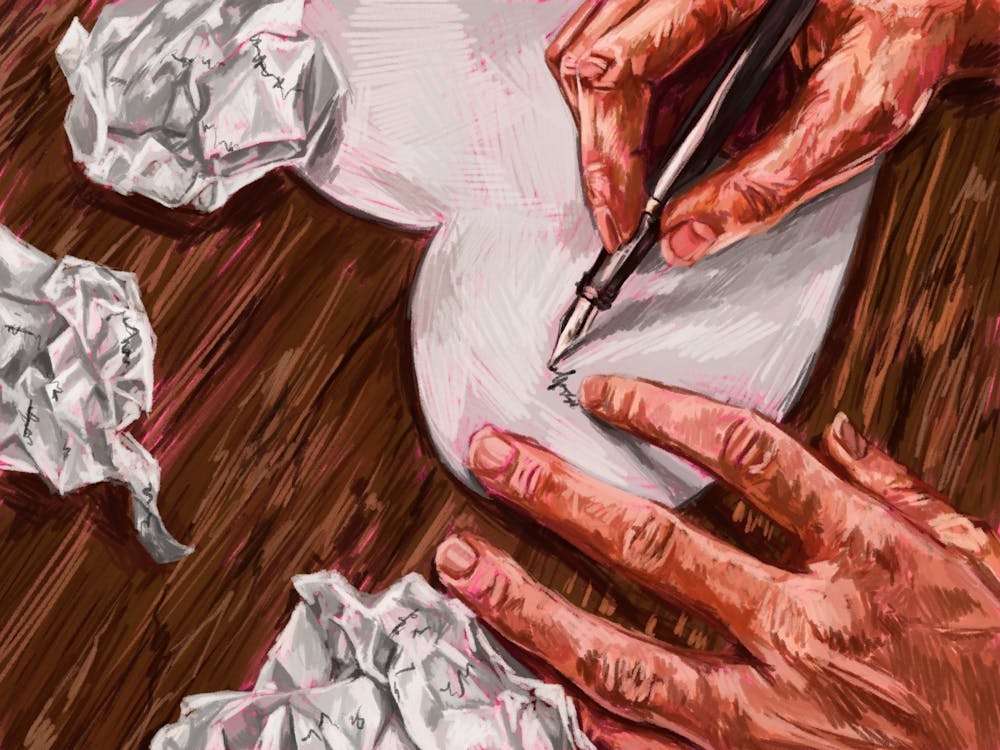
Over winter break, I began writing poems. This was unusual behavior for me. As I wrote in one such poem, “When I first met the poem / I remember hating it more than the illness that was in my body at that time / That made all the adults around me act so / Weird.” Specifically, I resent how “Poems are so stubborn / They never tell you when to / Begin the next line or / When to compare a smile to the trees in autumn or when / To end the whole thing.”
Slowly but surely, my poems got better over the break. I began to hit the return key with more confidence and started to develop an instinct for when the poem had reached its end. The poem and I are still not friends, but we returned to Brown this spring as begrudging acquaintances.
Unlike my writing for post-, however, these poems are going nowhere. They won’t ever live on the internet or within the neatly bound pages of VISIONS magazine. They won’t ever feel the weight of hundreds of eyes upon them or win me money in any writing contest. Instead, they will live as Pages documents on my desktop for perpetuity. The only person who has and will ever see them in their entirety is the person they were written for and about. I refer, of course, to L.
L and I met in the summer of 2023. On our first date, I had no idea he would be responsible for so much of my best writing. At the time, he was just a beautiful stranger who also happened to be in Providence for the summer. “In every universe, / There are two people sitting on a rooftop, / Watching the sunset, / Ignorant of the beauty and vastness that awaits them. / How could they know? / They’re not us yet.”
The first piece I ever wrote for L was a Valentine’s Day letter. I remember the day I wrote it vividly—it was a snow day and all my classes had been cancelled. L was abroad, and I missed him so much it physically hurt. I had three items on my Notes app to-do list for the day: 1) build a snowman, 2) study for my history exam, and 3) write a Valentine’s Day letter to L. The third was easily the hardest task—writing something that was only for the eyes of one other person was a foreign concept to me then.
The letter ended up taking hours longer to write than studying for the exam did. “I’m struck by the inadequacy of language when it comes to describing how it feels to love you and be loved by you,” I complain in the letter. But that’s one of the things I have come to love most about L—the way he shows me where language fails.
I’ve always been someone for whom words come easily. Constructing arguments out of complicated words and footnotes is enjoyable to me. When I did debate in high school, I had a knack for finding harsh, biting words that would win me Best Speaker awards to put on my bookshelf. Confrontation doesn’t scare me, because I often know what to say. Putting the most difficult details of my life on the internet via my creative nonfiction doesn’t frighten me because the words are mine.
L, of course, changed all this. He came into my house and turned the chairs and tables upside down (metaphorically, of course). Suddenly, the previously unused erasers at the ends of my pencils became grey. How do you describe a face that, to you, is more beautiful than a perfect summer sunset? How do you describe any part of the only other body you’ve ever known as well as your own? How do you describe the feeling of an angel entering the room and sitting down next to you while everyone else in the Ratty acts as if it’s business as usual?
The answer, of course, is that you never really can, but there is much beauty and pleasure to be found in the attempt. Over the course of our relationship, I’ve written enough about L to fill multiple notebooks, and even then, I swear I haven’t captured a fraction of what I feel. But I’ll keep pushing the boulder up the hill regardless, trying to combine the two great loves of my life thus far: the written word and L. The former will always fail to capture the latter, but every time I pick up my pen, I write with the hope that one day I’ll write a sentence so perfect, so precise, that I’ll look at the page and I’ll see L staring back at me, beard and all. I don’t know what the sentence will be, but I know how it will feel to write: like a forehead kiss, like a key fitting into a lock, like leaves falling into a perfect pile.
There is also much joy to be found in searching for L in the writing of others. I found him once in Maggie Millner’s “Five Poems,” when she writes, “In poetry then, let me say that love / has been, above all things, the engine of / self-knowledge in my life—and even after everything / is still what makes the rest worth suffering.” Another time, I found him in an old favorite: Sally Rooney’s Normal People. Connell, a writer,
“...has tried writing his thoughts about Marianne down on paper in an effort to make sense of them. He’s moved by a desire to describe exactly how she looks and speaks … He writes these things down, long run-on sentences with too many dependent clauses, sometimes connected with breathless semicolons, as if he can preserve her completely for future review.”
Oh, Connell, you know as well as I do that the task is impossible, but great fun. Futile, but fantastic. You and I will never make precise copies of Marianne or L, but we can certainly try and make our hands cramp and our fingertips grey from graphite in the attempt.
I used to wonder why most artists produced so much about their lovers, why the subject of most paintings and poems and novels is romantic love. Now I understand. It’s because love is impossible to capture, and that impossibility just makes you try harder, and more often, and with more spite.
The closest anyone has ever come to reading my writing about L was when my friend P helped me print out a poetry booklet I’d made for L. I was having trouble formatting it on InDesign, and P is a graphic designer of professional caliber.
“Don’t read it,” I insisted as they helped me via FaceTime. “It’s far too intimate.”
“You know I won't,” they said, smiling.
Recently, J—a friend who reads each of my post- pieces with care—commended how much art I’ve been able to produce about my assault, how so much writing has come from something so horrible. While her comments are true and kind, let this piece be an overdue corrective to the post- archives. For the future historians using the Brown Daily Herald archives to research what life was like for students during the 2020s, allow me to amend the record. Much art has come from that, yes, but far more has come from my time with L, most of which you will never see. These poems and letters and ramblings are not on the internet because, after two and a half years, I still have a crush. I’m still shy. I’m still blushing like I did on that first date.
Every day, L shows me where language fails—when he smiles at me from across a room, when he says I love you in Nepali, when he exists, when he exists, when he exists.
Indigo Mudbhary is a University news senior staff writer covering student government. In her free time, she enjoys running around Providence and finding new routes.


