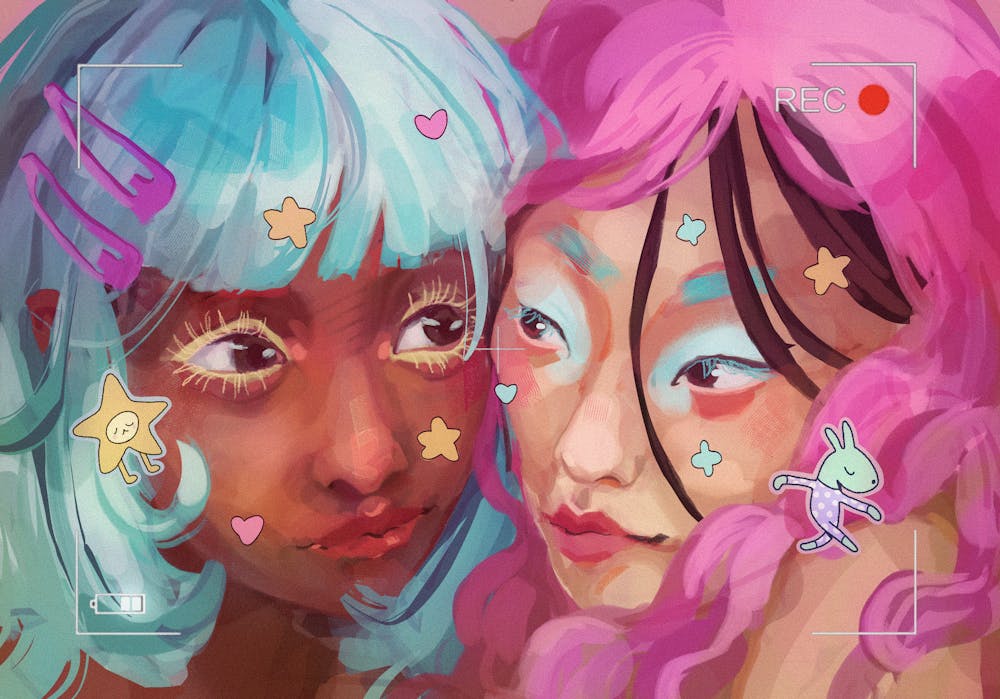
Recently, two friends and I put on different variations of 24-inch-long wigs and danced around a basement. Mine was dark at the root, metallic blonde, semi-chic, like Gaga in her meat dress. The wigs were heavy and sliding down our foreheads, shedding strands like molting animals onto the oak-stained floor. We spoke in accents so vague they belonged to no place at all, only to the concept of elsewhere. Our limbs misfired like wet noodles, attempting to stand or joust. My face was frozen in one of those really unattractive happiness expressions—the kind where my eyes were wet and puffy from laughter, and I was perpetually out of breath. Frankly, I was having too much fun. I felt like combustion was inevitable. There was no audience, or rehearsal, or occasion—just bodies ricocheting, pinballs in a warmly lit wooden cave.
Somehow, we wound up stripped down and in bikinis, obviously still crowned in our wigs, which humbled us with their decorative authority as the rest unraveled. The air became thick enough that you could swat through it and feel it, just like after a storm. Everything in the room was recycled energy; nothing could hold its shape. We slowly became the air we breathed, our bodies just vessels of inquiry and exploration.
There was an enormous camera just sitting around, so we said, Hey! We began filming ourselves talking. We weren’t performing, exactly; we were just going, letting ourselves go, and aiding one another in the process. Personalities began to emerge mid-sentence as we tried on different projections of ourselves and each other, reaching as far from reality as we possibly could. I think we were called Milenia and Simone-Symposium. Or something like that. Eventually, almost inevitably, we got into a fight. On camera, of course. In character, of course. Evidently, we were sisters. Evidently, we had discovered we were sleeping with the same man, who, evidently, also happened to be our pastor. This information surfaced not with shock, but naturally, as if it had been a truth all along and we were only now catching up to it. The argument escalated, and we did start pulling hair. Oopsies. Fingers were pointed, voices sharpened, and I may have cried. The camera kept us accountable. When we cut, our bodies collapsed onto one another in a laughing fit that can really only be described as true euphoria.
None of this struck me as unusual—not because I spend my days half-naked in a wig, but because I live my life in allegiance to play. For me, play is not a detour, but the method. It’s how I enter things without killing them with purpose. Maybe it’s because living every second with purpose for me sounds one, terrifying, two, exhausting, and three, no fun. I am irreversibly a play-oriented person. I orbit people who can riff, who can linger in a moment without demanding it justify itself. Of course, I have friends who are more serious, more contained, less interested in tumbling around naked. I don't blame them, and I love them no less. But they acknowledge and appreciate my play, consequently allowing me to play in front of them. I am no jester or self-obsessed performer; that is not the sentiment. I just love to play.
We are taught that play expires. That it belongs to childhood, to recess bells and brightly colored plastic, to a time when movement didn’t need an alibi. As we age, play becomes suspect, too soft, too unserious, faintly embarrassing. But play does not disappear—we just shove it back into ourselves, but it's potential energy. Play is everywhere, waiting for us, always readily available. It awaits in basements, in conversations that detour, in moments that refuse efficiency. It is not an action so much as a temperature. A way of staying with something without trying to harvest it—no climax, just release.
As I've gotten older, and shamefully embarrassed by my propensity for play, I've begun to wonder why it feels so essential to me. Why it was never indulgence or avoidance or laziness, but something closer to alignment. Then I read Kant, thank goodness! And it clicked, and, classically, my brain went, Eureka! Excuse this incredibly loose attempt to paraphrase Kant. He writes about beauty not as pleasure or desire, but as what emerges in “free play”: a moment when imagination and understanding move together without one subduing the other. A mind alert but unforced, engaged without hunger.
This is what I recognize in play: playing is just playing. When you stop playing, play is over. Attention without extraction. A seriousness that does not harden. What happens in play is less important than the fact that anything at all is allowed to happen. In play, the self loosens, and awareness turns outward. There is no monitoring of how we are seen or how much space we take up; no arranging ourselves for another. Play is not carelessness, but vulnerability. It asks for the courage to set down one's ego for a moment and, in that letting go, something alchemical begins to form as words arrive without intention, touch without agenda, and presence without performance.
In that basement, under the tyranny of blonde plastic hair, in the ridiculous gravity of our fictional betrayal, nothing needed to be resolved. No lesson learned. No improvement logged. And yet, everything was calibrated. Our minds and bodies moved together without hierarchy, without destination. We were not trying to arrive anywhere, but were simply in motion, and the motion held.
This is why I play. Not because it is frivolous, but because it is one of the few states in which I feel unmistakably alive: awake with no supervision and ridiculous without apology, and briefly, miraculously, free.


