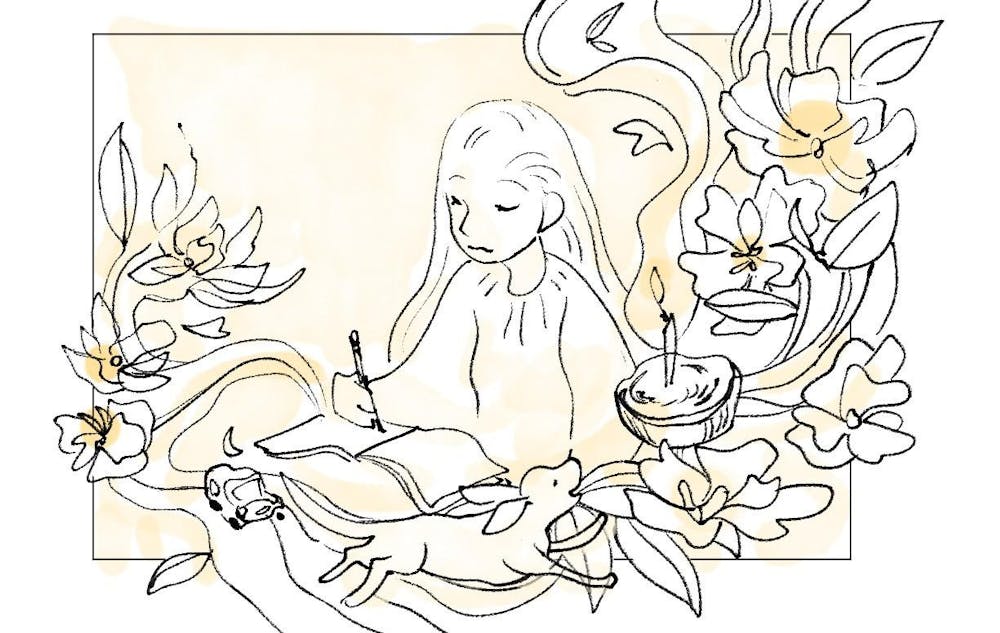
According to my mother, the magnolia tree outside our house blossomed the night I was born. When she left for the hospital, the tree’s branches only had buds. As if by magic, when she returned thirty-six hours later with me in her arms, the flowers had opened their pink and white petals to welcome me home.
For the fifteen years before my family moved, I marked the passage of time and the progression of my life with the blooming of the magnolias. Every March and April, I would marvel at the way they emerged delicately adorned with dew droplets in the mornings, and at their sun-struck ombré theatrics in the afternoons. My relationship with the tree and its flowers felt reciprocal and perennial. We were intertwined always—me and my tree, me and the first signs of spring.
Also important to my mythology is Bodi, the chocolate lab my mom had since graduate school, who died a few months before I was born. Once a creature of boundless energy and mischief, by the time my mom was pregnant with me, Bodi was sick and lethargic with old age. He had cancerous tumors in his mouth and his brain, and though my mom took him to chemotherapy in the hope he could be healed, it was clear he wouldn’t be able to survive much longer. The way my mom tells the story, Bodi accompanied her through the most dangerous part of her pregnancy, waiting to die until the three-month mark, when the pregnancy was considered viable. She knows it took him a lot of effort to stay until then, and she knows he stayed on purpose. He was like a little angel watching over you, she tells me, smiling, over the phone. She loves Bodi still, and despite never having met him in the flesh, so do I.
When I think of the beings and figures that mark and precede my life—the magnolia tree, Bodi—I feel held in a profound way. It is other entities and forces that brought me into existence, cared for me, and continue to sustain me; and though forgetting this is easy, remembering it is a great relief.
I am also coming to realize, as I attempt to detail these stories for the first time in writing, that they are in large part about my mom and the way she oriented me toward the world. She taught me, in small ways, to see living things as innately loving and as actively demonstrating their love for me through their beauty and constant ability to inspire and surprise.
While interpersonal interactions did not come naturally to me as a child, probably by virtue of this ethos my mom instilled in me, I was able to make non-human friends wherever I went. My parents remember how, in the backseat of the car at night, I would look up at the sky and shout out in glee, Otra luna! (Another moon!), every time we turned a corner and the moon came into view again. Per the tales my mom grew up with in Latin America, she would look up at the night sky with me and point out the bunny in the moon. Magic was real. Not only was there a moon, but there were many moons, and better yet, there was a bunny in each one.
I cannot recall, in those days, ever feeling lonely. There was always a moon, who, I had no doubt, was looking down at me, just as I was looking up at it. There was a magnolia tree who remembered my birthday each year. There was a dog who prolonged his last breath to be sure I would take my first. Donna Haraway, whose scholarship spans the fields of multispecies studies, feminist studies, and the history of consciousness, writes that “beings do not preexist their relatings.” I did not question this; I had no reason to.
As I’ve gotten older, however, and especially very recently, I’ve found it difficult to trust in the inherent goodness of things. Every day, I learn of terrible new occurrences from the news. In my classes, I learn about disturbing events from the past, too. In the last few months, enormous tragedies have struck both my home and school communities. As much as I might like to for my own peace of mind, I cannot convince myself that there is any sort of justification for these horrors, or any others, for that matter.
In light of this, it’s easy to dismiss the connection I felt to my “relatings” growing up as simply a symptom of naïveté. But the magic was never a misunderstanding. The magic was the truth of the matter that there is no such thing as being alone. The magic was a simple connection—fortified by stories and tangible interactions—to all that is living and all that is. In Braiding Sweetgrass, Robin Kimmerer writes, “Even a wounded world is feeding us. Even a wounded world holds us, giving us moments of wonder and joy.” The world, as I see it now, is a place of immense suffering and extensive wrongdoing. But even so, nothing can negate our belonging to it and everything that exists within it.
Spring arrived a few days ago—not by any technical metrics, but that’s how people are talking about it. The sun made its gracious return, and everyone piled onto the Main Green for the sheer pleasure of letting the soft warmth envelop them. It was my twenty-first birthday, and I thought of my magnolias. I wondered if they still knew when to open their petals, if they had grown shyer or somehow more eager still.
My dad took me out to dinner that night, and I thought with such certainty, as I most often do in his company, that there was nowhere I would rather be. There is a precarity in perfect moments. They threaten ending, and in the end, they always do. They do not undo what has been broken. Still, they are perfect precisely because the ephemerality they promise does not detract from their beauty. At 9:30, I blew out the candle on my crème brûlée and wished for true and lasting friendship. Really, I think it was a prayer for the sense of interwovenness I carried so effortlessly when I was younger. I’ve never dared share my wishes. But twenty-one has made me sincere. I used to be sure that everything was listening. Why not be sure of it once more?


