Whenever I am brainstorming what to write about for the Arts & Culture section of this fantastic publication, I tend to make a list of the films, TV series, books, songs, albums, and other media that I have consumed recently. But as I geared up to do this once again, I realized that there is an equal amount of art being produced on campus that is just as worthy of the attention of A&C writers like myself, yet seldom populates this section. From student bands to campus publications to visual art thesis exhibitions, art is alive and breathing among Brunonians.
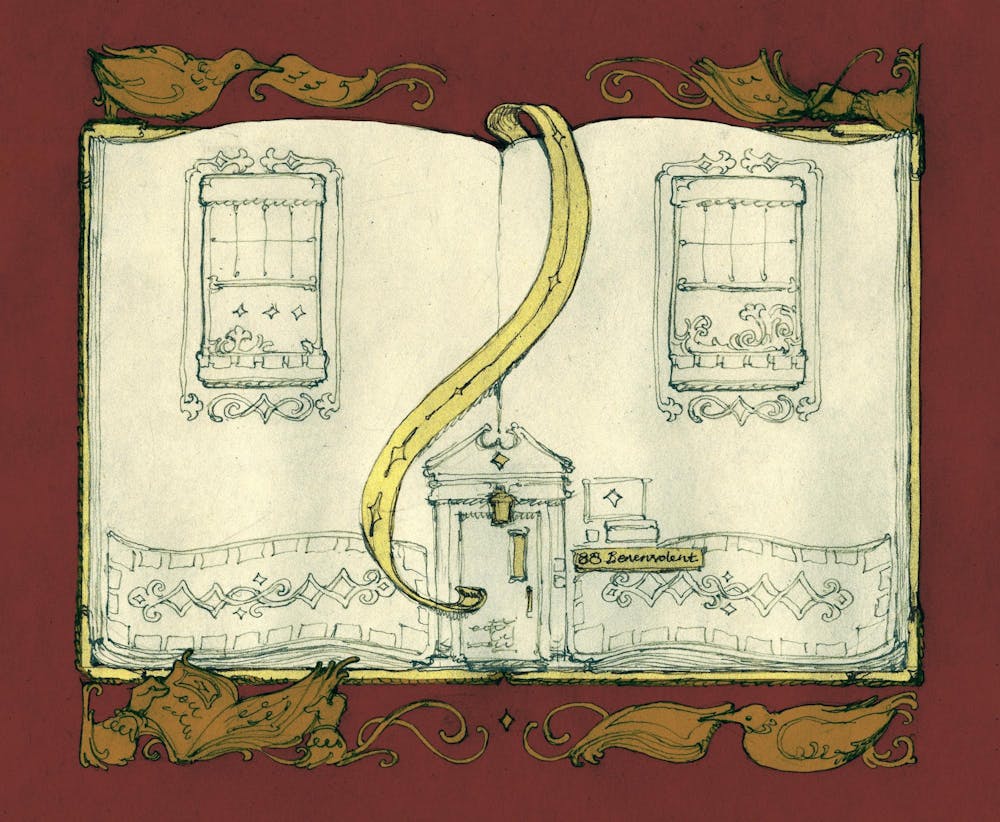
I often hear people boldly assert that art is generally on the decline—movies are getting worse because of TikTok, nobody wants to read anymore because of our shrinking attention spans, and AI has ruined everything. While these fatalistic statements contain kernels of truth, as a student who has been faithfully involved in the campus publication scene for almost four years, I have yet to see evidence of this rot that so many people around me say exists. Every week, as a copy editor, I enter 88 Benevolent and read beautiful creative nonfiction authored by my peers. While much has changed during my time at this institution, the earnestness, prose quality, and beauty of the pieces I am asked to check for grammar mistakes have remained constant.
This pessimistic assertion that art is in decay is deeply insulting to those who write, sing, paint, produce, and create in spite of how our society explicitly incentivizes us not to. People are making, and they’re making gorgeous things despite the tremendous obstacles to doing so. If more of these cynics picked up student publications or attended campus shows, I imagine I’d hear such declarations about the universal decline of art in the 21st century less often.
Getting to interact with great art is a big reason I have stayed at post- as long as I have, but it was certainly not why I joined. As a first-year, I knew I loved to write, but knew very little about how to turn this into a career. Publishing seemed like a good idea at the time, so I signed up for as many campus magazines as possible. I remember going to the CareerLAB my first year here for resume help and the peer career advisor saying to me: “Wow! Your publications section is VERY long!”
I looked at her with wide, first-year eyes. “Is that a good thing?”
post- was the first magazine I applied to upon resolving to pursue a career in publishing—a dream which fell apart when I discovered my love of research, but that’s another story. I remember hesitating on the Google Forms application over the choice to apply to be a writer or a copy editor. While I love writing more than basically everything else that is available on this planet, I felt shy about the prospect of sharing my writing with these students I had never met.
Plus, I loved catching grammar mistakes. When I was in seventh grade, our English teacher would have us do an exercise each class called “Daily Grammar.” It was a half-page grammar worksheet that we would do in small groups, and then one person would share out the answers to the class. I loved Daily Grammar so much that I appointed myself the share-out person five classes in a row, after which my English teacher had to pull me aside to tell me that I had to let others take the lead on Daily Grammar once in a while. I was devastated. All this to say—forgive me if I sound melodramatic—sometimes I feel that I was born to be a copy ed. (In Sally Rooney’s sophomore novel Normal People, the protagonist says to the love of his life, “I’m not a religious person, but I do sometimes think God made you for me.” On the right day, I feel similarly about fixing comma splices.)
With years of Daily Grammar under my belt, I showed up to my first night as a copy editor at post- full of excitement. After stepping into the main conference room, I was informed that the “copy closet” was across the hallway. In a much smaller room, three other copy eds and I sat on a fuzzy pink rug as the copy chief, A, instructed us on the ins and outs of the post- style guide. I looked longingly at the main room where people were laughing and chatting. In the copy closet, we did not have chairs, much less any sort of joie de vivre.
The copy closet was a temporary institution, and eventually we lowly copy eds were upgraded to sitting at the main table with everyone else. Yet, things there were not much better. The copy chief was addicted to making “That’s what she said” jokes, which is not, on its own, an inherently bad thing. It’s just that every time she did so, she would look at me—the only first-year on the copy team—and say something like, “I shouldn’t say that! You’re just a baby!” or “You’re too innocent!” It was deeply odd, and I still don’t understand what compelled her to single me out like that. Besides, if she had ever cared to ask me anything about my life, she would have learned that I was no virgin—not that the behavior would have been any less problematic had I been.
Over the course of two semesters, this “That’s what she said” dynamic began to deeply irk me. Did she need me to fuck someone on the post- conference table to prove that I could handle a “That’s what she said” zinger? First-year me was so frustrated by this pattern that I might have done so if it would have meant A would stop being so weird to me in front of everyone.
Though I thought about quitting many times because of A, I stayed. I loved having a structured 45 minutes in my week where I was forced to read beautiful creative nonfiction. I was learning a lot about Brown and sometimes Providence through these pieces, and that was a good enough reason for me to stay. It’s funny how what seems like a small decision at the time, like staying at a campus publication despite an annoying copy chief, can change the course of your life.
My first year came and went in a haze of Keeney parties and “is football throwing tn” texts. It was a vapid year, but whose first year isn’t, at least a little bit? By the time I returned for sophomore year, I had much more clarity about what exactly I hoped to get out of my time here (see: more learning, both inside and outside the classroom). That fall, a new copy chief was appointed because A had graduated. Her name was E, and though I didn’t know it yet, she would go on to become one of my favorite people at Brown.
E was everything a copy chief should be: meticulous, dependable, and kind toward all copy eds, new arrivals and old timers alike. Once I figured out how to make her laugh, a friendship quickly followed. When she graduated, I gifted her a copy of Plain Style, a print edition style guide for academic writing. We’re still in touch, and I miss her every time I walk into 88 Benevolent.
E’s arrival meant that I started to feel a lot more comfortable at post-. Over time, I learned how to make the rest of the production team laugh, too, sending memes in the Slack and starting bits that I knew would crack even the most reserved section ed, such as inventing a fake beef between post- and the BDH and joking that we should start a separatist movement. (For the record, I believe no such thing and sincerely think the BDH represents the best of what undergraduate journalism can be.) Production nights slowly turned into a stand-up routine for me, of sorts, though I never let my new position as the post- jester impact the quality of my copy editing.
It was that year that I started writing in addition to copy editing. I received thoughtful edits from people who were becoming close friends. This motivated me to overcome any shyness I had about sharing my writing with other students who I respected. The kindness and care with which my writing was treated motivated me to eventually write about difficult topics, from personal crises like my rape to broader horrors such as the erosion of American democracy. Over the years, post- has become a place where I have worked out complicated feelings with the support of a team of people who care about me, ultimately culminating in short pieces for public consumption.
For example, take the aforementioned assault. While my casual reference to it earlier may make it seem like it’s something I know how to talk about, it’s actually very hard for me to talk about it off the page. Yet, I simultaneously need to talk about it, because it impacts my daily life at this university. post-, then, has given me a middle ground in which I have begun to heal: In writing, I am able to broach a topic that I need to think about but struggle to bring up verbally. As a copy editor, I have read similar pieces about others’ traumas and seen other authors do the work of thinking through difficult things on the page. That’s the beauty of creative nonfiction, I think: to be able to say, “This happened, and I want you to know about it.”
But it’s not the medium of creative nonfiction alone that makes such reflection possible for authors like me—it’s the post- staff, and an institutional culture that encourages writing about difficult things, not for the sake of shock value or trauma dumping like the good Gen Zers we are, but rather out of the firm belief in writing’s transformative power.
post- is also full of pieces that foreground the joys of life. Such works are equally important in making the publication what it is. I wrote one just a few issues ago about how much I love my boyfriend. I think that’s the strength of post- and what ultimately makes it stand apart from other campus publications: the sheer diversity of our pieces (though, of course, it’s no competition and we’re all friends here). In the same issue of post-, you’ll have an article about a popular film as a metaphor for the failures of international governance, an article about the joys of communal living as a college student, and an article about the passing of a loved one, to name a few hypothetical examples.
As someone who has worked at a variety of campus mags (and rags), the beauty of post- is in its heterogeneity. At other publications I have worked for, there is a similar writing style across pieces. I don’t want to throw shade—our campus, much less the student writing scene, is far too small for that. However, I feel that for most publications, if I said to a student involved in this literary scene, “Write a piece in the style of [insert magazine here],” they would be able to do so, through certain prose and thematic choices. With post-, that would be genuinely impossible, and I think that is our greatest strength. It’s what’s kept me coming back for almost four years, despite an increasingly busy schedule and the decreasing relevance of this position to the rest of my resume. It’s what will keep me reading post- after I graduate in May.
And what a beautiful community of readers post- has. There have been multiple times where I have met someone new and introduced myself only for them to inform me that they’ve read a post- piece of mine. I recently learned that many people in my life have read these little musings—a fact that surprised me, as I never send them to anyone upon publication. I only just discovered that my roommate is religious about reading these articles, having consumed every single one. A long-ago friend with benefits (we got together back when there were dinosaurs) said his mom had read all my post- pieces, which is how I implicitly discovered that he had told his mom about me—something we had never discussed and which served as the final sign to end things.
A few times, I’ve even received emails from people with no Brown affiliation, including a message from a student in Boston who was also assaulted at her university. She said my writing gave her faith she’d reach her senior year. I share these examples not to glaze myself (as the saying goes), but rather to show that the readership of post- is as diverse as the pieces within its pages, from the mom of an ex-friend with benefits to a fellow rape survivor looking for solidarity.
So, contrary to popular discourse, art is not dying. We’re making it every week here at post-. I will no longer be a part of these efforts when I graduate—I will become post-post-, if you will. Yet, post- will always be a part of me, living on via my fundamental belief in art and what it can do for others and myself. I don’t know who I would be if I did not believe in the value of making art and living it, which is to say I don’t know who I would be if I hadn’t joined post-. Luckily, I’ll never have to answer that question, but I will inevitably have to learn what it’s like not to be a copy ed here. It will probably be hard, and I will probably cry. It will be exactly the kind of thing that would make a good post- piece.
Indigo Mudbhary is a University news senior staff writer covering student government. In her free time, she enjoys running around Providence and finding new routes.


