
Under the moon, I do not sleep. I gnaw at my fingernails. I fix my sights on an indifferent body. I invent words for myself that will never leave these walls. I recite them, letting each syllable linger a second longer than necessary. I put ink to paper, which is to say I dream with my eyes wide open. And I think:
Let me begin again.
.
.
.
I. ANDANTE
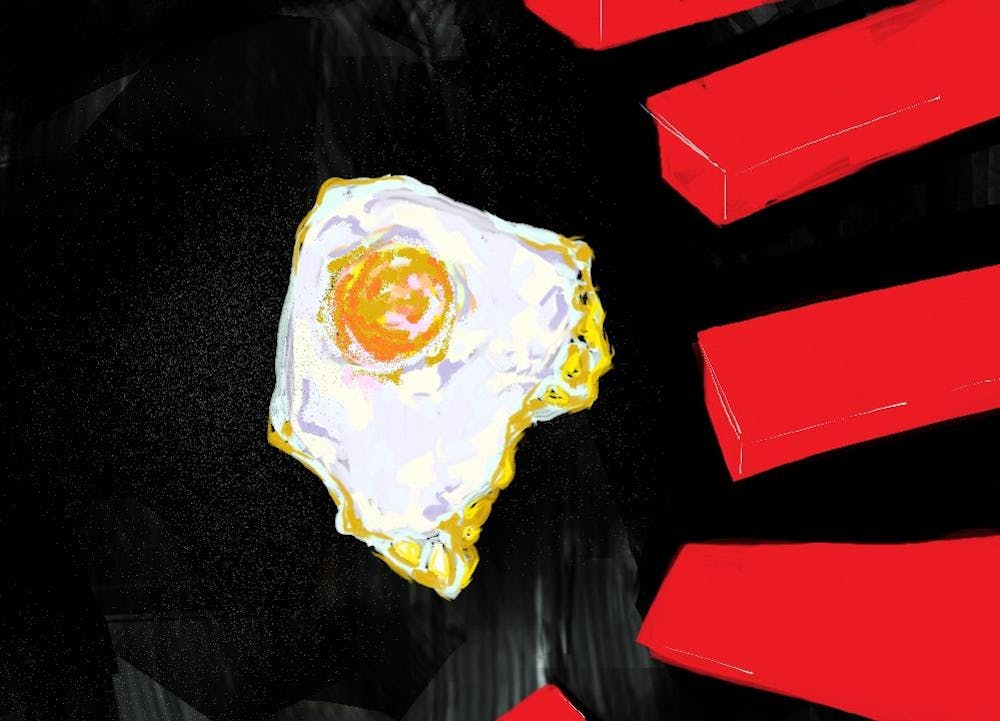
When I was four years old, my mother introduced me to a new friend. First name: Piano. Last name: Forte. Back then, my legs dangled limply off the bench, toes barely reaching the step stool placed below. My eyes scanned over the massive creature before me, a thing of wood and wire. How grand, indeed. My teacher, a lovely lady who introduced herself as Meg, lifted the fallboard to reveal a pattern of black and white that stretched out from left to right. She reached around my shoulders and gently held my elbows. Now, bend your arms so they’re at the same line as the keys. Keep the top of your arms straight and at your sides—there you go. Then, her hands cupped over mine and guided them closer to the teeth. She placed my finger down on a single tooth. When you play, hold your hands like this—never let your wrists drop below the keys. Imagine an egg cradled in your palm, nestled there. Let your fingers relax. Don’t use them to grip the egg. Good. Now try pressing down here.
I did. I did, and suddenly I could feel the creature’s heart beat with each hammer that came down on a string, one part of an intricate network of veins that ran through its body. My fingers danced along three black steps as Meg hummed “Hot Cross Buns” in tune with the notes. Every organ breathed and thrummed; every note rang out into the air. It was alive. It was glorious.
That night, I became an egg-handed girl.
II. ESPRESS. DOLCE
In between books of arpeggios, scales, and theory, I found a personal scripture. Every month, Meg would receive copies of Piano Explorer, a serialized publication written for young piano students across the country. After each lesson, I would grab a Werther’s from the little dish Meg always left by the door for her students, then dash to the car, copy in hand. While most focused on the magazine’s national competition for “most days practiced in a row,” frantically flipping through the pages to find their names among that month’s highlights, I dove into the pages headlined with a singular name in bold lettering. I was, admittedly, horribly pretentious, yet infatuated—with history, with composers, with the world that contained and had composed all the sheet music around me.
Every month, I feverishly studied the biographies of each issue’s spotlit composer: birth date, death date, nationality, musical era, distinct style, stories upon stories. I chewed and savored the words, unfolding the composers behind the notes and the music. I memorized each one, spellbound in a self-imposed ritual, then eagerly regurgitated the details to Meg at my next lesson. There was Ravel and his dead princess and his mirrors. There was Mussorgsky and his bald mountains and his Pictures at an Exhibition. There was Holst and his winged messenger and his mystic and his magician. There were the Baroques and the Classicals and the Romantics and the Modernists. There were the impressionists, my personal favorites, but I always secretly returned to the Romantics—Chopin and Liszt and Rachmaninoff, whose measures seemed to bend and twist and feel.
And so I collected composers. I collected their stories. I added them to my mental encyclopedia. I wanted to know and know and know. It is all that remains.
III. CRESCENDO
In my bedroom, there is a metal creature or, alternatively, a keyboard. We got it not long after my first lesson, something practical and affordable. It is unlike the grand one in Meg’s house—there are buttons, for one. A square button sits amongst the others off to the left. When you press it, a melody—sweet yet pensive—swells from the speakers embedded onto the surface. The recorded notes are carefully measured, marked by waves of restraint and release, accompanied by a steady, consistent flow. It is a single piece, a nocturne, building and flourishing.
Growing up, whenever I slept in too late on school mornings, my mother would enter my room and repeatedly call my name. Exasperated, she eventually turned to my keyboard and pressed down. Those same notes in E-flat major would emanate out and loop in a perpetual cycle. I would wake up to the last remnants of night, at the height of its meeting with day, the culmination of their dramatic romance.
IV. POCO RUBATO
Moon,
I play for you tonight, once again. I play the same progression over and over again—not just to perfect my fingering, but also in the interest of music itself. How fascinating it is. How fleeting it is. For one moment, one note at a time, it exists. It fills rooms, bodies, hearts, only to disappear in the next minute. How immortal, to be reborn again and again over centuries. We play music to relive it, to revive the hands that wrote it. Allow me more hours. Allow me to live in this darkness a little longer. How many times have you been the sole audience to this magic? Stars, guide me. Let me breathe you in—bathe in your company—swallow you whole. Do not look on impassively. Let me hear that nocturne once more. That perfect melancholy.
V. SEMPRE
There is an old legend. Like all legends, it is likely equal parts myth and truth (though I’ve always liked mine to be more myth). They say that in 1830, a twenty-year-old Frédéric Chopin left his beloved native Warsaw in pursuit of his musical career, seeking the western lands of composers before him. They say that in his final hours in Poland, he bent to the earth, reached out his hand, and grasped the soil beneath. He lifted his hand to his chest, dirt breaking from ground, and breathed in the night—his last night home. As he carefully stored that little handful of Polish dirt in a jar among his trunks, he vowed to carry the soil of his motherland with him for the duration of his travels. When I pass, scatter this soil over my coffin. Bury my heart in Poland. The next day, he cast a final look back as his feet left the ground for the last time.
One month later, Polish rebels incited an ultimately unsuccessful insurrection against Russian rule, launching years of turmoil. Chopin would never return to his homeland again. The jar of soil would sit in his Parisian residence. A fleeting memory. A limb detached from the body. A lost love.
VI. CON FORZA
I haven’t touched a piano in years.
The day I quit came and went. It only took one email to Meg, and then I never saw her again. I had stopped practicing. I couldn’t reach the octaves in my new pieces, my hands stretched thin and just short of a comfortable span—stupid, knobby hands. Practice had turned into a nuisance, and so our nine-year relationship ended. Months afterward, my sheet music still lay open atop my keyboard, a waltz from my first Chopin book. There was a brief stint with the cello afterwards, when I got randomly placed in middle school orchestra for a year (not as overcrowded as the violins, no new clef to learn as with the violas, not too big like the double basses). Like clockwork though, as soon as the year wrapped I never went back.
I don’t remember any pieces anymore. I only sit with the ghost of a Kuhlau sonatina in my right hand, quietly drumming the opening notes along my leg. I let my wrists drop. The eggs crack open.
VII. STRETTO
Sometimes, it feels like I can only ever write at night. Illuminated by a lone light, my fingers dance across a different keyboard. The world outside my window is dark and unformed. It twists at one point, then weaves around another. It is unknowable. It is everything.
Sometimes, I worry that one day—slowly, quietly, achingly—my writing will follow my piano. I try to hold onto the eggs. I cannot sleep. I take all the previous stories I’ve read, the nights I’ve consumed, the hours I’ve stolen, and pour them out onto the pages before me. I press down the keys one by one, one after another—a quieter movement, a bolder rhythm. At night, no human watches me. At night, no human hears me. It is music to my ears.
Sometimes, I consider Chopin at twenty, alone in Paris. Under the moonlight, he releases his restless mind into the night. The city slows to a low hum beyond his four walls, but the moon sways his sullen heart—sways him into action. He does not shy away from the pain, the struggle. He creates under only his own eye and that of the stars above. It is not the type of night for a lullaby. As such, he writes.
VIII. CODA
When I was 19 going on 20, I returned home for break.
As I unload my carry-on in my bedroom, I reorient myself with my surroundings. Here I am: a teenage girl in my teenage-girl bedroom for the last time. Against one wall, my keyboard stands dormant as usual, a thin layer of dust across the keys. I cannot express why or what, but something told me to sit down on my bench once more. Off by the corner, my ancient pile of Piano Explorers rests, now long discontinued. I never threw them out.
I brush off the square button—it feels smaller against my fingertip when I press play this time. It takes a beat, then that familiar B-flat note rings out. I now recall: “Nocturne Op. 9 No. 2,” published with Chopin’s first collection of night music in 1832, but likely written sometime in 1831. My hand hovers above the keys. Another beat, then:
We are reborn.


