By coincidence, every time I sit down to write a post- article, I happen to be next to my seventh-grade best friend who is the only one from home who went as far from home as me—selfishly, I dragged him to NYU when I knew I wanted to go to Brown—and we always happen to be in a coffee shop, him studying for a midterm while I figure out what I could possibly write about next.
He always picks me up, no matter what train or bus I get off of, and we link arms and walk through the soaked New York streets while he puts up with my torrent of stories, terrible jokes, and repeated requests for Heytea. It’s rituals like this, no matter how infrequent, that have kept our friendship as comfortable as the day I met him eight years ago. I often think about the unlikelihood of it; how many millions of choices must we have made to end up on the same street, semester after semester, regardless of the states and countries and time zones we have to cross?
That morning, a few hours before I would board my bus to New York, I woke up in a bed that wasn’t mine to get coffee with a girl—our mutual friend—and her boyfriend from Williams College. We sat and listened to her boyfriend talk, at 7 a.m, about his Nepalese co-founder, while I bonded with him over our summer birthdays. Call it a double date, call it worlds colliding—either way, it was surreal, and writing it down isn’t making it any less strange.
For the past few weeks, all of my stories have sounded like this: implausible, funny because “Vanessa, of course this is happening to you,” built on timing and usually set in the early hours of the night. Almost every night, I find myself excited to meet up with the same clamorous laughs, childish jokes, and “I love you”s said through insults, so we can tell each other about our days and nothing more.
Often, the rhythm of my days reminds me of the theatre shows and films I’ve worked on this year, unfolding line by line, character by character, until the entire film ends somewhere so far from where it began that I have to watch it over again to figure out what happened.
I wonder, as I’m walking or ambling or sprinting down my path, what hidden variables are placing my steps on cracked pavement or rolling pebbles into my shoes. What hidden variables have already dictated the inconceivable, inevitable events I will later experience, ones that will make no sense to me, but that were long ago written into the cosmic show. Ants feel rain and mistake it for magic.
That girl, the one whose bed I woke up in, is my most recent example of magic. For the longest time, she was just another familiar face on campus. We’d bump into each other everywhere, caught in our own worlds. Over time, like a loose thread, we kept pulling and pulling, slowly, until we unraveled into morning walks and late dinners, kisses on fire escapes and the memory of my perfume in her room.
Now, she walks me thirty minutes across College Hill to my bus stop where, while looking out of the window of my Greyhound, I find a lot of solace in knowing that no matter what country or what life I might find myself in, somewhere in New York is a boy who knows to greet me with an umbrella and a McDonald’s bag in hand.
“I keep picturing all these little kids playing some game in this big field of rye and all. Thousands of little kids, and nobody’s around—”
(The Catcher in the Rye, J.D. Salinger)
In three short weeks, the class of 2028 will advance into upperclassman status, no longer the starry-eyed first-years or second-years we are now. My friends and I are slowly entering our twenties, some even older, and we’re all making different choices as our priorities shift, just as the cherry blossoms grow back and the sun visits campus more often.
When sophomore year first started, I remember entering it primarily with apprehension. I started the year off strong with Bruno Leader parties and days in the sun, until suddenly October snuck up on me and it was impossible to see my friends, and everyone was stressed about friend-group fallouts, or careers, or classes, or the storms that swept through our class and our school. We kept losing each other, over and over and over, in a vicious cycle that seemed like it would never let up. During the snow days, when my friends and I sledded down hills and made ice cream in the cold, I wondered to myself if we were just pretending, grasping at what it felt like to be kids again.
I spent a lot of this year learning how to forget, how to move forward, how to wake up into another gloomy day and still believe, endlessly, that the next one wouldn’t be. I can’t speak for the entire class of ’28. If I could, though, I would say we are doused in hope.
The first time I read Catcher in the Rye, I hated it until the carousel scene at the very end, when Holden watches over his sister and comes to terms with the fact that he can’t shield her from the cliff of time forever. I read it in high school, back when I could still blast Ribs by Lorde while racing my high school friends down highways, back when I could sit on top of cars in parking lots, and we would talk like we would all be seventeen forever.
I’ve always dreaded times of transition. Times like the blue hour or dusk, or even the entire season of fall—it makes me sick to think of the bright hours basking in sunlight coming to an end, of packing up picnic blankets and trading them for sweaters. It scares me to think that one day, my days in New York with my friend will come to an end, that one day I might get my last bagel with him here, and I won’t even know it.
“To live, then, is a matter of time, of timing.”
(On Earth We’re Briefly Gorgeous, Ocean Vuong)
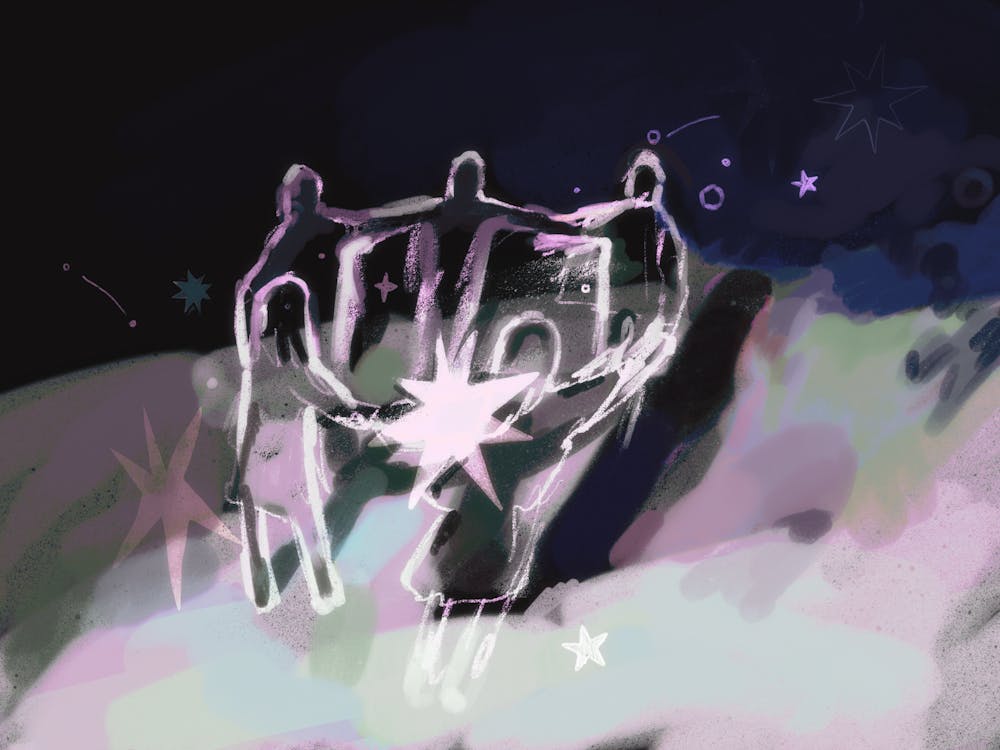
Nowadays, I’ve traded my car for trains and flights, swapped out sunburnt lake days for corporate internships, slumber parties for trips abroad. And yet, for the first time, the thought of the cliff doesn’t scare me. Everyone I care about is running through the field with me, all of us dancing to and from the edge, time as a corrosive material forever building and eroding, shifting the dirt beneath our feet as the landscape slowly shifts in and out of focus. When it gets cold, someone will wrap a blanket around me while I find snacks for us all to watch the ending of the blue hour together. And when it finally does settle into night, we will hear the crickets serenading, celebrating—the same crickets I heard when I was four, and fourteen, and probably twenty-four.
In the meantime though, I’m going to get my second drink from this coffee shop, my friend interrupts me to giggle about how a specific genus of mouse has two copies of the obese gene, my other friend texts to tell me about a set of pens she’s excited about—how lucky I am to have people to miss—and in the back of my head I know that we are all falling, catching each other, falling again, and catching each other again, over and over through every winter and summer and dusk and dawn, morning after morning until one day the rye fields are trampled over, wind whistling through the stalks, dirt stamped stiff with the footprints and head-shapes of everyone who I love, loved, and will love.
“But it's beautiful here, even the ghosts agree.”
(The Emperor of Gladness, Ocean Vuong)
We’re three weeks away from a new abyss. Today, though, a lot of my friends are in love, a lot of my friends are lying in the sunlight, and almost all of them are here. That alone is enough for me to trust the jump. To look over at the cliff and do nothing but smile with teeth.


