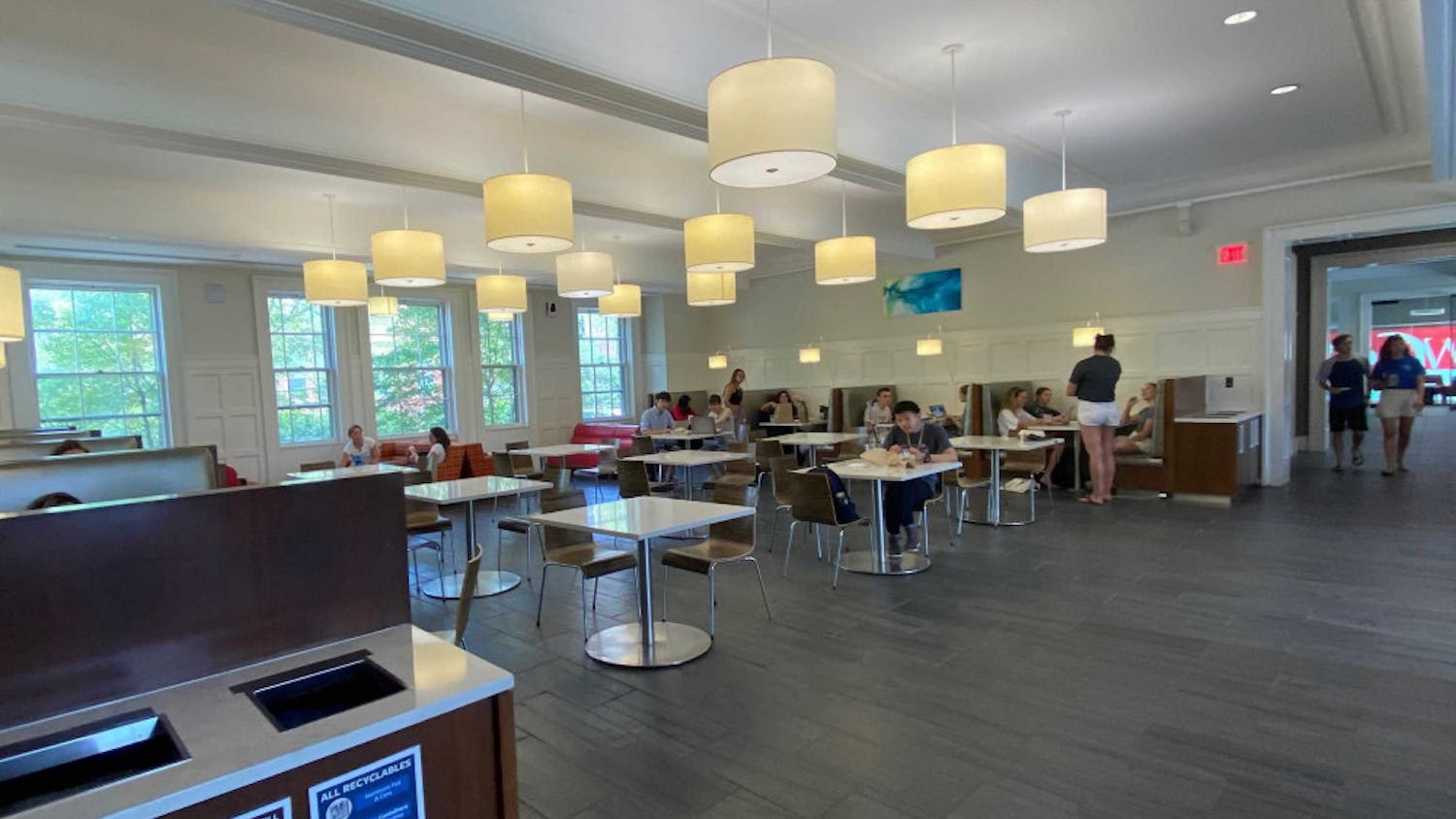
At Friday night dinners, students of legal drinking age at Colby College in Waterville, Maine, are now able to say cheers to both friends and professors over a glass of fine Australian wine and a local Maine microbrew. This does not take place in a cramped dorm room or fraternity house, but in the safe and controlled setting of their campus dining hall.
Three trial nights of the program in the fall semester were so well received that this spring it will take place nearly every Friday night.
Students pay $1 per drink, far below market value. The difference is paid by Colby dining services, which has "been very eager to help us out," according to Colby Dean of Students Janice Kassman.
The new program was the brainchild of Colby Student Government Association President Cat Welch '05 and Vice President Adelin Cai '05. Last fall, the idea spontaneously arose during one of their weekly breakfasts with Kassman.
Kassman liked the idea and sprung into action to promote it. Later that night, Kassman called Welch and Cai and told them the idea had been cleared. The following Friday night, the program's trial run officially began, Welch said.
Welch stressed the importance of keeping the price of drinks low, so students do not abandon the program and return to binge drinking lower-quality alcohol off campus or in other unsupervised areas. She said part of the program's mission is to bring the social scene back onto campus in the dining hall and at Colby's pub, eliminating the risk of drunk driving or students drinking in unsafe off-campus environments.
Not surprisingly, the program has been extremely popular among students. Participants, who gather in a smaller room with glass doors adjacent to the main dining space, have enjoyed the social aspect and the educational presentations that take place over the course of the evening. The visible nature of the program "makes an impact, when younger students see that those of age in the side room are content with having just one or two drinks," Cai said.
The educational presentations are intended to instill an appreciation for quality beers and wines in the students, and help them understand that there is far more to drinking than simply getting drunk.
On the program's first night, the owner of a local brewing company came in to explain how beer is made, Welch said. Cai said there will be more guests this semester, who will further discuss with students the importance of respecting alcohol and not misusing it.
The bartender is also knowledgeable about varieties of beer and wine and helps students select a drink that will complement the tastes of their meal, said Cai, who recently put in a request for Asian beers to help diversify the already impressive selection.
Students are allowed to taste all of the selections each night before deciding, to determine which pleases their palate most. In accordance with the program's mission to encourage moderate drinking, each student is entitled to only two alcoholic beverages each night. This is carefully monitored by event organizers, who also ensure that all participants are of legal drinking age by checking their names on an official list provided by the college.
International students, often accustomed to a more relaxed attitude around drinking in their home countries, have responded particularly positively to the program. These students have been "comforted and refreshed" by the new policy, Welch said.
According to Welch, Cai and Kassman, the program has encountered virtually no resistance from parents, administrators or Colby faculty. "Many think it's a positive step," Welch said.
According to Kassman, "The program is not being abused in any way that we can see," and overall it has been "just very low-key."
"It is a good model of cooperation between under(graduates) and the administration, and of community building," Kassman said. "Students appreciate the chance to get to know faculty in a very convivial setting."
"I see real strengths to a program like that," said Nancy Barnett, an assistant professor of psychiatry and human behavior at Brown. Barnett will also be the chair of a new subcommittee of the Campus Life Advisory Board that will focus on alcohol use at Brown.
She cited numerous advantages to Colby's program, including that it combines drinking with eating, which keeps blood alcohol level down, the presence of trained servers and supervisors, the educational component and its context in the structure of clear policies about alcohol use at Colby. Like Cai and Welch, she called the program "a small step closer to how alcohol is consumed in other cultures."
But Barnett was skeptical about some aspects of Colby's program. She said the program might simply provide another avenue through which students could conveniently pre-party, calling it "another stop in a long night of drinking."
Barnett was also skeptical of the fact that the program takes place on Friday nights. "If the goal is to encourage moderate drinking, why can't it take place on a Tuesday night?" she said. She said that on Friday nights, students have a party spirit, which might deter them from bringing a professor to the table and might encourage them to continue drinking after dinner.
"I think it's an open question as to whether or not something like that would work at Brown," Barnett said. "Everybody, I'm sure, will be looking to Colby to see how it's going," she added.
Frances Mantak, director of health education at Brown, also had concerns about the program, though she agreed with its emphasis on moderate drinking.
Mantak, like Barnett, did not think that drinking moderately at dinner would prevent students from drinking more heavily later on Friday night. "There's potential for unintended consequences," she said.
Barnett said drinking should not happen in a college dining hall, where over 75 percent of students are underage. She called drinking in the dining halls a "mismatch" which could create "a dichotomy (between students of age and those not of age) that is not necessary for a college dining service."
Brian Bidadi '06, chair of the UCS Admission and Student Services committee, was enthusiastic about Colby's program and the possibility of bringing something similar to Brown.
"We don't need to have so many restrictions on drinking, but we need to encourage it in public, well-supervised spaces. We need to allow students to make their own decisions about how they want to run their own lives, so they can enjoy drinking in a responsible way," said Bidadi, who has drafted a resolution to allow kegs at registered parties on campus.
"The timing is good to bring such a program to Brown, in that we are already reviewing our alcohol policy," he said. But he said there would be a long way to go before such a program could come to Brown.
Dining Services would have to acquire a liquor license, a designated space for the program would have to be created in the Sharpe Refectory and the regulations would have to be strictly enforced, he said.
Bidadi said such a program could encourage "a new kind of experience on campus" and might "make the Ratty a more social space, as opposed to just a place to pick up dinner."