I think I owe the moon a love letter.
This love, this debt, is no surprise to anyone who knows me well. I point out the moon almost every time I see it, compelled by the split second of delight that catches in my throat on repeat. But to explain it, to put this loving in words, feels impossible. Still, I want to try.
***
One of my earliest memories is milky: riding in the backseat as a little girl while the moon, chalky-white in the blue of the daytime, kept pace on my left side, skimming treetops and rooftops, never falling behind. Mama. My juicebox, sweet. The moon is following us. How was it possible?
I don’t remember my mother’s explanation, and it ended up mattering little. Whatever the science was, the moon could do fantastic things—that much I understood. Even then, I think I sensed some great and beautiful power; I read Goodnight Moon with the smallest bit of apprehension at the sight of that stark white circle, peering into an endlessly green bedroom from behind the window frame.
It’s easy to understand why the moon was worshipped, why it is still. Before humans could see other planets or far-flung stars through telescopes, all they knew was moonlight. Today, in the smoggiest city, where even the North Star is washed out by street lamps, the moon is a constant, the one thing that we can count on no matter how much light we pump back into the sky.
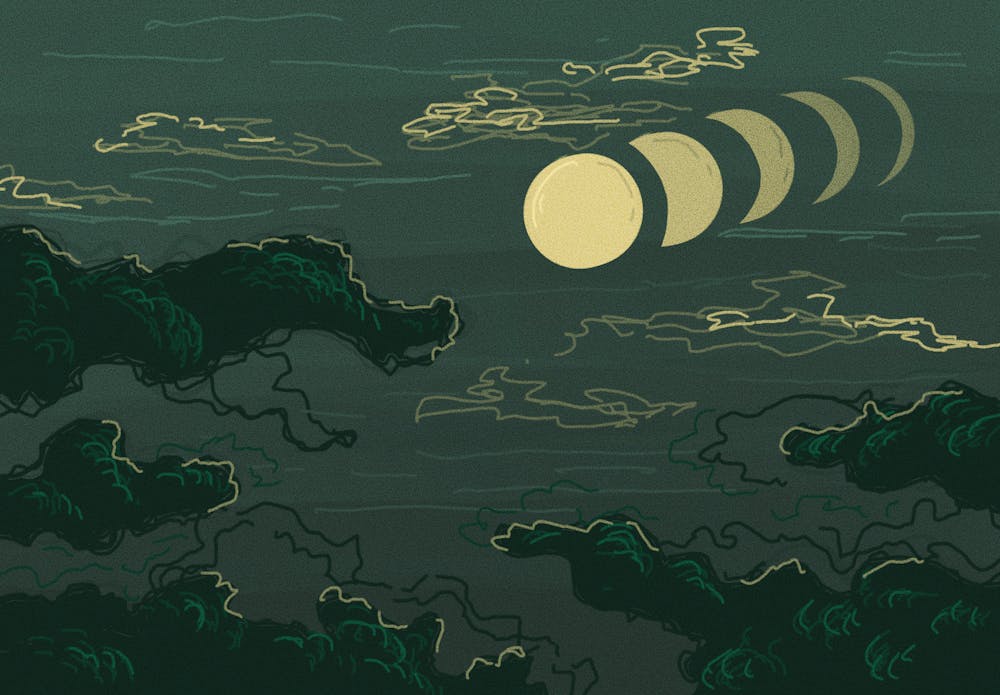
Unlike the sun, the moon doesn’t warm us or poison us or grow our food or burn our skin. All it does is drag gently at our waters, inspire our poetry. It makes faces at us: the sliver of a nail, the round-cheeked bowl of light.
We give each of its full faces their own names in our folklore and almanacs: Strawberry Moon, Wolf Moon, Hunter Moon. The Worm Moon in March is also known as the Sore Eyes Moon because of how its blinding light radiates off the early spring snow. The Pink Moon emerges just as the magnolias on the Main Green reach their first rosy bloom. Despite its coldness, its distance, the moon draws us ever closer to the wet and growing things that crowd with us under its gaze.
It is this act of noticing, more than anything else, that has oriented me to a certain kind of faith, one that has buoyed me across the phases I have been moving through.
***
Once, during a spell of bone-aching boredom during the COVID lockdown, I filled a glass jar with tap water and left it on my porch overnight underneath the Flower Moon. I had read somewhere online that water charged with the light of the full moon has the power to manifest my desires, to cure illnesses, to make good things happen, and to stop bad things from happening.
I did not entirely believe in what I was doing, but I was lonely and more than a little unnerved by the silence that had descended on my city. The jar collected dust as I worked, miserably, on my college applications, clicking through digital maps and trying to imagine a future whose shape and color I could not figure.
Despite my growing fascination with the moon during these years, I spent little time with it. There was nothing much to see or do in the dark. Instead, I wore myself out worrying in front of my phone, clicking long, looping paths under the hot sun on a broken bike chain. I slept early and long, my body blooming over a mattress that was too small to contain me. My dreams were bleached from my mind before I woke up.
Now, the jar of moon water still rests on the corner of my desk, an afterthought. I ended up never taking it with me to college, never even touching it on my many visits home. I think I already knew that whatever magic I found in the moon could not be bottled. More and more over these last four years, I have instead begun to shake my body awake in the night.
***
I am starting to remember things that are not yet finished: my college years, moon-soaked.
At eighteen, I arrived on campus and learned with delight that the boundaries between night and day were easily degraded, or discarded entirely. I remember that first uneasy September feeling new-born in my body, trampling over one green, then another. There was newness everywhere I looked: unfamiliar voices and elbows scraping into one another and laughter splattering over everything. Stars. A smear of white. Moon, I remember delighting, silent, inebriated, my legs spurred into a gallop over Wriston. Moon, moon, moon.
I started spending long amounts of time moving at night, taking walks, only sometimes with a destination in mind. Sometimes I went alone, earbuds in and learning my new city on foot: the sweet, creaking houses, the golden lamps, and the faint smell of the ocean. Sometimes I was accompanied by other people, friends who were new until they weren’t. Our hands scampered ahead of our bodies as we talked. Our voices bounced off of flagstones, scattered by a wind that blew down to the Providence River with a force I had never felt before.
The whole time, the moon has kept its promise, kept its watch over me, a crescent over my shoulder, a spotlight at my back, or a beacon before me. It followed me on those long treks back North from Keeney, on winter afternoons emerging from 88 Benevolent when the dark was already pulled so tight that even a lukewarm Ratty meal and cup of tea felt like a harbor from the cold. It looked after me on pale spring mornings as I shook out the soreness from a run. Again and again, it has spilled through my window, whose blinds I leave open, just like in Goodnight Moon, so it can play with light and shadow on my covers.
***
At the end of freshman year, some friends of mine had the idea to pull an all-nighter for no other reason than our tenderness at the thought of pulling away from each other for a few short months. It was the first time I had seen the sun move under and over the horizon uninterrupted, running black to blue to pink and blue again, like peeling a fruit in one long pull. We emerged rumpled and slightly nauseous, swearing we would never do it again. I remember the moon, a white coin against the sunrise over the bridge. It has whipped around us dozens of times since then and suddenly, I have loved these people and places for years.
It’s a tale as old as time; you grow up, you graduate. My sadness, it’s not proportionate. It bloats me, distracts me from my work. It nags at me as I move through my cycles of studying, cooking, and sleeping that propel me from Hope to Benefit to Benevolent to George and Brook, again and again, like a satellite.
So close to being ejected from this orbit, I do not know how to measure any change in myself, nothing besides the clothing acquired and discarded from my closet. Or the things I have read and remembered. Or the fact that I am happier, or maybe more afraid of unhappiness, than I was under that first September moon. None of it feels adequate as proof of what I have tried to find in this particular piece of sky.
***
I need to turn to other words instead. After all, I am only one of the many who have fallen in love with the moon, saturated it with dreams and desire, poured into it what is too much to carry down here:
In poetry by Sylvia Plath and Emily Dickinson, the moon is savage and then silver—“bald and wild,” in one moment, a “stemless flower” in the next. Phoebe Bridgers, staring upwards into the night, confesses in the lyrics to “moon song”: whatever you want me to do, I will do. Mitski asks: tell me if I could, send up my heart to you?
A few months ago, I hummed along to one or two of these songs in the kitchen of a friend who loves all the same music I do. We swaddled a hot loaf of challah in layers of tinfoil before I lit for home like a comet. Something about that night, the proportions of my body in relation to the clapboard houses and the warm food and drink swilling in my stomach, made me feel a love of my particular place and time so vigorous that it rocked me to a halt at the corner of Arnold and Thayer.
It was only the bread, steaming in my hands, and the promise I made to share it that spurred me back into motion, with Gregory Alan Isakov’s “That Moon Song” crooning through my AirPods.
***
Underneath a lunar eclipse, I told another friend of mine I was thinking of writing about the moon. She saw through me immediately, to the heart of my obsession, the lexicon of my gratitude. Is it about how you looked at the moon years ago and look at the moon now, and it’s the same moon?
Her voice was warm with good humor; it was all true—I was embarrassed all the same at how simple and melodramatic it sounded, said aloud. We kept looking for the signs of the eclipse, catching glimpses of rust-colored light refracted against the clouds.
I could envision the coming hours clearly. If I stood still, I would witness the blue witching hour, the pink lightening of dawn, and then the greys and whites of the sky sharpening into focus. I had seen it before.
You know what, maybe I won’t do it. I lied to her, knowing immediately I would anyway.
***
The moon is moving on from us. Bit by bit, it is drifting by about four centimeters a year away from the gravitational pull of the Earth. Lunar recession, they call it. It won’t make it far enough to leave our orbit before the sun swallows us, planet and satellite both, but I hate the thought of it all the same.
Grief comes in all colors, pulling like a tide. I feel its sweetness: at the sound of his birdsong voice and the sight of her long, long hair on the bathroom floor. At her laughter diffusing up through the floorboards, his sarcastic, sideways smile, and her careful eye for blue and lovely things.
I feel it in the tug of my book bag slung over my right shoulder, the soreness in my calves straining to make it to class, or as the heft of the shirts and shoes I know I will sell or give away—it is all too much to carry with me.
It wasn’t until I was on a plane, the Narragansett Bay sparkling beneath me with three full moons until graduation, that I finally, finally, knew what to call the lurch in my stomach that would not abate. It was not the fear of flying. Let me talk about the moon.
With the same certainty I felt in that car seat, when I first understood just how far it would follow me, I know that I will spend the rest of my twenties craning my neck upwards at night, nearly slamming into telephone poles. I will wait for the pink flowers to bud as sweet and shy as they do in Providence, for the tomatoes to come to fruit in July, for my loved ones to cycle in and out of new cities.
When I see them in the dark, I will wish them goodnight, I will use old words: Do you see how bright the moon is?


