
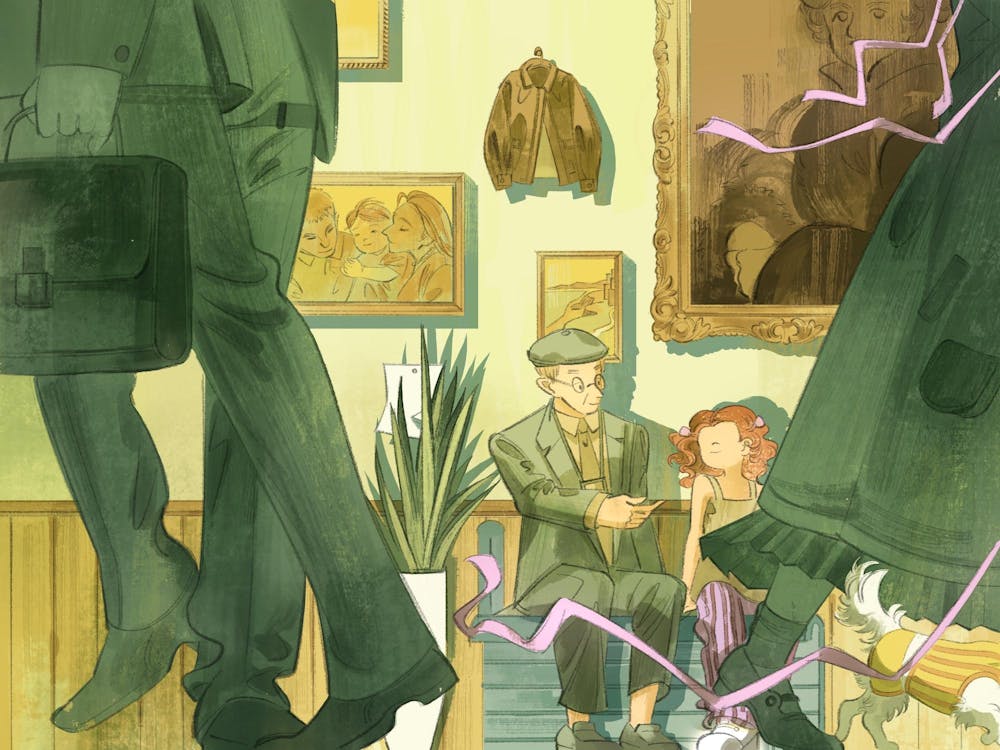
Today I’m in the museum lobby, newly thrifted jacket in hand, waiting for my friends to come out. Today I’m in Amsterdam. Specifically, I’m at the Rembrandt House Museum, though I wouldn’t know—I haven’t gone past the lobby. Still, “Rembrandt van Rijn" is written in a font so big it’s impossible to miss, resting right in front of me. For how cultured I aspire to be, you’d think I’d want to learn more about the guy. But it’s late and I’ve walked a lot and I’m too tired and my friends are already inside. Today I choose freedom—every small act doesn’t have to function as a perfect representation of my entire sense of self. My apathy towards Mr. Rembrandt doesn’t define me: I remain an artist.
Today I’m sitting on a bench—the one furthest from the entrance—and I’m pretending to read a book. Today I’m thinking and I’m interrupted by this man who comes up to me. He immediately intrigues me; he’s wearing an all-black suit and oval-shaped glasses, seems to be around 60 years old, and is very strong-looking. I notice his badge and feel the weight of authority. He seems almost too calm, too confident, too clean—except for the remains of old finger tattoos, a scar from a former eyebrow piercing, and a keen eye for my leather jacket.
“Tell me a story,” he asks as he sits by my side.
Usually, the open book in my lap would keep a stranger from mistaking my posture for an invitation to talk, but he can tell that I’m not really reading. I’m rarely open to talking to men I don’t know, especially if they’re older, and even less so with a demeanor this controlled. But “tell me a story,” he says, and despite my instincts, I choose to trust him. I mean, he’s a man in an all-black suit with a museum badge—what harm can he do?
“Should it be a real story?” I ask.
“No,” he says. “Make up something fun.”
I start with a story where you find yourself at a flea market hunting for the perfect jacket. You look and look and look, and eventually you stumble upon one that you wouldn’t have imagined, one you wouldn’t have intentionally looked for—but when it’s right in front of you, it’s suddenly perfect, so you buy it. It’s about doing something fun for yourself, and though the process of searching feels time-consuming and unsuccessful and never-ending, eventually you find the one. And it’s even better because it was unexpected. Surprise factor! So fun!
“Trust me, the market was huge,” I say. “It was so unlikely you ended up buying that exact one.”
He glances at my jacket, then looks back into my eyes with a serious expression, doubting the fiction of my narrative. I don’t miss his slight smile—a playful kind of disapproval.
“You missed the part where I became friends with some of the sellers,” I justify. “Sure, it’s all in hopes that I get a discount, which I do, but it represents more than that, no?”
He’s not convinced.
“The power of kindness and friendship in casual conversation and all,” I argue, “and of unexpected beautiful finds.”
For some reason, I want to prove to this man that I’m a good spontaneous storyteller.
“Cheesy,” he replies, no longer hiding his smile. I’m winning him over.
“Thought I’d play it safe.”
There’s a moment of silence then. We sit on the bench, both still facing forward, and my gaze starts to drift. This place is interesting—full of character and a subtle energy that only becomes apparent once you pay attention. If you bother to drop your book and deign to look up. If you decide to be present, curious, to crave details and explanations. So I pay attention, then: to the creaking of the wooden floors as people walk by, the way the light filters through the windows near the entrance, how it falls on the too-bright white, cold-toned walls. How those walls match the clean lines of the sharp gray reception desk. I wonder about this—“Do you think Rembrandt notices? Do you think that he’s aware of the lobby’s modern dullness, disapproving from above, offended by the staff’s decorating choices? That he might deem it disrespectful, an inaccurate prelude to his art?”
The man, deep in thought, turns to me. “What?”
“Look at this lobby,” I say. “It looks nothing like his paintings.”
On the front desk, a small TV displays pictures of Rembrandt’s works, their titles in a small font at the bottom-left corner. The image changes after around six seconds. I spot “The Night Watch,” “The Return of the Prodigal Son,” “The Jewish Bride,” and “Self-Portrait.” Sitting on the bench, I glance toward the stairwell leading down to the museum’s entrance, catching the corner of a painting in the hallway—maybe it’s one I just saw on the screen. The walls there are painted darker, warmer, as if to match the paintings’ moods. I can’t see much from here, still in the lobby, but I imagine everything down there must have a story—this is indeed the house of an artist.
“I don’t think he’s too upset,” the man says. “Rembrandt, I mean. Do you really think he ghosts around his house museum all day?”
I nod in agreement. “Yeah,” I say, “good point,” or something like that. I’m still focused on the walls. Our silence doesn’t feel awkward; it’s respectful. I notice a poster on the wall across from us showing a world map. It marks similar museums on different continents; places like the Musée Eugène Delacroix in Paris, Goya’s House in Madrid, and Frida Kahlo Museum in Mexico City—all former homes or intimate spaces of artists, now turned into quiet, reverent temples where the walls still feel like they’re listening. I wonder how Mr. Rembrandt feels about all these strangers constantly wandering through the halls, judging him and his art. Maybe he thinks that some of them don’t form strong opinions at all and are just passing through like it’s any other place. Or that some don’t even enter, but just wait on benches for their friends to get bored enough to leave. He probably finds that ridiculous; it’s not like they’re at his house, his most meaningful place in the world. Does he ghost around, thinking about all these things?
Still staring at the map, I turn my view to South America, seeing how few places are marked there. I think of South America and I think of home, and my gaze softens as my mind drifts. I haven’t thought about it in a while, and I miss it, and sometimes I wish that—
“Where are you from?” he interrupts, catching me staring. Or maybe he noticed my accent earlier. “California,” I say, trying on my best valley girl voice, but he cuts me off quickly. He faces me, narrows his eyes, sees right through it. “I’m from Peru,” I tell him. “Lima, more exactly.”
Now he’s intrigued. He has this very particular way of looking into my eyes as I talk—as if confirming, or genuinely wanting to hear more. He asks good questions. It’s encouraging. I open up, then, about how my city is dangerous yet safe, about the complicated politics, about how I really feel about the place. I tell him about how, as a teenager, I used to count the days until I left, and how now I count them to go back. About how living abroad is hard, but it's something I’d never regret. No one’s asked me about home in a while.
I notice he has an accent too. South African, he says. There’s a pause, a moment of quiet responsibility—to share more, dig a little deeper, get more emotional. He doesn’t talk much about politics, if at all. Not about the government or the economy or social injustice or international affairs. Instead, he talks about his childhood. He lived in a housing complex with small units, a very modest space, he says. He talks about how he walked back from school every day with his two best friends, and how his mom was always waiting for him, lunch in hand. How they spent so much time together and how the enormity of their affection could never be confined to the house’s walls. He pulls out his phone then and shows me a photo of him and his mother standing in front of their simple home.
“The energy of a place is more than the color of its walls.”
“Who’s the corny one now?” I tease back.
“At least I’m not dismissing museums because of their lobbies,” he says.
He has a point. He turns to me and he moves a little closer.
“I don’t think Mr. Rembrandt is offended,” he says. “But it’s not for the reasons I mentioned before. Don’t get me wrong, he’s definitely watching everyone here, paying attention, but maybe he agrees with the odd decorating choices.”
I turn toward him now, too, but my eyes still wander the walls. I’ve become observant.
“I like to think there’s a point to it all, you know. That it’s intentional. Only those who know what they’re looking for here—or those who truly look—don’t get turned off by first appearances. I spend so much time here. I know the place well.”
I see where this is going: “Maybe it’s right that I don’t get to walk in there and experience it, then.”
“I work at the museum because a cold lobby wasn’t ever going to keep me from the beauty of its paintings,” he adds. “You could’ve figured it out yourself—I can always tell when someone isn’t really reading.” He gestures at my book, the one I’d been pretending to read when he approached me earlier, now forgotten at my side.
“That’s not a very common way to meet people.”
“You never would’ve thought of picking up that jacket until you saw it,” he says, looking at the brown leather jacket beside me.
I meet his eyes in defiance. He doesn’t waver.
It’s true, I think.
I glance back at the TV on the front desk, now showing Rembrandt’s “Self-Portrait,” a painting where he sits staring out at the observer. What I see in his eyes surprises me—he doesn’t hold the look of a calculating guest-watcher. Instead, I see the face of an artist—humble, slightly too emotional, wearing his feelings openly for everyone to see. He’s not concerned; he’s honest. And he’s been looking right at me all this time, with the truth of what his art carries. After six seconds, the image changes. I sit at the bench, unmoving. I look back at the man.
He’s still facing me. Puzzled yet hopeful, he continues to stare, slowly making his point:
you see?
I look away as my phone buzzes. My friends are asking where I am. It’s getting late, I realize. I gather my bag and my book and my jacket, and I stand in front of him.
“I never really liked talking to strangers,” I say with a shrug. “Thought it was weird.”
“Yeah, me too,” he smiles softly. “Who even does that anyway?”
He still looks straight into my eyes. I meet his stare and can’t help the smile that begins to form on my lips. He returns the smile, and I know he gets the message.
I always saw.
“It was nice meeting you,” I say at last.
“You as well,” he replies, nodding his head in acknowledgement.
I slip the unread book into my bag, put on my new jacket, wave goodbye, and walk away.


