
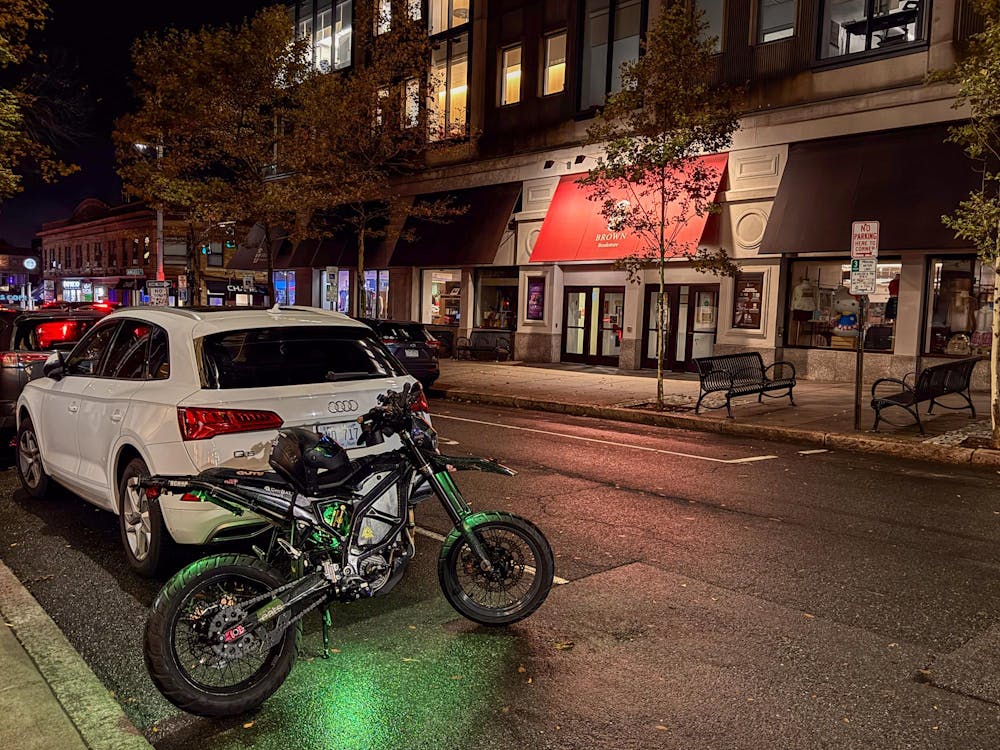
From the New York Times to local news stations to The Herald, much discussion in the last few years has centered around noise in Providence. Hearing motorcyclists revving their engines and lifted vehicles blasting music has become a hallmark of the Brown experience. But should it be?
The University has a responsibility to protect its students — even from noise. In response to the city’s new plan to install noise cameras throughout Providence, Brown must advocate for cameras on its loudest street: Thayer.
Providence Mayor Brett Smiley has pushed for the installation of noise cameras to fine vehicles in violation of the city’s rarely enforced noise ordinance, which prohibits excessive sound at night. This approach has already been tried in New York City, among other U.S. cities. Smiley suggests that these cameras could arrive by the end of the calendar year.
In 2022, a Brown research lab found that noise levels in Providence were similar to those of New York City despite only being a fraction of the size. This research was conducted in partnership with grassroots organizations such as the Providence Noise Project, which was founded in response to this issue. Their slogan, “Noise is the New Smoking,” highlights the negative health effects of excessive noise pollution. In the project’s “Noise Survey,” they report that over 90% of respondents face repeated exposure to vehicle noise, and almost half of them report recurring sleep disruptions — something students living near Thayer can attest to.
In 2021, the American Public Health Association released a report named “Noise as a Public Health Hazard,” in which they state that chronic noise can lead to the “exacerbation of psychological disorders and premature mortality.” Despite Brown’s campus resting in one of the city’s quietest neighborhoods, second only to Blackstone, Thayer Street remains an “earsore.”
Noise is a two-way street — just as Brown students are expected to respect their neighbors and abide by the city’s noise ordinance, we too should be able to expect quiet on the main street that runs through Brown’s campus. Many undergraduate students live in dorms on Thayer, such as New Pembroke 4, Caswell Hall and Gregorian Quad B. They deserve to be able to sleep peacefully. In advocating for noise cameras, our intention is not to push residents out of College Hill, but rather to ensure mutual respect for everyone who shares this city. Reducing noise makes Thayer more family-friendly and ensures that locals feel comfortable exploring all Thayer has to offer, even after dark.
Some community members, and even Brown Corporation member Xochitl Gonzalez ’99, argue that the “sound of gentrification is silence” and that measures to address noise unfairly penalize residents of color. While this concern deserves serious weight, the opposite is also true: People of color disproportionately suffer the consequences of unchecked noise pollution, which worsens health disparities. Ensuring that enforcement is equitably distributed — including on Thayer — is part of solving the problem, not avoiding it.
As the single largest landowner not only on College Hill, but in Providence, Brown has both the power and the responsibility to advocate for noise cameras on Thayer. The University already works with the city on policing, transportation and redevelopment. It should use this same influence to protect students from relentless noise.
Students should not have to choose between an education and a good night’s sleep. A quieter Providence means a healthier, more livable campus.
Editorials are written by The Herald’s editorial page board, and its views are separate from those of The Herald’s newsroom and the 135th Editorial Board, which leads the paper. A majority of the editorial page board voted in favor of this piece. Please send responses to this column to letters@browndailyherald.com and other opinions to opinions@browndailyherald.com.


