
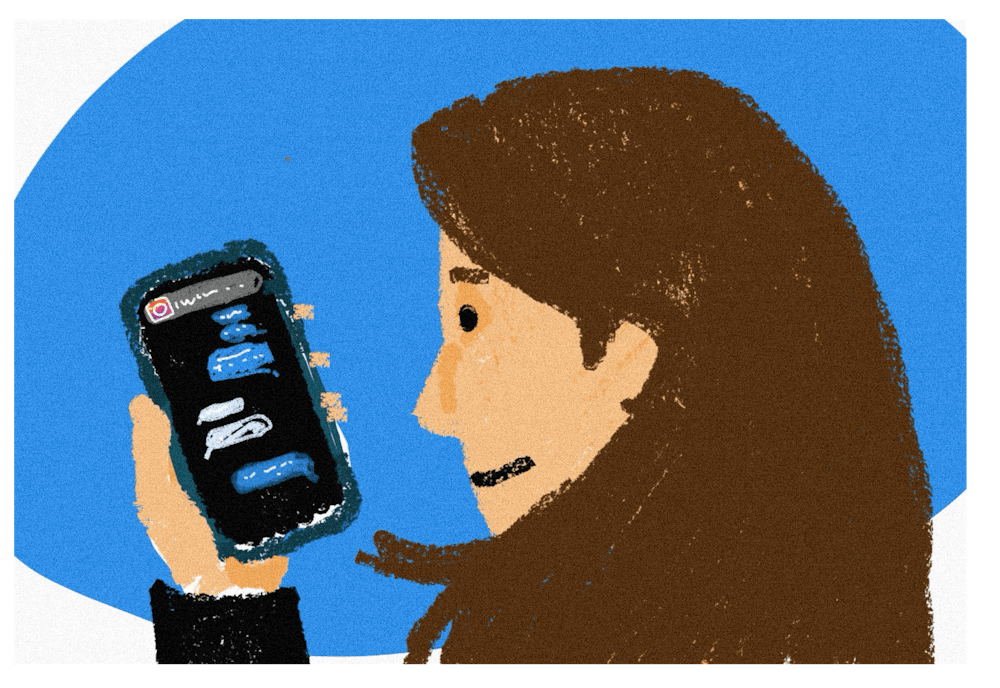
You’re a few minutes into meeting someone new on campus. Names and hometowns have been exchanged, and you’re thinking of making the jump to ask for their contact information. But then a phone appears in your face, paired with the tantalizing question: “What’s your Instagram?” This instant leap — from strangers to practically online confidants, sharing years worth of media — shortcuts the challenges and joys of building connection naturally. Texting, by contrast, still holds onto that sense of discovery.
In recent years, social media has come to dominate the first stages of friendship. For instance, many first-year students were introduced to their classmates not during orientation, but rather, months before on Instagram. This year, the Instagram account @brown2029_ invited incoming students to post five photos, a short caption and a link to their personal Instagram page. Through carefully selected photos of hobbies, big friend groups and personal style, students grab for social clout before the school year has even begun. These types of accounts have become popular ways for incoming students to showcase themselves to their new peers, garnering thousands of followers and posts each year.
Pages like these reinforce the idea that social existence hinges on online presence. When the default is to scroll through someone’s curated highlight reel, the reliance on social media for connection deepens. Why has Instagram become a prerequisite for making friends? Once smartphones reduced face-to-face interaction, texting became the “next best thing.” Now even texting has been displaced by a platform that is shinier and more addictive. If we want to resist the insincerity of social media, we may need to start texting more, not less.
Social media platforms — Instagram in particular — are so addicting in large part because they offer “easy” social connection. With one tap, you can see what all of your friends and acquaintances are up to. But this is a steep trade-off: Instagram bypasses the conversations, curiosity and lived experiences that form lasting bonds. Friendship grows out of messy questions, unpolished stories and flaws, which are all filtered out of carefully curated photo carousels. What’s lost online could be regained through simple, direct conversation, even with something as small as a text message.
The social media algorithm itself is the trap. Stanford Psychiatrist Anna Lembke describes how “social connection has become druggified by social-media apps.” Instagram executives have engineered this doped-up version of social connection to get you to spend more time on their app and generate ad revenue. When people ask for Instagram handles before phone numbers, I just picture Mark Zuckerberg’s net worth gaining another zero.
What’s striking is that young people understand this problem. In a poll conducted by Pew Research in 2024, 48% of teens said social media harms people their age. As teens, we recognize that social media is harmful, but at the same time, 74% of teens still think that social media is a crucial way to stay in contact with their friends. Our generation is complacent in our own harm.
Texting is not a perfect solution to this conundrum. It’s rather that we need to be intentional about the social norms we set. If you’re wary of Instagram’s grip on social life, you may want to take active steps now to stop this normalization. Next time you want to connect with someone via technology, offer your phone number first. Texting may not bundle entertainment and communication into one endless feed, but it can offer something more valuable: a relief from the over-stimulating world of social media and social expectations. A simple switch back to texting could mean stronger friendships, deeper connections and a little more peace of mind.
Clara Murray ’29 can be reached at clara_murray@brown.edu. Please send responses to this op-ed to letters@browndailyherald.com and other opinions to opinions@browndailyherald.com.


