There is an altar in my mother’s family home.
For years, I left the room alone, the closed door foreboding and strange. In a home of hoarders, I imagined it was probably an attic, piled high with belongings nobody could name. I never cared enough to ask, anyway. Between stuffing my face and running circles around my grandparents, I was far too busy to snoop.
It was only after my grandfather’s death that I was allowed in.
I’d never seen an altar before then, at least not one I’d had any personal connections to. Stepping into the room for the first time, my grandfather’s altar feels foreign, lined with portraits of ancestors I’d never thought to view as my own. Logically, of course, they are—I still carry so many of their features—but Thailand is hardly real to me. I don’t know any of my relatives. I’ve never spoken the language. And I’ve only ever been once or twice. Even then, I’d never gone with my grandfather, the man who knew his homeland best.
After my grandfather’s death, his face joined theirs.
For a house that had been falling apart for years, the room had been meticulously kept. Tiles swept, altar dusted, statues shined; my grandfather had cared enough to keep the place—and his ancestors—alive.
The day I am let in, my mother has me kneel and pray. Under my father’s watch, I’d grown up in the Catholic Church and had knelt enough for a lifetime. But blasphemous in my grief, I join her and press my knees to the tile.
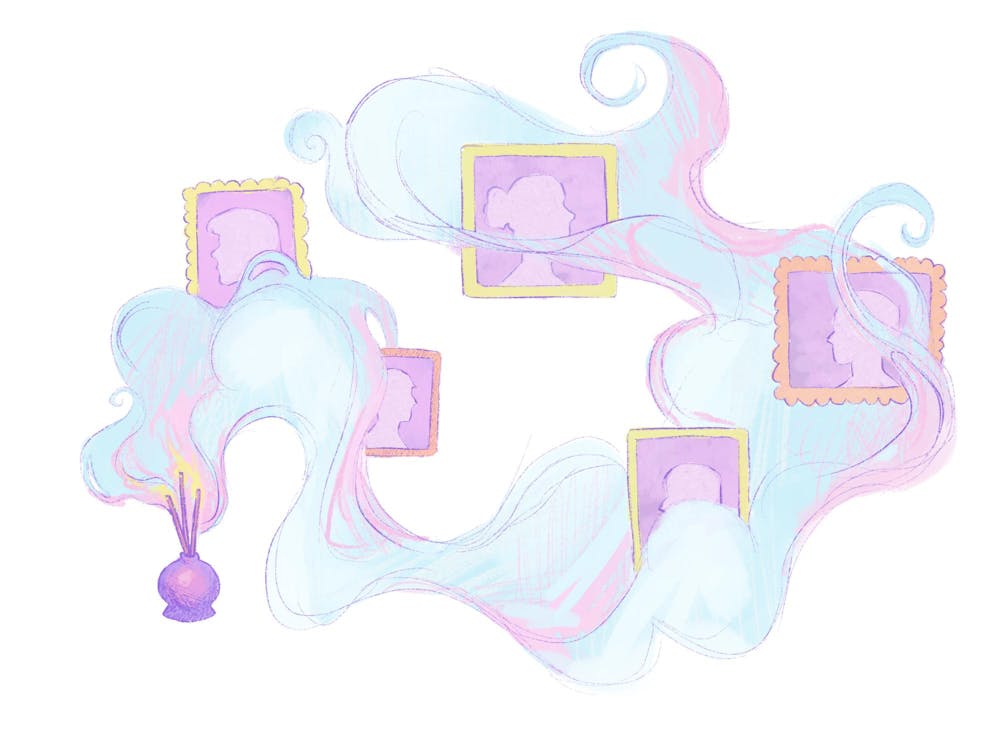
We pray, first, to Buddha. My mother lights a pair of candles on the altar. Then, picking through a half-empty box of incense, she lights a stick by the flame.
Meekly, I follow suit. The incense lights up between my fingers, and I hold the stick upright between my palms, trying my best not to let it slip. My motions are clumsy, and the smoke rises in jagged, wavering lines, too disturbed to settle.
My mother bows her head in prayer. I bow mine, too, and keep the silence. The smell of my grandfather—of incense, wafting—lingers in the air the entire time.
After our prayers, we leave the lit sticks behind with a portrait of my grandfather, face still chubby with health. Caught in a collared shirt and tie, the smile on his face almost reads like a grimace.
The smoke joins the lines on his face, rising to swim around the ancestors above him.
*
Once the door was opened, it stayed that way. Gradually, it became routine to bend, bow, pray.
I go through the motions with the little I’ve been taught, but I’m divorced enough from my mother’s Buddhist faith and my distant Chinese ancestry that altars and altar-making have become foreign acts. Even the prayers I mutter feel improvised and amateur.
Do you pray to your ancestors, or to Buddha? Is there a right way to pray to Buddha? Are you supposed to pray to the Buddha at all?
Untethered, I know so little about what it means to grieve, to remember.
My mother performs this all with ease, but I know these practices will die with me.
*
My father’s ancestors must have built altars, once, before we’d absorbed the Dutch’s Catholic faith. Even after generations in Indonesia, they were far more Chinese than we ever could be.
Today, their graves are tucked away in our middle-of-nowhere hometown. East Java, in a burial ground for Chinese-Indonesians.
The one time we visit, we bring flowers by the bag, purchased on the side of the road. Blue, like butterfly peas. We toss them onto the headstones and the grass in careless clumps, muttering vague prayers with the motions. In another time, this would have been ritual, imbued with meaning. But for us, it is another sunny day.
My paternal grandfather’s girlfriend comes from a family that is more recent immigrants. She tells us about Chinese cemeteries as we move through.
Chinese graves, she explains, are guarded by a deity, for whom an altar is built at the foot of the grave. According to her, the custom is to pray to the deity and offer incense before paying respects at the grave itself.
We skip the routine. Partly because it would be blasphemy; partly because we hadn’t known to bring incense at all.
The last grave we visit that day is the oldest. It belongs to an ancestor whose name has been worn down over time. There, we leave her wilted flowers and pray with practiced solemnity.
Partway through our silence, my grandfather lets out a cry of surprise.
Someone had built over her altar. The neighbouring plot—grander, from a family wealthier than ours—had cut through the stone to build a staircase to their plot, leaving her with half a deity. Carved through, the stone is pitiful.
“They can’t do this,” my grandfather tells us, rubbing the half-altar with his hands.
Though a gentle man by nature, I half-expect him to curse, yell, bite. This might be the worst offense of all: to be built over, physically; to be denied space for solace in death.
Instead my grandfather sighs, resigned. I watch him retract his hand.
It takes so little to destroy a sacred place.
I wonder how that affects an afterlife.
*
My maternal grandfather is brought from his deathbed in Jakarta to Scottsdale, Arizona, where my cousins live. For this journey, my grandmother decides she will bring his ashes in a Tupperware.
There is no customs declaration form to bring your dead husband into America, and he crosses the land, sea, and sky with ease. He flies across the world before being emptied into a ceramic urn.
When my grandmother washes the tupperware out, particles of my grandfather flow into the pipes and out into the sewage. His body enters the water cycle of the Southwest.
I like to think that he nourishes the cacti, that he lives on in the land.
This, I suppose, makes him eternal.
*
The next day, the container is used for lunch.
Is it honorable to eat the dead in trace amounts?
*
My mother tells me she refuses to be buried. Cremation, she tells me, sternly so I do not forget.
I am afraid to tell her that I wouldn’t know what to do with her ashes.
*
For all I write about my family, grief doesn’t actually hit me very often. Birthdays and deathdays blur into the other blips on the calendar. The disconnect, though, is always felt. An entire ocean separates us. From here, I have no land or graves or ashes. No altars of my own, nor any knowledge of how to build them. I don’t know what it means to remember or honor when so much has already been lost, razed, or eroded with time.
I worry that we will have no sacred places. That our names and lives will be forgotten, that our lands and bodies and altars will be built over.
To be forgotten by the mortal realm is to wander, untethered and restless.
The afterlife must be tenuous with nowhere to rest your soul.
*
The sacred, I think, might have to be small.
I’ve never met my paternal grandmother, but I know her well. There was a portrait of her in the living room of my childhood home, smiling and radiant and full of youth. The space, carefully tended, was always hers.
Every night, as the sun set, we’d stop by her corner and turn on a lamp, the bulb offering her a pocket of light.
With us around, she never sees darkness.
*
Maybe one day I will stop writing about my family.
Or maybe I’ll never stop. Maybe I’ll come to the page forever to light my ancestors’ lamps, to keep them bright in my mind and yours.
Maybe, then, they’ll live on in you, too.


