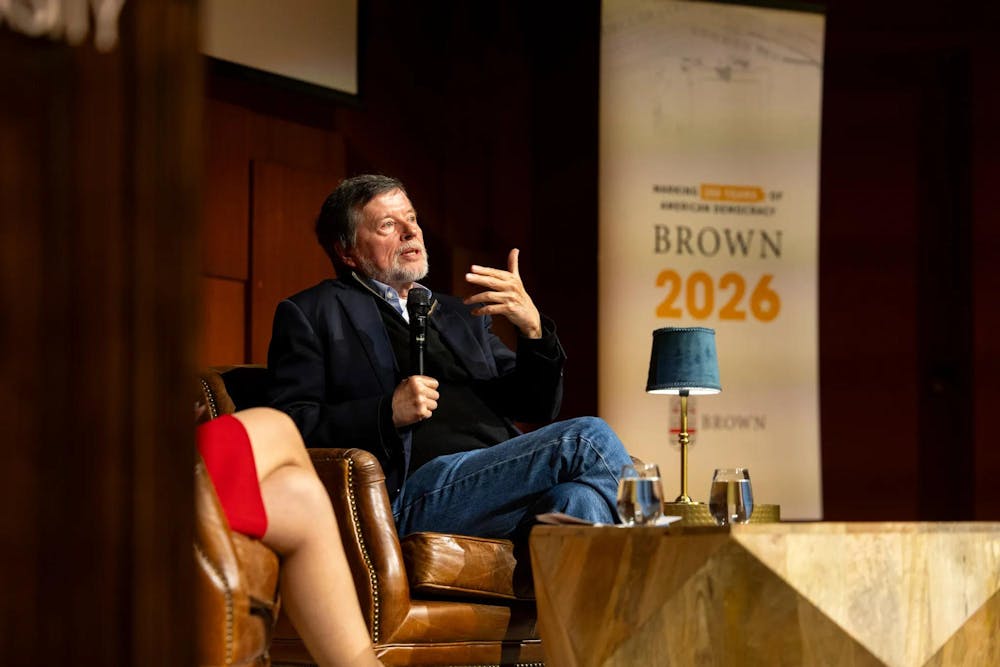
On Friday, cinephiles, historians and Family Weekend attendees alike gathered for “An Evening with Ken Burns,” in the Salomon Center. In partnership with Brown 2026 — a campus-wide initiative celebrating the 250th anniversary of American independence — the event featured an exclusive screening of Burns’s upcoming documentary series.
After the screening, Burns sat down with President Christina Paxton P’19 P’MD’20 for a conversation about filmmaking, U.S. history and the origins — and future — of democracy.
Burns, who initially gained praise for his 1990 miniseries “The Civil War,” has since won more than a dozen Emmy awards for his work. He began the discussion by highlighting the importance of the Public Broadcasting Service — where his new series will air — in the wake of the federal government’s elimination of public broadcasting funds.
The first half of the event presented a screening of several short clips from Burns’s “The American Revolution,” set to premiere Nov. 16. The clips spanned the series’s six episodes.
The first clip highlighted Burns’s dynamic storytelling style, featuring several moments from the series’s first episode. Through a combination of interviews, archival shots and stunning cinematic footage, the clip set the tone for the series. The screening progressed by showing various segments of the second episode, including scenes depicting the Battle of Bunker Hill and the drafting of the Declaration of Independence.
The remaining clips covered events and topics ranging from the harsh winter conditions of Valley Forge, to George Washington’s leadership and the Battle of Yorktown.
After the partial screening, Paxson led a question-and-answer portion with Burns featuring prewritten questions from University faculty. Answering a question about his research process for the film, Burns told audience members that “every day was a revelation” and the project was a product of “a decade’s worth of following the scholarship, following the trails.”
Though creators knew the series would ultimately be cut down to a total of 12 hours, Burns said they recorded around 40 times the final footage, or close to 480 hours.
Later, when asked whether he thought the American Revolution was about democracy, Burns promptly answered “no.” When elaborating, he claimed that the revolution was “essentially arguments over property” — specifically between white, property-owning men — and that democracy, while being a consequence of the revolution, was “not the intention.”
Burns said there are many complexities in America’s origin story, and emphasized the time it took for liberty “for all” to be achieved.
Still, he noted that the American Revolution remains a source of hope, claiming that “to believe in the American Revolution is to believe in possibility.”
Several event attendees praised Burns’s comments and his description of the documentary-making process.
Linford Fisher, an associate professor of history, told The Herald it was “a delight to hear in person the thoughtfulness, the carefulness and the wide consideration of the full span of revolutionary history that went into this film.”
Other attendees, like Anjie Wang GS, a graduate student in history, emphasized the series’s impressive cinematography and archival research. Wang added how Burns’s ability to include both archival footage and depictions of various scenes of the Revolutionary War “was a really good way of incorporating contemporary scenes and historical narratives.”
Having grown up watching Burns’s documentaries, history graduate student Sam Bisno GS said that “just to see Ken in the flesh was pretty amazing.”
“He’s clearly put in an immense amount of research and done his best to capture … every angle and every voice, including those that are often left out of the story,” Bisno added. “I can’t wait to watch the full documentary.”

Ann Gray Golpira is a Section Editor covering Arts & Culture. She is from Norfolk, Virginia and plans on concentrating in both International and Public Affairs and Anthropology. Outside of The Herald, you can find her writing, recording and producing her original music.