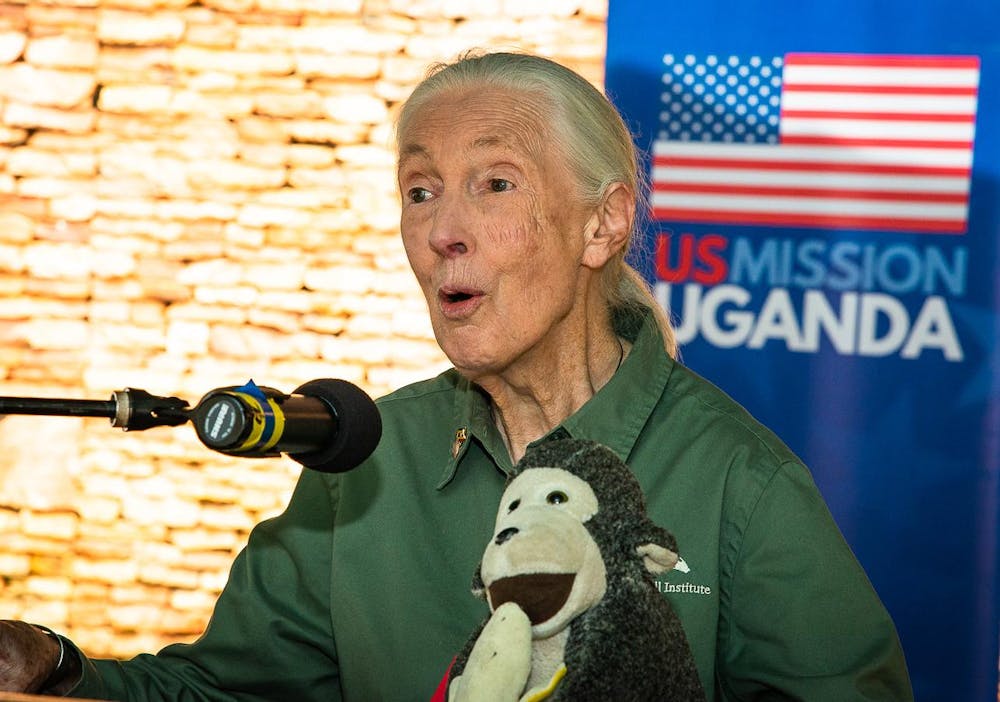
The world has lost a voice of extraordinary wisdom and hope with the passing of Jane Goodall. For many of us in conservation science, her life’s work was more than research — it was a compass pointing toward humility, curiosity and responsibility.
As a Ph.D. candidate in ecology and evolutionary biology at Brown, I had the privilege of meeting and sharing my work with Goodall last week in the final days of her life. We gathered at Arader Galleries in New York City to discuss her role with Partnerships for the Planet, a Cornell program that sends students around the world to work on conservation issues within local communities. There, the evening was spent supporting the establishment of a Jane Goodall Professorship for Conservation Science at Cornell, ensuring that experiences like this would exist long after she was gone.
Yet, what I remember most from the evening is not only her unwavering commitment to conservation, but the gentleness with which she carried herself. She was kind, giving her time to everyone who asked, and she was strong — offering words of hope even amid today’s environmental challenges. Goodall spent her final week tirelessly advocating for the environment and animals, far from home and family — though I do not think she would have wanted it any other way.
Goodall’s pioneering research with chimpanzees redefined what it means to be human, but her greatest legacy is her insistence on our interconnectedness. At a moment when humanity is fractured — by political divisions and social inequalities — her call for a unified humanity feels both urgent and unfinished. Even as her own time on Earth grew short, she reminded us that we are more similar than different — across species, across countries, across any difference — and that is what gives meaning to science and to life.
For students and scholars at Brown, honoring her legacy means more than remembering her name. It means embracing research that is rigorous yet compassionate. It means seeing science not as separate from life, but as an avenue to build bridges across communities and ecosystems. It means remembering the young woman who traveled into Gombe without a college education, who taught us to rethink humanity and embrace humility. And it means carrying forward her belief that hope is not naive — it is necessary and limitless.
During my time with Jane last week, I highlighted her quote: “What you do makes a difference, and you have to decide what kind of difference you want to make.” With Jane’s passing, it is my hope that this message endures. Her hope is now ours to carry: that a better, kinder, healthier, more unified world is always possible, if we choose it.
Montana Stone GS can be reached at montana_stone@brown.edu. Please send responses to this column to letters@browndailyherald.com and other opinions to opinions@browndailyherald.com.