
It has been just over three years since oral arguments began in Students for Fair Admissions v. Harvard, a landmark Supreme Court case that ruled race-based affirmative action in higher education unconstitutional. Since that moment, selective universities have seen sharp declines in the number of Black and Hispanic students admitted, and the Trump administration’s recent attacks on diversity, equity and inclusion programs certainly haven’t helped in this matter.
After the court’s decision in June 2023, Democratic politicians across the ideological spectrum condemned the ruling. However, many overlooked the fundamental issue that created the need for affirmative action in the first place: inequality in K-12 education. For instance, in the aftermath, the American Civil Liberties Union released a statement about “moving beyond” the decision, and nowhere did it mention the need for better funding for public education. Instead of fretting over the Supreme Court’s ruling, we should redirect our time and energy to a different front — one that is a more effective pursuit. To address the issue of diversity in higher education, whether it be class or racial disparities, we must shift our focus away from the Supreme Court and federal actors and toward our governors, state legislatures and local municipalities.
In his lone dissent in Plessy v. Ferguson, Justice John Marshall Harlan wrote, “our Constitution is color-blind, and neither knows nor tolerates classes among citizens.” After the passage of the 13th and 14th Amendments, as well as the Civil Rights Act of 1965, our Constitution has done all it can to make Harlan’s words a reality. Past the immediate remedies following the abolition of slavery, racial considerations are not tolerated in American jurisprudence. To put it simply, the federal government’s hands are tied.
Activists of race-conscious admissions need to turn their attention to their own capital, and I don’t mean Washington, D.C. We have no national education system, which means that the failings of our state’s education system will, over time, be reflected in admissions to highly selective universities. The 10th Amendment of the U.S. Constitution reserves powers not delegated to the federal government to the states, serving as the basis for state control over education. However, this capitulation by the federal government has had drastic effects on the uniformity of public education across the country.
Funding differences are largely regional, with the highest state-funded education concentrated in the Northeast, while the lowest funded states are located in the South and Southwest. This is further exacerbated by the same dynamic in the allocation of federal funds to K-12 education. Disparities in funding directly correlate with performance. The performance results on the National Assessment of Educational Progress vary widely across states. Oklahoma, Arkansas, Mississippi and Georgia, among other states, are performing significantly below the national average in key measures like reading and mathematics.
Intra-state disparities further complicate the issue. Once race is factored in, understanding the lack of diversity in higher education becomes even clearer. African American students are 3.5 times more likely than white students to be in “chronically underfunded” districts. Even well-to-do states, such as those in the well-funded Northeast, like Connecticut and Pennsylvania, struggle to target their funds effectively, leaving large gaps between their wealthiest and poorest school districts. A case study of Alabama, New Jersey, New York, Louisiana and Texas found that “on every tangible measure,” schools with higher percentages of students of color had significantly fewer resources than their white counterparts.
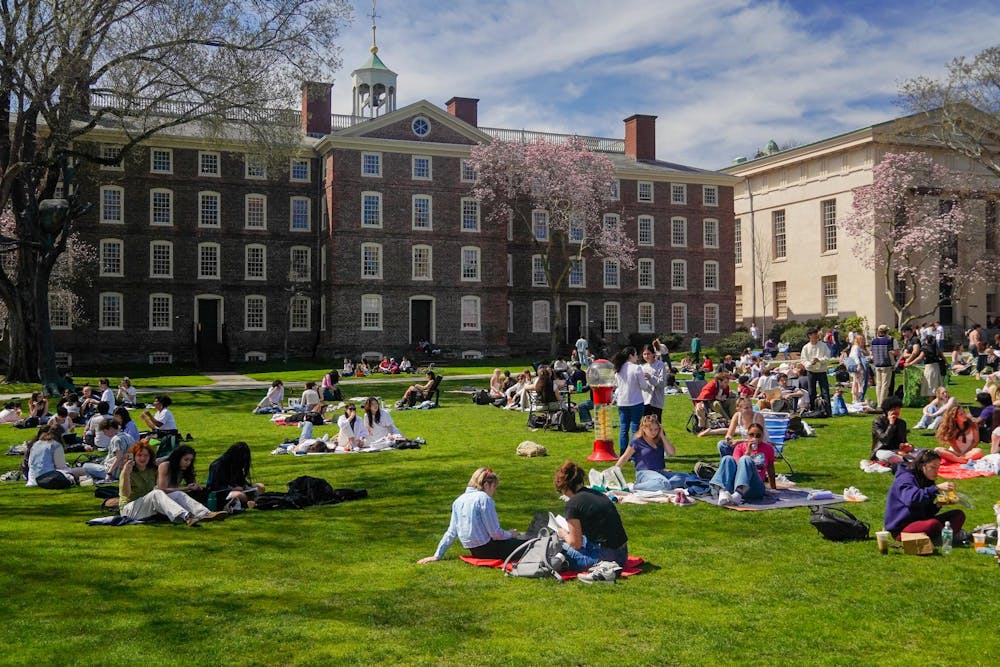
Let’s use our own university as an example. Despite nearly 40% of the U.S. population hailing from the South, they only account for 17% of enrollment here at Brown. It is no coincidence that the regions of our country that suffer from the greatest intra-state disparities in funding for public education are least represented at our institution. It is no coincidence that 56% of the Black American population lives in the South and is continuously underrepresented at selective colleges.
Your governors, state legislatures and municipal leaders are responsible for these inequalities, not the Supreme Court. Fixing the problem of funding at the local and state level — a factor that is strongly correlated with race and class — unlike affirmative action, will create the world activists of affirmative action seek. Funding is not a silver bullet, and these changes will take time to manifest but more money certainly doesn’t hurt. To ignore state responsibility in the aftermath of SFFA v. Harvard is to absolve them of responsibility for diversity in higher education, and that must not stand.
We, as a country, don’t need to change or bend the Constitution — we just need the Constitution to be what it already is: our founding document. One that promised us in the words of Justice Clarence Thomas, “that all men are created equal, are equal citizens and must be treated equally before the law.” The notion of school choice in the United States is a myth. However, the right to ubiquitous public education, regardless of one’s positionality, is not. Once we see the reform of our public education system, then we will see what methods such as affirmative action could never truly achieve: a diverse and reflective American university system.
Christian Davis ’27 can be reached at christian_davis@brown.edu. Please send responses to this op-ed to letters@browndailyherald.com and other op-eds to opinions@browndailyherald.com.


