
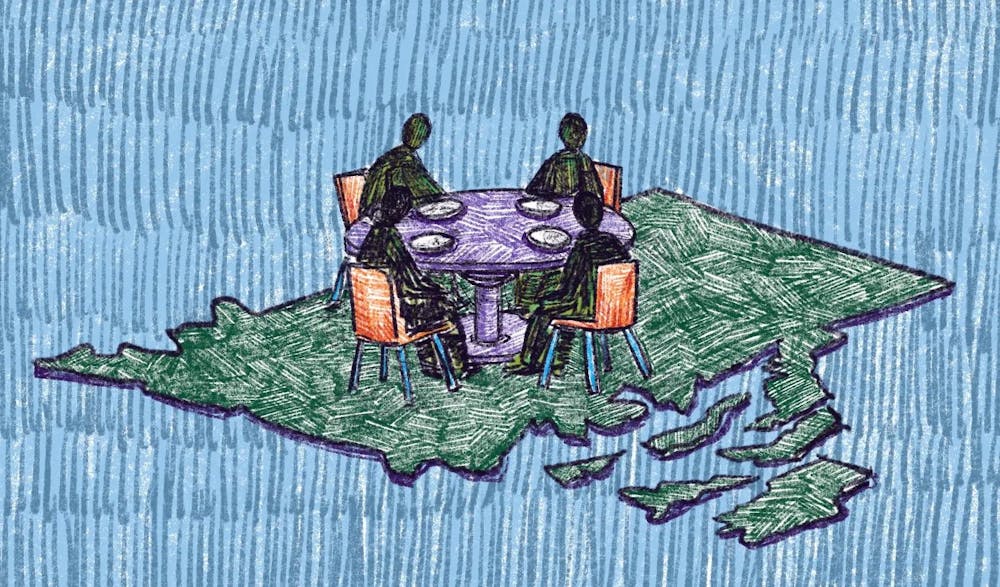
On Oct. 1, the federal government shut down, halting federal programs and services across the country and partially freezing Supplemental Nutrition Assistance Program benefits starting at the beginning of November. In a typical month in 2024, SNAP helped 41 million low-income Americans afford a healthy diet, meaning that the pause in funding left these individuals, 40% of whom are minors, without access to food stamps. While SNAP benefits have since been restored, the paused funding caused confusion and hardship for millions of people, including those on college campuses and in Brown’s backyard.
Though Brown’s student body has ranked the lowest among the Ivy League in socioeconomic diversity, not all students are immune to food insecurity. While there isn’t specific data on how many undergraduate students at Brown are food insecure, a Graduate Student Council’s annual Quality of Life Survey showed that 13% of the University’s graduate students faced food insecurity in 2024 and 30% in 2023. Plus, nearly a quarter of college students faced food insecurity on their campuses in 2020, making it likely that at least some Brown undergraduate students do too.
The crisis hits close to home with roughly 144,000 Rhode Islanders relying on SNAP benefits to feed themselves or their families. Despite its impact on our local community, however, Brown students and administration offered a limited response that fell short of what was necessary given the scale of the crisis. While there are certainly other crises worthy of our concern, the pause of SNAP benefits and the broader issue of food insecurity is a problem that merits immediate attention, and Brown can do more to help.
As most students will attest, Brown’s student body is far from ambivalent when it comes to political issues. Less than two years ago, Brown’s campus erupted in protests over the Israel-Hamas war. Earlier this semester, over a hundred students and faculty gathered outside the Van Wickle Gates urging Brown to reject Trump’s “Compact for Academic Excellence in Higher Education.” But aside from the occasional Instagram story, the pause in SNAP benefits saw no student-led campaigns or on-campus protests rallying against the pause in funding or urging Brown to take a stance. While I applaud the University for sharing a list of resources and programs through which people could support students and community members through the funding pause, I still think administrators and students could have met the moment with more urgency, the University by demanding federal action in a public statement and students by organizing movements to call attention to the crisis.
Brown has put some measures in place to help students who struggle with food insecurity. Brown Market Shares Program provides fresh food to the Brown community, there is a food pantry in Page-Robinson hall and a website that provides food security resources for graduate students. Though well-intended, these initiatives alone are not sufficient solutions: The food pantry fails to address the stigma associated with food insecurity, relying on students to retrieve food in public spaces, and the University provides no comparable food related resource website for undergraduate students.
To adequately address the crisis, Brown should participate in Swipe Out Hunger, a program already used among 900 college campuses throughout the country, including the Rhode Island School of Design and Providence College. The non-profit organization helps create a meal swipe fund that collects unused meal swipes for those who need it. Instead of letting them go to waste, Brown could collaborate with Swipe Out Hunger so that leftover meal swipes can be distributed among students in need. Since the meal plan is prepaid, joining this initiative would be at no cost to Brown.
Brown prides itself on cultivating students who care about justice, equity and public well-being, but those values ring hollow if we ignore the food insecurity crisis unfolding around us and, in many cases, within our own student body. If we are serious about these values, then it is our responsibility to put pressure on the University to respond to the pause in SNAP benefits and take action to address food insecurity within the Brown community.
Max Mooney ’29 can be reached at max_mooney@brown.edu. Please send responses to this column to letters@browndailyherald.com and other opinions to opinions@browndailyherald.com.


