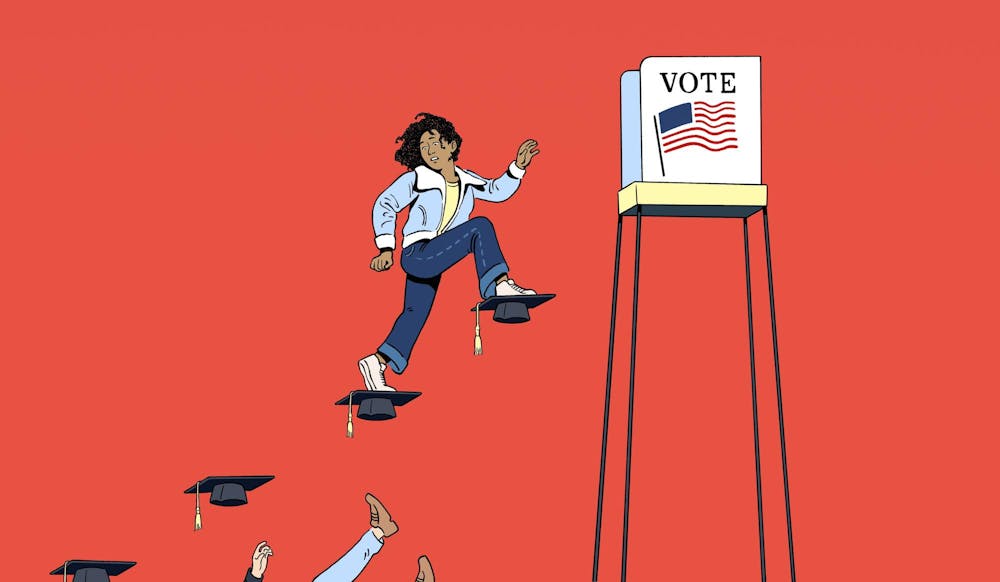
Voter participation rates differ widely across levels of education — according to a new Brown study, administrative burdens are partly responsible.
The study, which drew on 17 years of voter data from the Cooperative Election Study, found that the administrative complexities of voting disproportionately deters less-educated individuals from democratic participation.
According to the paper’s author Cameron Arnzen, a postdoctoral research associate at the Annenberg Institute and the Watson School of International and Public Affairs, it has been a consistent finding in political science that “individuals with more education vote more than individuals with less.”
“We’ve known about this for over 100 years,” Arnzen said. While the phenomenon is “well documented,” researchers know “relatively little about why.”
“Wrestling with this question of, ‘Why is it that individuals with higher levels of education are more represented in our democracy?’” was what motivated the paper, Arnzen said.
He explained that when citizens engage with the government, there are “bureaucratic or administrative” processes that impose costs “on citizens in accessing services or ultimately realizing a right.” Arnzen added that administrative burdens such as voting methods, times and places differ by state and affect people differently.
The study combines CES voter data with figures from the Cost of Voting index, which approximates and standardizes the administrative burden of voting in different states. Election procedures are left largely to states’ discretion, and while some states’ voting processes have become more burdensome in recent years, others have moved the opposite direction.
Individuals with higher levels of education vote at similar rates in both high- and low-burden contexts, Arnzen explained. But those with lower education levels are “far less likely to vote” in high-burden areas.
Arnzen explained that college students may adopt certain skills through activities such as studying for exams, registering for classes and filling out paperwork that can “teach you how to navigate similar processes.”
“The process of education prepares you to vote in certain ways, at least in the United States’ voting context,” he said.
According to Niamh Stull GS — who researches the intersection between education and politics and was not involved in the study — found it interesting that there was no change in voting rates for individuals with higher levels of education in different burden levels.
“Voting was less complicated back in the day, and now there are, at the state level and local level, lots of hoops to jump through,” Stull said. “As these laws and barriers continue to be put in place, it only widens that gap in voter participation between education levels,” she added.
According to Lindsey Kaler, a postdoctoral research associate in education policy at the Realizing Rights Lab, Arnzen’s research is connected to special education services.
“Students with emotional and behavioral disabilities have lower rates of college enrollment and completion than their peers without disabilities,” Kaler wrote in an email to The Herald. “That may impact their ability to navigate certain systems in which administrative burdens are in place, such as voting.”
Kaler wrote that Arnzen’s work “highlights that education is a key component of how people navigate the world and the systems and services around them, including democratic participation through voting.”
“We should design policies that make it easy for everyone to vote, make it easy for everyone to access their basic democratic rights, and maybe even go a step further and make it desirable and engaging and a positive experience,” Arnzen said.
Amrita Rajpal is a senior staff writer covering science and research.