
Since July 2021, there have been at least 22,810 instances of book bans in public schools across the United States. One of those was a picture book written by author Edwidge Danticat MFA’93.
Danticat’s “Mama’s Nightingale: A Story of Immigration and Separation” was removed from a Connecticut school’s curriculum for being “not developmentally appropriate for teaching,” according to News12 Long Island. The story follows a young Haitian girl whose mother is detained in an immigration detention center.
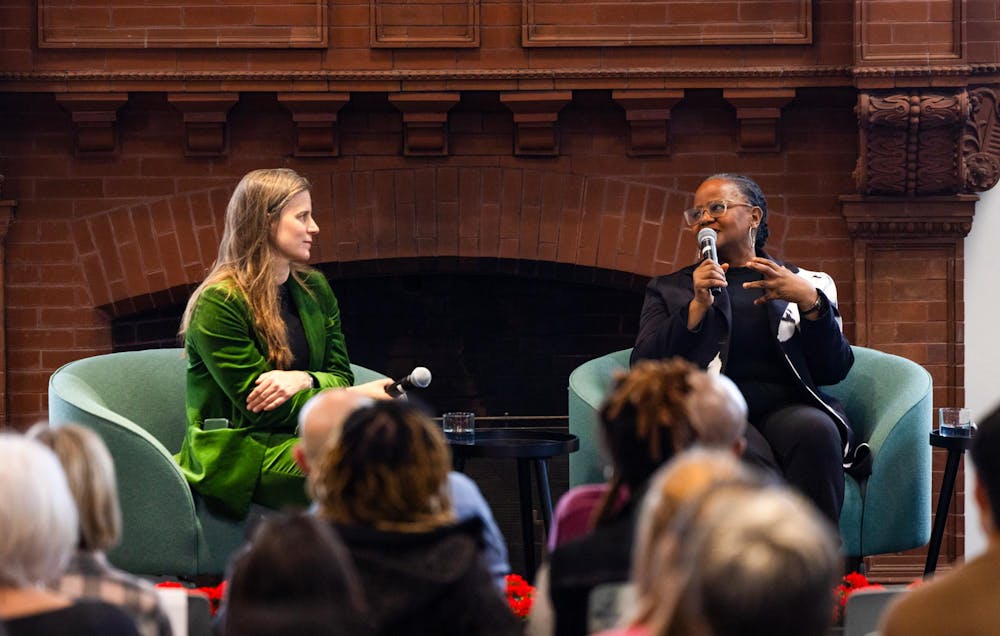
Danticat and Lauren Groff, an author who also owns a Florida bookstore that sells books the state has removed from libraries, discussed the impact of these bans in a talk titled “Banned Books and Troublesome Texts” as part of the Office of Diversity and Inclusion’s Honest Conversations Series on Monday afternoon.
“What began as a sharp spike in parental challenges at local school board meetings has increasingly evolved into a systematic state-sanctioned restriction,” Vice President for Diversity and Inclusion Matthew Guterl, who opened the conversation, said. He added that book bans have resulted in “disturbing normalizations of censorship” and a “comprehensive rewriting of history that is reshaping public education.”
According to Guterl, those who seek to ban books “overwhelmingly target” stories that discuss marginalized identities and works by authors of those identities.
“Part of me was proud,” Danticat said at the event, noting that she had grown up under a dictatorship in Haiti where writers would bury their books to avoid being punished. “I knew the power of the word.”
But she added that the targeting of her book set off an “alarm,” posing the question of what will “be banned next if a picture book is banned.”
Groff, a New York Times bestselling author, explained that individuals can and should choose what they want to read, and authorities should not be the ones making that decision.
“I do not want people who do not read telling my children what they can or cannot read,” Groff said. “It’s control of other people’s children, and I find that is absolutely egregious and needs to be fought at every level.”
Both authors also discussed how book banning aligns with a rise in authoritarianism, drawing connections to the McCarthy era.
“What feels different now is that it’s such a compulsive, driven effort at erasure,” Danticat said. While books are not being physically burned, the ideas within them are being erased in an “effort to try to replace them with these white supremacist ideas,” Danticat added.
Groff noted that authoritarian regimes ban or burn books in an attempt to “identify and isolate” certain populations. She added that this tactic allows governments “to make laws against them, to then turn them into second-class citizens.”
Groff and Danticat also emphasized the importance of engaging with books that make readers uncomfortable.
“Reading a book you hate forces you to think of why you hate it,” Danticat said.
She gave the example of “Drums at Dusk,” a book she taught to a class that tells the story of the Haitian Revolution from the perspective of the French. When her subsequently frustrated students asked why they were reading it, she told them it was “because it’s riling up this reaction.”
Groff asserted that some books should make readers angry and that “engaging with difficult arts, no matter what it is, is deeply important to become a human being in the roundest sense of the word.”
Reading true art is different from reading for entertainment, Groff also noted. “The purpose of art is to earthquake the status quo. It is to shake it. It is to change it. It is to move. It is to undermine it,” she said. “I think the purpose of entertainment is to uphold the status quo.”
“If you're reading just to escape your life, that's fine, but don't be misled into thinking that you're reading art,” Groff added.
Annabelle Stableford ’28, who attended the event, said she was able to take away from the conversation that “art is uprooting and revolutionary and not entertaining or comfortable,” she said. “It should be disturbing or unsettling, maybe not in a dark way, but it should be making change.”
Professor of Engineering Christopher Rose explained that discussions about literature allow people to understand a broad, diverse array of perspectives.
“What we try to do as science folks is distill things down to the simplest equations. Those simplest equations sometimes miss the bigger picture,” Rose said. “Reading helps you expand that picture so that you know what to include in the way you’re looking at the world and what not to.”
For Caroline Fenton ’29, the event was a way to hear from one of her favorite authors. Fenton pre-ordered Groff’s new book, Brawler, last February. Ahead of the talk, her mom mailed the book to her for Groff to sign.
Fenton added that she was excited to hear what the two authors had to say about book banning, explaining that she had heard from friends who are from Florida that “the curriculum has changed so much in the past few years.”
“Literature is such a transformative experience, and that shouldn’t be filtered through whatever politicians think should be banned,” Fenton said. “I think people should be allowed to have their own experiences with books.”

Zarina Hamilton is a university news editor covering activism and affinity & identity. She is sophomore from near Baltimore, Maryland and is studying mechanical engineering. In her free time, you can find her reading, journaling, or doing the NYT mini crossword.


