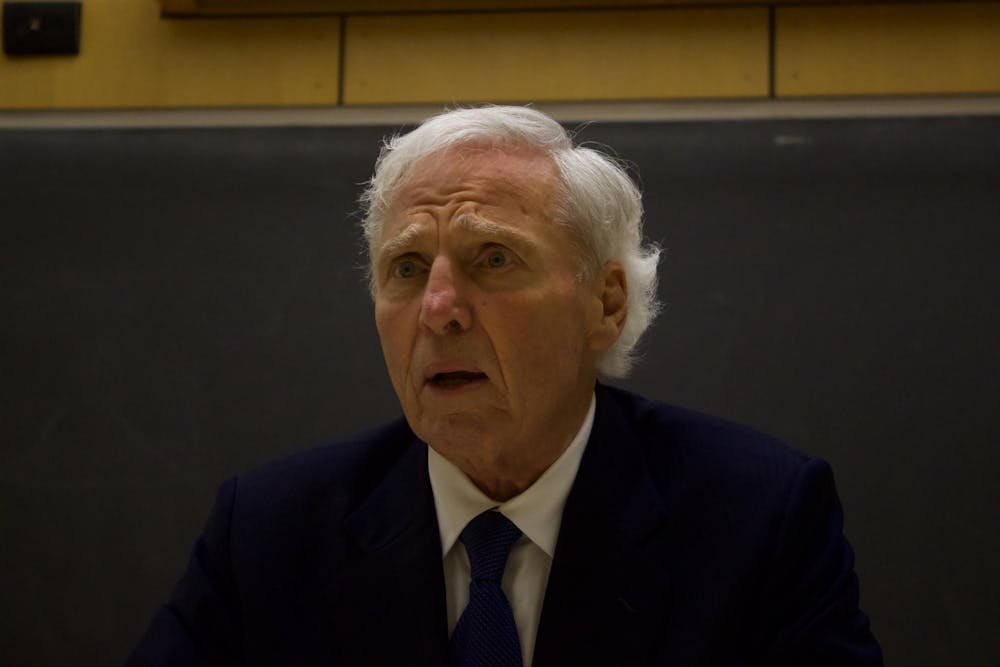
Former Commissioner of the Food and Drug Administration Andrew von Eschenbach opened his Monday night Brown Political Union lecture with a common phrase: “May you live in interesting times.”
Von Eschenbach argued that the rapid development of technological and scientific breakthroughs has made the present the most interesting era in human history. At the event, titled “Policy, Politics and Public Service in Medicine,” the 2006-2009 FDA commissioner discussed his career trajectory, ideas for FDA reform and the future of the agency.
“I have long advocated that the (FDA) should become an independent agency,” von Eschenbach said in an interview with The Herald. The FDA is currently under the purview of the U.S. Department of Health and Human Services.
He believes that the FDA should “always be above and outside of any political influence, but it does have to take into account policy issues and policy influences,” a sentiment he echoed in his lecture.
At the event, von Eschenbach added that the FDA must lie in a place where it can “inform policymakers and other agencies,” rather than make policy decisions based on politics.
“Keep the FDA sequestered around scientific decisions about the performance of the products it’s regulating,” von Eschenbach said.
Additionally, von Eschenbach said that FDA regulatory decisions should be delegated within the agency — not made unilaterally by the HHS secretary. Previously, the decisions were made by the FDA commissioner, who would rely on scientific experts and directors within the organization, he said.
“The secretary is using the authority he’s always had but probably shouldn’t,” von Eschenbach said. “My advice to him would be, ‘you’re not the scientist who knows the content. Let that decision-making occur where that scientific expertise exists.’”
Von Eschenbach called for greater transparency at the FDA, which he said is currently a “black box.”
Public mistrust in institutions is a “complicated disease” that can be battled by putting patients first, von Eschenbach added. He called for the pharmaceutical industry to stop advertising drugs directly to consumers since it treats patients as a means to an economic end.
In his conversation with The Herald, von Eschenbach described the elimination of roughly 3,500 FDA positions last year as “too much, too soon.” Though some of these cuts have been undone, he added, experienced leadership at the top and entry employees with emerging skill sets at the bottom are the “most critical people that you need” in the agency.
The HHS did not immediately respond to The Herald’s request for comment.
A Navy Medical Corps veteran, former director of the National Cancer Institute and former chair of the department of urologic oncology at the University of Texas MD Anderson Cancer Center, von Eschenbach said he was motivated by the desire to “make a difference.”
Von Eschenbach said that each of his roles widened his perspective of the field of medicine. He described his time at MD Anderson as being on the “front lines,” his role at the NCI as like being in a surveillance plane and his time at the FDA as being like “spy satellite.”
Though he no longer leads the FDA, von Eschenbach currently sits on the board of the Reagen-Udall Foundation, a congressionally sanctioned nonprofit that helps “create the interface between the (FDA) and all the stakeholders in the private sector, both industry as well as patients,” he told The Herald.
Looking to the future, von Eschenbach said artificial intelligence’s emerging role is “unlocking the vault” of information that the FDA harbours.
This “vault” — including every drug, biologic and device that the FDA has ever approved or disapproved — used to be a physical archive, but now resides digitally in the cloud, von Eschenbach told The Herald.
“If we unlock that vault, we can accelerate our ability to bring safer, more effective drugs quicker to patients in need,” he added.
“I am from the world of the caterpillar,” von Eschenbach said to the event’s audience. “You are part of the metamorphosis.”
Nishita Malhan is a senior staff writer covering science and research.