
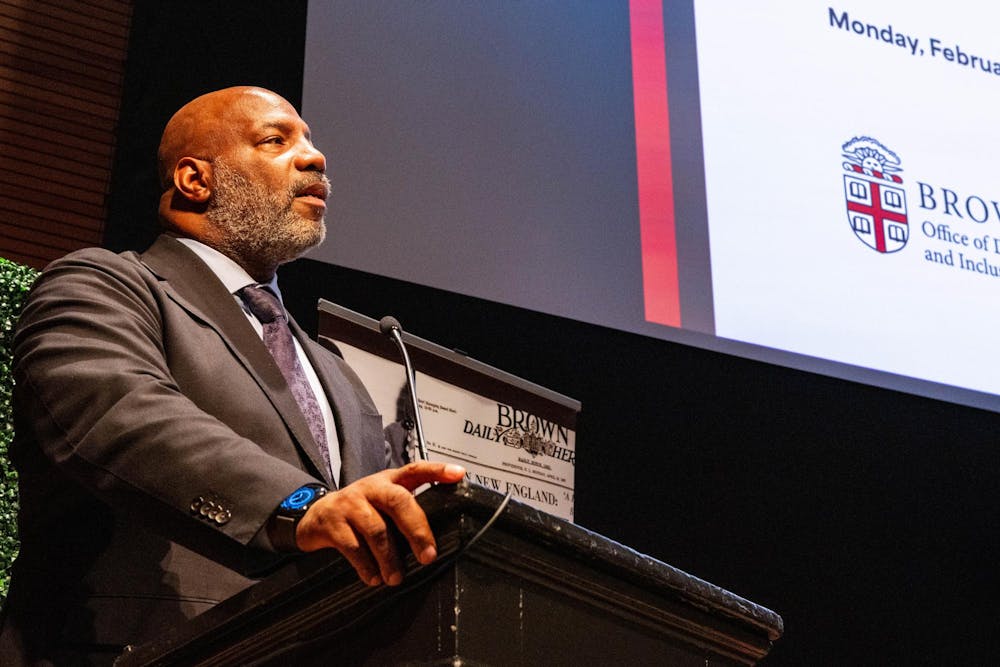
On Monday, Jelani Cobb, a staff writer for the New Yorker and dean of the Columbia Journalism School, spoke at the Office of Diversity and Inclusion’s 30th annual Martin Luther King Jr. Lecture. During the talk, Cobb traced activist movements and collective resistance from the Civil Rights Movement to the modern day.
Throughout times of injustice, “The most basic thing that we have as a society is our collective conscience and our willingness to fight back,” Cobb said.
In addition to his work as a journalist and dean, Cobb was a finalist for the Pulitzer Prize in Commentary in 2018 and, two years later, won the Peabody Award for his film titled “Whose Vote Counts?” Cobb has also written multiple history books, including his most recent titled “Three Or More Is a Riot: Notes on How We Got Here: 2012-2025.”
Opening the lecture, Cobb drew on King’s book “Where Do We Go from Here: Chaos or Community?” to outline some of the setbacks and successes of the Civil Rights Movement.
“Victory has a way of erasing all the things that could have been or might have been or that weren’t executed to the way that they would have been intended,” Cobb said.
He explained that King’s novel is a kind of “self-assessment tool that he uses to try to understand what is next for the civil rights movement.”
Cobb tied the history of the Civil Rights Movement to present-day community-based efforts to resist U.S. immigration enforcement activity.
“When we look for sources of inspiration (in fighting injustice), they generally come from people who have far less in terms of power and far less in terms of resources,” Cobb said.
That sentiment is embodied by those in Minneapolis who protested, night after night in freezing weather, against immigration enforcement actions, Cobb said. Those protesters stood “up in defense of people whom they may not have actually known but to whom they believed they owed a civic responsibility as their neighbor,” he added.
Aaron Stark, a PhD candidate at Brown who attended the lecture, said that he “liked what (Cobb) said about the issue of neighborly decency as being a sort of cornerstone to any democracy.”
Having grown up in Queens, New York City, Cobb said he has long understood the importance of collective community in one’s neighborhood.
In 1960, Queens was the second-whitest part of New York City, Cobb said. But throughout his childhood, the borough was “en route to becoming what it currently is, which is statistically the most diverse county in the United States.”
This change in Queens reflects a similar trend toward diversity across the rest of the country, he said, adding that the rising rate of interracial marriages and increased representation for people of various backgrounds in American institutions also reflected this pattern. But President Trump is attempting to reverse this progress, Cobb added.
“We are fooling ourselves if we believe that it is a coincidence” that Trump, who Cobb called the “most xenophobic politician in modern American history,” grew up in Queens, an area that experienced such sudden diversification.
The White House did not immediately respond to The Herald’s request for comment.
But amid social turmoil, Cobb said that he has the “optimism of a boxer in the late rounds, which is that if you’re still on your feet, if you haven’t been knocked out, you still have a chance to win.”
“And that’s what optimism is — a chance, not a guarantee,” he said.
Cobb “has a way of giving us information that pulls on history, but also gives us a path forward for the future,” said Jai-Me Potter-Rutledge, chief of staff for Brown’s Office of Diversity and Inclusion. She said her biggest takeaway from his lecture was to “never lose sight of optimism.”
“As long as you’re still standing, keep at it,” she added.
Marat Basaria is a senior staff writer covering activism.


