
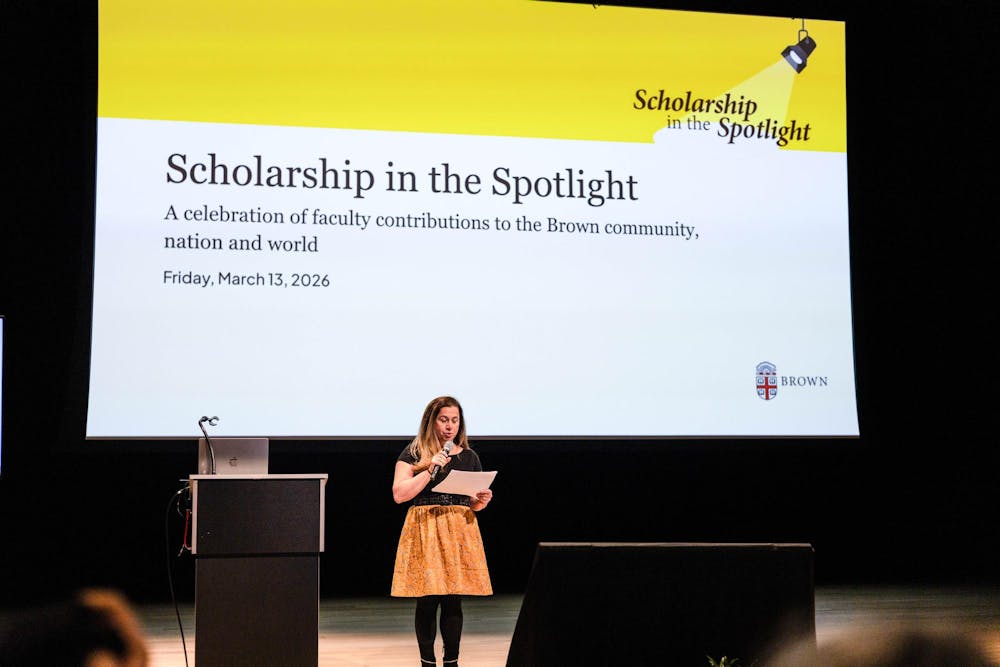
The University first offered French courses in 1769, Virginia Krause, chair of the Department of French and Francophone Studies, told a crowd in the Lindemann Performing Arts Center during the Faculty Executive Committee’s inaugural “Scholarship in the Spotlight” event.
On Friday, colleagues from the Departments of Applied Mathematics and Sociology joined Krause in sharing the histories, research and achievements of their respective departments.
An aim of the event was to provide a “shared understanding of what we do and why it matters” so that faculty can “uplift each other” and “be each other’s best advocates,” Anna Lysyanskaya, professor of computer science and chair of the FEC, said during her opening remarks.
“If we don’t band together in our shared conviction that (our work) is valuable, then the public at large will fail to believe in it either, and it will spell the end of the era of academic and intellectual freedom,” Lysyanskaya said.
The idea for the departmental spotlights was born after the FEC visited academic departments and found that many faculty members felt as if the University’s “attention is scattered,” she said in an interview with The Herald.
“We want to focus on what is really important and really critical, which is the mission itself, the work itself,” Lysyanskaya said in an interview with The Herald.
According to Lysyanskaya, the event — which is set to occur on a semesterly basis — will feature a balanced selection of departments. The departments chosen for this first spotlight were picked in a “totally arbitrary” way, she said.
She also believes that this event can provide a “voice” for faculty to express what their departments care about. She noted that this could inform the decisions administrators make when developing the University’s priorities.
Lysyanskaya explained that events like this typically occur during commencement weekend. She hopes that the event will attract alums in the future, providing a space for those within the same department across different class years to connect with each other.
“There’s so many things that we don’t know are happening, and we need to give ourselves more opportunities to discover them, so that we can do better in our own wheelhouses as well,” she said.
In preparation for the spotlight, each departmental chair participated in planning meetings to discuss how they wanted to represent their department.
Chi-Wang Shu, chair of the applied mathematics department, said the department wanted to highlight its achievements to “anyone who is interested in Brown.”
At the event, Shu presented a brief overview of the department, including its history as the first applied mathematics department in the United States, focal points for research within the department and notable accomplishments of faculty members.
Following Shu, George Karniadakis, a professor of applied math and engineering, discussed the topic of scientific machine learning.
“We live exactly at the intersection of mathematics, physics, data and computation,” Karniadakis said.
Prudence Carter ’91, a professor of sociology and director of the Center for the Study of Race and Ethnicity in America, followed Karniadakis with a pre-recorded video detailing her path to higher education and her motivation to pursue sociology after observing “stark inequities in educational opportunities.”
Her own research focuses on inequalities within the educational system and the potential of “relational equality,” or using diverse relationships to facilitate empathy and understanding, she said at the event.
Overall, Carter and her colleagues’ research “embraces a fundamental shared question: how can individuals and social groups within institutions work to produce a more viable, healthy, multiracial, multicultural democracy?” Carter said.
Josh Pacewicz, an associate professor of sociology and urban studies, presented after Carter and focused on officials in Republican-leaning states and their impact on the current status of democracy in the United States — a topic he is currently researching for an upcoming book.
Associate Professor of Sociology, Nicole Gonzalez Van Cleve, then discussed the topic of her book, “Crime Fictions: How Racist Lies Built a System of Mass Wrongful Conviction,” which covers wrongful convictions and their association with race in the United States.
The French and Francophone Studies department concluded the event’s discussion. Krause told the story of the namesake of Rochambeau House, which houses the department, named for Jean-Baptiste Donatien de Vimeur, Comte de Rochambeau, who commanded troops that lived on campus during the Revolutionary War.
“The father was a hero of the American Revolution, but the son was a villain of the Haitian Revolution,” Krause said. “Named after the father, our building is haunted by the specter of the son.”
Rochambeau’s son, Donatien Marie Joseph de Vimeur, Vicomte de Rochambeau, was “infamous for the brutal tactics he deployed” as a French officer in the Haitian Revolution.
“We have become a department of French and Francophone studies to signal our discipline’s commitment to studying the voices, histories and literatures of those countries where French troops were not revolutionary allies like the father, but colonial masters like the son,” she said.
Mohamed Amer Meziane, assistant professor of humanities, then gave an overview of the research being conducted by faculty members within the department, including works on Derrida, Rousseau and “enchanted stories.”
Laura Bass, an associate professor of Hispanic Studies and history of art and architecture and interim chair of Portuguese and Brazilian Studies, said she thought the event was “very moving.”
“You have these people committed to such important areas of study,” she said. “It filled me with hope in such a very dark time in our national and world’s history.”
Kathi Fisler, a research professor in the computer science department, said she enjoyed the event, adding that “it’s nice to get out of just living in our own departments.”
When she received an email about the event, Susan Roper ’96 P’29 said she knew that she wanted to come learn about Brown’s departments. Roper said she found the event “incredible,” adding that she felt “very privileged” to have “an insider’s view into what’s happening in three different departments at Brown.”
Anna Ershova ’26, a departmental undergraduate group leader for French and Francophone Studies, expressed appreciation that the event provided an opportunity to “advertise” the diverse applications of the field beyond what people might typically associate with the department.
“I think almost all of us are overstretched, over-committed, and it’s not easy to learn about, or, I guess, appreciate the kind of work that goes on in other departments,” said Scott Frickel, chair of the sociology department and professor of environment and society and sociology.
“I think it’s just a really good idea to take a minute to pause and come together and see what’s going on elsewhere around campus,” he added.

Samah Hamid is a university news editor covering faculty and career & alumni. She is from Sharon, Massachusetts and plans to concentrate in Biology. In her free time, you can find her taking a nap, reading, or baking a sweet treat.


