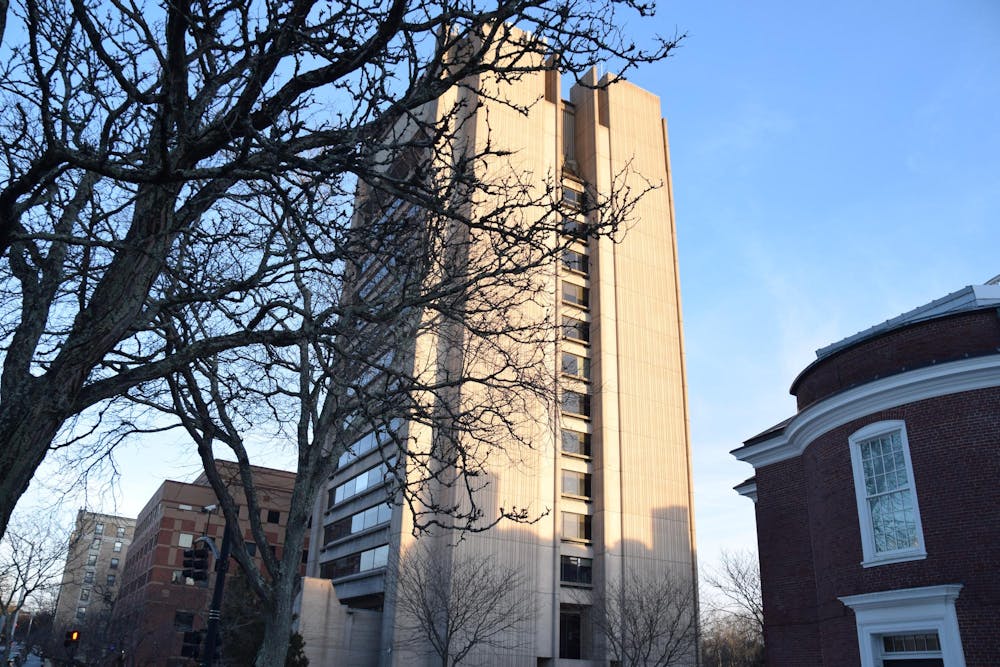
Starting Sunday, the Sciences Library will no longer remain open for 24 hours on weeknights. The building will now close at 2 a.m. and reopen at 8 a.m., except during reading period and finals when 24-hour access will resume.
In an email to The Herald, University Librarian Joseph Meisel cited rising security costs and associated budget considerations as the “primary drivers” behind the decision. Security services account for a substantial portion of the library’s operating budget. The costs of the services increased considerably, even before the University raised its security presence after Dec. 13, according to Meisel.
Since then, total security expenses “expanded significantly,” Meisel added, noting that guards are now stationed during all open hours, as well as in additional locations where they weren’t previously assigned.
Adjusting the hours will help offset cost increases and reallocate resources to meet new security needs, according to Meisel.
Library staff began considering a potential reduction in hours in late November and early December as part of annual budget planning.
Entries during those early-morning hours are typically “in the single digits,” Meisel wrote.
According to data obtained by The Herald, the occupancy in the hours between 2 a.m. and 8 a.m. amounts to less than 1% of yearly total occupancy.
The new schedule also allows for nightly security sweeps of the building, which were previously conducted weekly, Meisel wrote.
Mitchell Hanegan ’29 sees the change as a “net negative” because “it’s going to impact people who normally use this place to study.” Hanegan said he likely will not be personally affected by the change since he rarely studies past midnight.
But Pawel Odziomek ’29 said he spends roughly 75% of his study time in the SciLi and often works past 2 a.m.
“Initially I was quite annoyed, because there’s not that many 24-hour spots you can stay to study,” he said. “If you want to study at this time, the only option you have is your room.”
Odziomek said the earlier closure will “force” him to adjust his study habits and reduce procrastination, but said that students may begin using more “random” study spots.
He added that students should have been consulted before the change was made.
Students were not consulted on the question of changing library hours, according to Meisel. “Given the data on actual entries we judged that the actual impact on students would be limited,” he wrote.
“We don’t like letting anyone down, but hope that disappointed students will at least appreciate the reasoning behind the change,” he added.
Daniel Xu ’26 said he was unaware of the change, but also does not expect it to affect his study routine.
He noted that “having late-night hours at a library is always really nice for those times when people need it,” especially for those who “don’t have a nice dorm environment” to work in. But he said that the change is overall “positive,” noting that overnight hours require staff to remain on duty despite low traffic. “It’s better to respect everyone’s time involved,” he said.
Xu said that some of his “really good memories” have come from late-night work sessions with friends, which took place in spaces other than the library, such as dorm lounges.
The change is not necessarily permanent. Opening hours can be adjusted “up or down based on circumstances,” Meisel wrote. “We’ll know more after the University has been through its security reviews and decided on its overall approach.”
Miriam Davison is a Senior Staff Writer for University News covering Academics & Advising. She is a first-year from Los Angeles, CA and plans to study tentatively the realm of International & Public Affairs and English, though her interests span from linguistics to history to music. In her free time, she plays on one of Brown's ultimate frisbee teams and likes writing silly poems.